

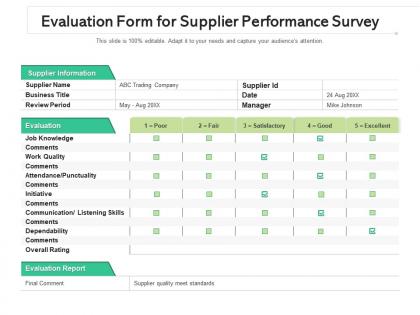
Evaluation form for supplier performance survey




Try Before you Buy Download Free Sample Product
 Impress Your
 Audience
 100%
100% Editable
 Save Hours
 of Time


Our Evaluation Form For Supplier Performance Survey are topically designed to provide an attractive backdrop to any subject. Use them to look like a presentation pro.
People who downloaded this PowerPoint presentation also viewed the following :
Evaluation form for supplier performance survey with all 2 slides:
Use our Evaluation Form For Supplier Performance Survey to effectively help you save your valuable time. They are readymade to fit into any presentation structure.
FAQs for Evaluation form for
Start with quality stuff - defect rates, returns, compliance scores. Those hit hardest when they go wrong. For delivery, track on-time rates and lead times (order accuracy too if you're getting burned there). Cost-wise, look at price variance and total ownership costs - payment terms if suppliers are being weird about that. Service metrics are huge though - how fast they respond, communication quality, problem resolution time. I'd honestly add financial stability checks because nobody wants a supplier going under mid-contract. Pick maybe 4 KPIs that match your worst headaches right now, then build out more later.
Numbers only tell you what happened, not why. Qualitative stuff captures the messy human elements - like how fast they respond when things go sideways, or if they actually get what you're trying to do. I've seen suppliers with perfect delivery stats who were nightmares to work with. You need both approaches really. Send out surveys, do site visits, have real conversations with their team. When your data shows problems, the qualitative feedback tells you if it's just a rough patch or if you should start looking elsewhere.
Honestly, automation is a total lifesaver here. Instead of drowning in spreadsheets (ugh, been there), you can build dashboards that pull delivery times, quality scores, and costs automatically from your current systems. AI will actually catch suppliers going downhill before they screw you over. Having everything centralized with live updates? Game changer. You'll spot trends way faster and make better calls. Oh, and start with whatever you're tracking by hand right now - that's your low-hanging fruit for automation.
Honestly, I'd go with 40-30-30 for quality-cost-delivery to start. Quality gets the biggest chunk because bad suppliers will make your life hell later - learned that the hard way. But you'll want to tweak those numbers based on what you're dealing with. Price-sensitive stuff? Bump up the cost percentage. Time-critical orders? Delivery matters more. Oh, and definitely tell suppliers your scoring criteria upfront - saves everyone headaches. I usually revisit the weightings every few months since business priorities change way more than you'd think.
Honestly, most people mess up by only caring about price and speed - they totally forget about quality and whether the supplier actually communicates well. Don't evaluate them like they're working in a vacuum either, because tbh the relationship goes both ways. I've watched teams get absolutely screwed because they didn't write anything down, then couldn't prove their point later when things went sideways. Oh, and waiting months between check-ins is brutal - problems just get worse. Set up regular meetings and track multiple things, not just the obvious stuff like cost.
You'll catch way more issues when different departments evaluate suppliers together. Procurement sees cost stuff, but quality engineers spot red flags nobody else notices. Finance tracks payment headaches. Operations knows if workflows will actually work - trust me, they've seen disasters before. We started doing monthly supplier reviews where everyone jumps in with their data. Honestly, it's night and day compared to having one person make all the calls. Each team brings totally different concerns to the table. Sometimes the operations team will flag something that looks fine on paper but would be a nightmare in practice.
Just send surveys to the teams who deal with suppliers daily - they'll tell you everything. Set up regular meetings where departments can actually talk about what's working or not. Honestly, focus groups are gold because people *love* complaining about vendor problems when you give them permission to. Create some simple feedback portal too, nothing fancy. Your procurement folks probably already have scorecards and daily horror stories. The trick is collecting this stuff constantly, not once a year like most companies do. Oh, and start with whoever whines about suppliers most - those people give the best details anyway.
Honestly, I'd do quarterly check-ins for your most critical suppliers - the ones that could really screw you over if something goes wrong. Annual reviews work fine for the smaller players since they're not gonna tank your whole operation. Think about it this way: you don't want to be the person explaining to management why everything ground to a halt because of supplier drama. Quarterly gives you enough time to spot issues and fix them before they blow up. For the less risky ones? Once a year is plenty. Just make a list of who's critical first, then set some calendar reminders so you don't forget.
Honestly, scorecards are a game changer for this stuff. You pick like 4-5 metrics that actually matter - quality, delivery times, cost, whatever's killing you right now. Then you can compare suppliers with real numbers instead of just remembering "oh yeah, those guys always mess up our Friday orders." Weight the categories based on what you care about most. The numerical ranking makes it super obvious who's crushing it vs who needs to go. I'd track monthly since weekly feels like overkill unless you're dealing with crazy volume. Takes the guesswork out of supplier decisions completely.
Here's the thing - bad suppliers will absolutely wreck your supply chain. Late deliveries, crappy materials, can't keep up with orders? You're screwed. Production stops, inventory costs go crazy, customers get pissed. Good suppliers keep everything running smooth, but the bad ones? You'll be scrambling with expensive rush orders and fixing quality problems left and right. Honestly, it's exhausting. Track stuff like on-time delivery and defect rates so you can catch issues early. Way better than dealing with the mess later when everything's already falling apart.
Look, ditch those boring annual reviews and switch to quarterly check-ins instead. During each one, pick specific improvement goals together and track them alongside your normal scores. Way better than just grading suppliers like they're students or whatever. The whole thing works because it feels like partnership, not judgment - honestly, suppliers actually want to participate when you frame it that way. Also make sure you're documenting what worked and what totally flopped from previous attempts. Quick wins matter, but so do the lessons from failures. Bottom line: treat it like an ongoing conversation, not some formal report card nobody cares about.
Talk to them first - figure out what's actually going wrong. Maybe they're drowning in orders or hit some roadblock you don't know about. Give them deadlines with real numbers they need to hit. Honestly, you should already have backup suppliers lined up (learned that one the hard way). If they keep screwing up, add penalty fees to your contract or renegotiate the whole thing. Document every conversation and email - trust me on this. Sometimes you just gotta cut your losses and find someone who actually shows up when they say they will.
So industry standards are basically your cheat sheet for figuring out if suppliers are actually good or just mediocre. You get concrete benchmarks - delivery times, quality scores, safety stuff, environmental compliance. ISO certifications are a big one. Without these you're just guessing based on gut feel, which honestly is a terrible way to make decisions. They become your scoring system so everything stays consistent. Plus if someone questions your choice later, you've got solid data backing it up instead of just "well they seemed fine to me."
Honestly, talking to your suppliers regularly is huge - like, way more than most people realize. Set up monthly check-ins to go over how things are going, catch problems early, that kind of stuff. I've watched so many good partnerships fall apart just because everyone got busy and stopped communicating. Your suppliers aren't mind readers, you know? They can't guess when your priorities shift or if quality's slipping. Keep some informal channels open too for quick fixes. Oh, and reach out when things are smooth sailing, not just during fires. Trust me on this one.
Join industry groups or benchmarking consortiums first - that's where companies actually share their supplier data anonymously. APQC has solid platforms for this stuff. Third-party research firms publish scorecards too, but they're expensive as hell. Trade shows are honestly goldmines though. Procurement people get weirdly chatty about their supplier disasters over drinks. Set up quarterly reviews to compare your suppliers against these benchmarks. Oh, and track trends over time instead of just looking at single snapshots - way more useful that way.
-
Very unique and reliable designs.