


Weighted Criteria Scoring Model For Project Selection




Try Before you Buy Download Free Sample Product
 Impress Your
 Audience
 100%
100% Editable
 Save Hours
 of Time


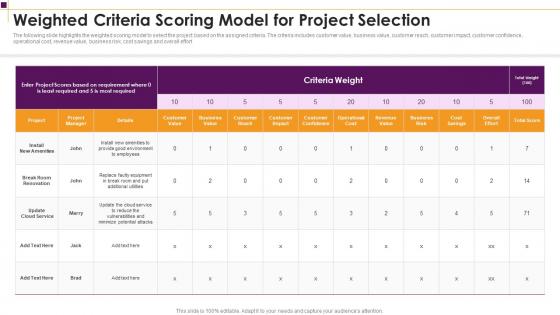
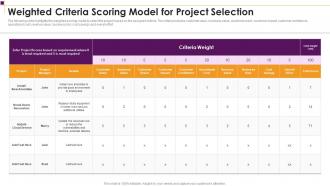
The following slide highlights the weighted scoring model to select the project based on the assigned criteria. The criteria includes customer value, business value, customer reach, customer impact, customer confidence, operational cost, revenue value, business risk, cost savings and overall effort.
People who downloaded this PowerPoint presentation also viewed the following :
Weighted Criteria Scoring Model For Project Selection with all 6 slides:
Use our Weighted Criteria Scoring Model For Project Selection to effectively help you save your valuable time. They are readymade to fit into any presentation structure.





FAQs for Weighted Criteria Scoring Model
So basically you list out what matters to you, give each thing a weight based on importance, then score your options against those criteria. Multiply scores by weights, add it all up - boom, you've got rankings. Honestly, it's a game changer because you can't BS yourself anymore about why you picked something. No more "I just liked it better" when someone asks. Though I'll admit, sometimes the math picks the boring option when your heart wants the flashy one. But yeah, definitely try weighting your criteria first next time you're torn between choices.
Honestly, start by brain-dumping everything that could matter - cost, timing, risk, whatever. Ask your stakeholders what they actually care about most. You'll probably end up with like 15 factors at first (I always do), but then you gotta be brutal and cut it down to maybe 5-7 max. Pick the ones that actually help you tell options apart and can be measured somehow. Oh, and make sure they don't overlap too much or you'll basically be counting the same thing twice. Here's my test: could you defend your decision using just these criteria? If yes, you're golden.
So here's what works for me - figure out what actually matters for your decision first. List all the factors, then give each one a weight based on how important it is (should add up to 100%). Pick a scoring system, like 1-5 or whatever makes sense. Score each option against your criteria, multiply by the weights, add it all up. Highest score wins. Oh, and definitely get everyone to agree on the criteria upfront - trust me on this one. Otherwise you'll be arguing about the scoring system when you should be making the actual decision. It's kind of tedious but saves so much drama later.
Get your main people together and have them rank what matters most for your specific call. List out everything first, then either do paired comparisons (each criterion vs every other one) or just give everyone 100 points to split however they think makes sense. The math's honestly the easy part. Getting everyone to agree on priorities? That's where it gets messy. Oh, and definitely test your weights on a couple scenarios before you lock them in - you'd be surprised how often something looks good on paper but gives you weird results.
This method works best when you're juggling multiple options with tons of moving parts. Perfect for stuff like picking software vendors - you know, weighing cost against features and support quality. Game changer when your team can't agree on priorities! It makes everyone put their cards on the table about what actually matters and how much. Use it for big decisions where you'll need to defend your choice later. Also super helpful when you're getting too emotional about a decision (guilty as charged). Short answer: any time you need structure to cut through the noise.
Don't just guess at your weights - actually ask the stakeholders what matters most to them. You'll avoid building your own biases into the whole thing. Make sure your criteria aren't too similar either, because then you're basically counting stuff twice. I made this mistake once where I had like 8 different criteria but half of them were measuring the same thing lol. Keep it simple with fewer, more focused factors. The hardest part? Don't change your weights halfway through just because you hate the results. Trust me on that one.
Set your scoring rules first and don't budge from them. What's a 3 look like vs a 5? Write that down before you touch any options. Otherwise you'll totally shift things without realizing it. Get other people to score separately if you can, then compare - way better than going solo. I learned this the hard way when my "objective" scoring was basically just my biases in disguise lol. Write down why you gave each score too, helps when someone questions your logic later. The hardest part? Don't cheat by adjusting scores to match what you already want.
Yeah, definitely! Weighted scoring works great for all kinds of PM decisions - vendor selection, feature prioritization, you name it. So basically you list out your criteria first (cost, timeline, risk, whatever matters). Then assign weights based on what's most important to your specific project. Score each option against those criteria, multiply by the weights, and you get objective rankings. Honestly saves so much time when stakeholders are going in circles arguing about priorities. The trick is getting everyone to agree on those weights upfront though - I always do the scoring matrix as a group thing. Way less pushback later.
For weighted scoring models, Excel's probably your easiest starting point. Everyone knows it and the formulas aren't too bad once you get the hang of it. Google Sheets works just as well if you're collaborating. There are fancier tools like DecisionLens or Expert Choice that are made specifically for this stuff, but honestly? They're overkill unless you're doing really complex evaluations. SmartSheet has some decent templates too, though I haven't used them much personally. My advice is start with Excel and see how it goes. You can always upgrade later if you need something more robust.
Definitely interview your stakeholders early - they'll tell you what criteria actually matter vs. what just sounds good on paper. Each group weighs things differently. Executives care about cost, end users want features, tech teams obsess over implementation (you know how they are). Their input helps you avoid building a model that looks smart but misses the real priorities. Get perspectives from different types of people since they'll have totally different pain points. Write down their reasoning too, because you'll need to justify those weights later when someone inevitably questions them.
Yeah, you can definitely use it for qualitative stuff too! The trick is turning those fuzzy criteria into numbers - like rating communication skills 1-5 or mapping poor/fair/good/excellent to point values. Sure, it gets subjective and feels kinda artificial at first. But honestly? It's way better than just going with your gut when you're comparing a bunch of mixed factors. Just stay consistent with how you score everything. Oh, and make sure everyone on your team agrees what each rating actually means before you start - saves drama later.
Weighted models are honestly so much better for control and accuracy. You can make cost 40% of your decision while customer satisfaction is only 15% - whatever matches your actual priorities. Basic matrices are quicker to set up, sure, but they'll mislead you when some factors matter way more than others. I mean, nobody wants those "wait, why did we choose this?" conversations later. Takes longer upfront but saves headaches. Go weighted when the decision actually impacts your business - trust me on this one.
So sensitivity analysis is just testing if your weighted scoring model is actually solid or not. You mess around with the weights and scores to see how much your rankings change. I mean, those initial weights you pick usually feel pretty random anyway, right? Major red flag if small adjustments totally flip your results - means the model's too shaky. Your rankings should stay fairly consistent when you tweak things within reason. I'd run through a few different weight scenarios before you show anyone the results. That way you know it's not just built on quicksand.
So here's what I'd do - put your summary table right at the top with scores and rankings. That's literally all most people will look at anyway. Then break down why each option scored what it did on different criteria. Charts are your friend here, way better than dumping a bunch of numbers on people. Oh, and definitely explain your weighting upfront! Like why cost got 30% vs user experience at 20% - someone's gonna ask. I'd throw in a quick sensitivity analysis too, showing what happens if you tweak the main weights. Lead with your recommendation, then let people dive into the details if they want. Most won't, but the data nerds will appreciate having it there.
Honestly, weighted scoring works pretty well for big decisions. Spotify's dev teams use it for feature requests - like 40% user impact, 30% development time, 30% strategy stuff. Hospitals do it for treatment plans, and procurement folks use it instead of just picking whoever's cheapest (which never works out anyway). Even city planners score infrastructure projects this way. The whole point is you get decisions you can actually defend later, not just "it felt right" moments. Next time you're stuck, try scoring your top options against 3-4 criteria that matter most.
-
Love how there are no boring templates here! The design is fresh and creative, just the way I like it. Can't wait to edit and use them for my extended projects!
-
The website is jam-packed with fantastic and creative templates for a variety of business concepts. They are easy to use and customize.