

 0 Comment
 Customer Reviews

The course catalog's been shared. Someone's already marked three programs as "high priority."
Nobody's signed up yet.
Not because the team doesn't need training—they do. Every BA on the floor knows it. Requirements gathering goes sideways on Tuesday, stakeholder meetings produce contradictory notes by Thursday, and by Friday someone's rebuilding a process document that should've been right the first time. The gap isn't effort. It's structure.
Business analysis training is one of those things where everyone agrees it matters and almost nobody agrees on what it should cover. Project managers want process. Data people want tools. Agile teams want something that doesn't take three weeks to absorb. Newer analysts want frameworks that translate to the actual job—not theory that evaporates the moment a stakeholder changes their mind mid-sprint.
And then there's the presentation problem. Even when training is designed well, someone has to communicate it. A learning roadmap. A certification program overview. A workshop agenda. A stakeholder analysis module. These don't write themselves, and starting from a blank slide costs more time than most L&D teams have.
That's the real friction—not designing the training, but presenting it in a way that gets buy-in, drives enrollment, and actually sticks with participants after the room clears.
SlideTeam's business analysis training templates exist for exactly this reason. Pre-designed frameworks built for training managers, L&D leads, and senior BAs who need to present structured learning without rebuilding the wheel each time. Content-ready slides that cover roadmaps, competency frameworks, certification paths, techniques overviews, and more.
What follows are the templates that do the structural work—so you can focus on the substance.
Template 1: Business Analysis PowerPoint Presentation Slides
Business analysis professionals need a reliable foundation for presenting complex workflows clearly. This PowerPoint slide is built for analysts and L&D leads who need a structured, professional deck. It covers the full scope of business analysis—from requirements documentation to process modeling—across 43 well-organized slides. Use this deck to walk stakeholders through analysis frameworks without losing clarity. The template is 100% editable and customizable.
[product_image id=217746]
Template 2: Detailed Business Analysis PowerPoint Presentation Slides
Breadth matters when presenting a business analysis program to a leadership team. This PPT template spans 89 slides, giving practitioners the room to cover every critical BA competency in depth. It suits business analyst training leads who need a comprehensive, well-structured deck for workshops or onboarding sessions. The slide design supports a clear bird's-eye view of the subject. The template is 100% editable and customizable.
[product_image id=343529]
Template 3: Business Analysis and Planning Training for Small Business PPT Summary
Small businesses rarely have a dedicated BA team—so training has to be efficient and targeted. This deck captures both the planning and analysis sides of the business analysis fundamentals conversation. It helps trainers walk owners and managers through structured thinking without overwhelming them. Elevate your small business training presentations with confidence and clarity. Download this dynamic template now and unlock smarter business analysis planning for your team.
[product_image id=1397558]
Template 4: Versatile Training Report Template for Clear and Impactful Business Analysis
A training report that looks generic undermines the credibility of even the best content. This deck transforms how you present business analysis training outcomes to stakeholders. The versatile design adapts instantly to your brand identity, ensuring every report looks purposeful and polished. Use it to document workshop results, skills assessments, or certification progress with visual authority. Download this dynamic template now and make every training report count.
[product_image id=1421714]
Template 5: Business Analysis and Planning Training for Small Business PPT Outline
Planning training for a small business means balancing scope with simplicity. This PPT preset is built for trainers who need to outline a business analysis and planning program without overcomplicating the message. It suits sessions covering requirements gathering training, process mapping, or stakeholder identification. The deck presents a clean, structured outline that keeps participants focused on what matters. The template is 100% editable and customizable.
[product_image id=1400622]
Template 6: Editable Training Need Analysis Form for Business Success
Training needs analysis is where most L&D efforts either gain traction or stall. This slide is designed for HR leads and business analysts who need to document skill gaps before building a training program. It works well for teams assessing readiness for a BA certification program or entry-level business analyst training. The form-based structure makes it easy to gather, record, and present findings to decision-makers. The template is 100% editable and customizable.
[product_image id=1456772]
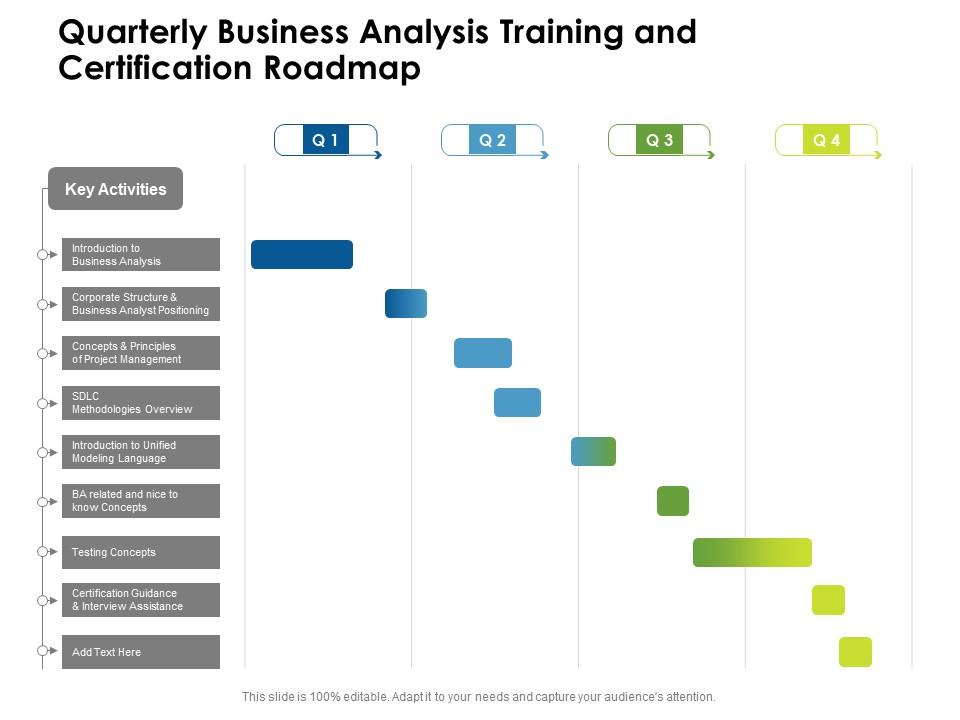
Template 7: Quarterly Business Analysis Training and Certification Roadmap
A certification roadmap needs to show clear milestones—not just a list of modules. This quarterly roadmap template delivers exactly that structure for business analysis training programs. It maps training phases, certification targets, and skill-building checkpoints across a clear timeline. Use it to present CBAP certification training plans or agile business analysis training schedules to sponsors and teams. Transform your training roadmap presentations today. Download this dynamic template now and give your certification program a professional visual plan.
Download this PowerPoint Template
Template 8: Training Needs Analysis Template for Business Success
Real training gaps are rarely obvious until someone maps them out formally. This PowerPoint slide helps L&D managers and senior analysts run a structured training needs analysis before committing to a program. It is particularly useful when assessing readiness for corporate training needs across business analyst teams. The design is clean and purposeful—built for boardrooms, not just planning docs. The template is 100% editable and customizable.
[product_image id=1435975]
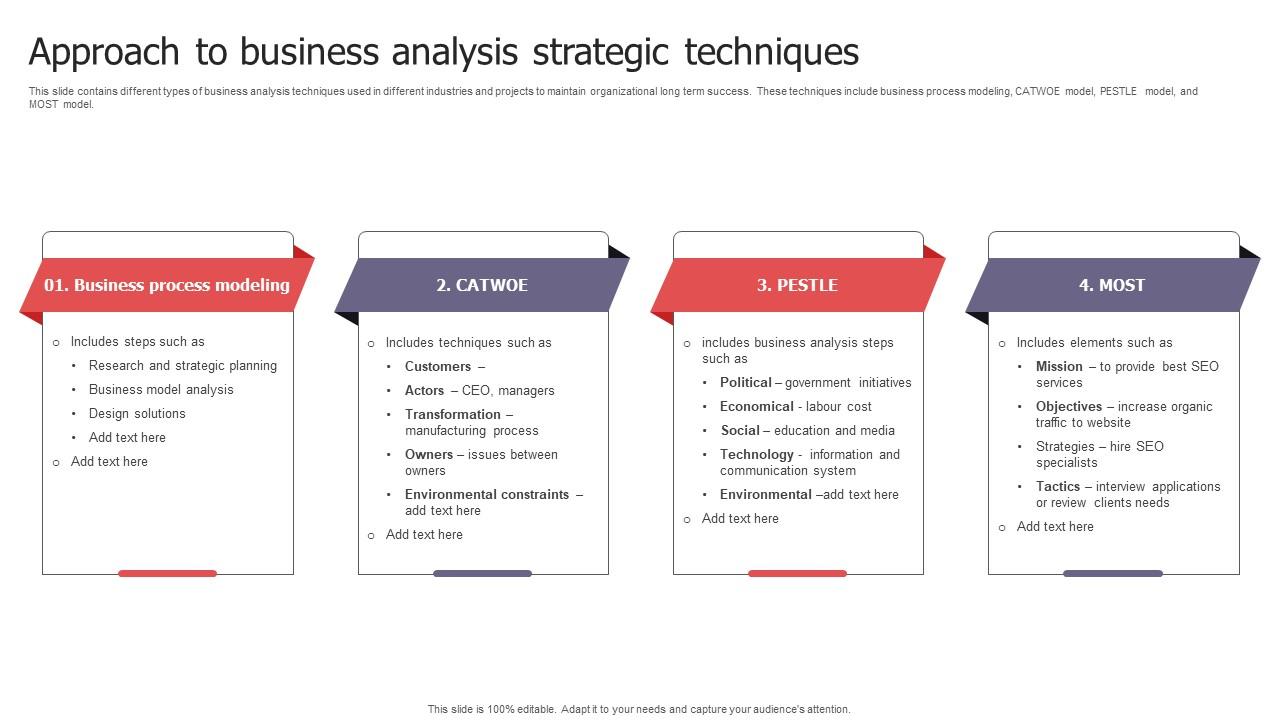
Template 9: Approach to Business Analysis Strategic Techniques
Business analysis techniques are only useful when practitioners know which tool fits which problem. This PPT preset covers four foundational approaches: business process modeling, the CATWOE model, PESTLE, and MOST. It is built for trainers running business analysis workshops or professionals preparing for stakeholder analysis training sessions. Each technique is presented with enough clarity to spark discussion and drive application. The template is 100% editable and customizable.
Download this PowerPoint Template
Template 10: Equity Analysis and Valuation Training Course for Business Research Analyst
Equity analysis training requires specifics—who teaches it, how long it runs, and what certification comes out the other end. This deck is built for training coordinators presenting upskilling programs to business research analysts. It covers course offerings, delivery mode, duration, and trainer credentials in a structured, readable format. Use it to build credibility with stakeholders approving a data analysis training course. Transform your equity training presentations today. Download this dynamic template now and give your analyst development program a clear, professional structure.
[product_image id=1085917]
Template 11: Getting Better at Receiving Feedback Training PPT Information
Feedback is one of the most skipped topics in business analysis skills development programs—and one of the most consequential. This deck tackles the practical side of receiving feedback in professional settings. It is built for trainers who want to add a behavioral skills module to a BA certification program or analyst bootcamp. The slides guide participants through actionable techniques without turning the session into a therapy exercise. Download this dynamic template now and build feedback literacy into your analyst training program.
[product_image id=1575852]
Template 12: Benefits of Competitor Analysis for Business Strategy Development PPT Presentation
Competitor analysis is a core business analysis technique, but it rarely gets dedicated training time. This PowerPoint slide is built for strategy leads and business analysts presenting the case for structured competitive intelligence work. It suits sessions covering business analysis best practices or process improvement training, where understanding the competitive environment is part of the brief. The design is clean and makes the argument visually without needing heavy narration. The template is 100% editable and customizable.
[product_image id=1751270]
Template 13: How to Conduct an Effective SWOT Analysis for Business PPT Presentation
SWOT analysis is one of the first frameworks any BA learns—and one of the most frequently done badly. This deck makes the method look credible when you're presenting it to a room that's seen it a hundred times. The clean, balanced layout keeps participants focused on analysis rather than slide aesthetics. Use it in business analysis workshops, entry-level analyst training, or process improvement training sessions. Transform your SWOT presentations today. Download this dynamic template now and run your next analysis session with complete confidence.
[product_image id=1670061]
Template 14: Three-Month Business Analysis Training and Certification Roadmap
A three-month certification roadmap needs to feel achievable—not like a wall of milestones. This PPT template is built for training managers laying out a structured business analysis training and certification path. It works well for CBAP certification training plans or agile business analysis training programs with defined quarterly checkpoints. Use it to align sponsors and participants on exactly what happens and when. The template is 100% editable and customizable.

Download this PowerPoint Template
Template 15: Strategy Analysis Evaluate Processes Training Techniques Business
Process evaluation is one of the harder business analysis skills to teach in a structured session. This 16-slide deck is built for practitioners who need to cover strategy analysis and process evaluation techniques in a focused, time-bound training format. It suits business analysis for project managers workshops where technique depth matters more than breadth. The design keeps the content front and center without visual distraction. The template is 100% editable and customizable.
[product_image id=222864]
Template 16: Introduction to Business Analysis PPT Presentation
Every BA training program needs a starting point that sets context without overwhelming newcomers. This PPT template is built for trainers introducing business analysis fundamentals to teams with mixed experience levels. It covers the core concepts—scope, stakeholders, requirements, and process—in a format that doesn't assume prior knowledge. Use it to open a business analyst bootcamp or as the first module in an IT business analysis course. The template is 100% editable and customizable.
[product_image id=1479020]
Template 17: Five-Yearly Business Analysis Training and Certification Roadmap
Long-range certification planning requires a visual that earns trust from leadership. This PPT preset maps out a five-year business analysis training and certification roadmap with structured phases and clear progression. It is built for L&D directors and BA practice leads presenting multi-year professional development plans. The slide supports organizational training needs analysis conversations where investment timelines need to be justified clearly. The template is 100% editable and customizable.

Download this PowerPoint Template
Template 18: Business Analysis for Beginners: Step-by-Step Getting Started PPT Summary
Starting from scratch in business analysis is less intimidating when the path is laid out step by step. This deck is built for trainers delivering entry-level business analyst training or onboarding programs for career changers. It walks beginners through foundational concepts in a logical sequence that builds confidence without skipping substance. Use it for business analyst career training sessions where participants need structure as much as content. Download this dynamic template now and give every beginner a clear, professional starting point.
[product_image id=1864522]
Template 19: Business Analysis Techniques Overview PPT Presentation
Business analysis tools and techniques need to be presented in a way that practitioners can act. This PowerPoint slide is built for senior analysts and trainers running technique-focused sessions — covering methods like gap analysis, root cause analysis, and requirements documentation. It suits business analysis training PPT programs where participants need to leave with applicable skills. The overview format lets facilitators set context before going deep on any single method. The template is 100% editable and customizable.
[product_image id=1842090]
Template 20: Business Analysis for Modern Analysts PPT Guidelines
Modern analysts work across more tools, teams, and data sources than what any single training program covers. This deck is built for practitioners and trainers who need to present business analysis guidelines relevant to today's hybrid, tech-integrated work environments. It works well as a capstone module in a business analyst bootcamp or as a reference guide in a PMI-PBA certification training program. Check out the training needs analysis templates to pair this deck with a structured skills gap assessment. The template is 100% editable and customizable.
[product_image id=1799820]
Elevate Your Business Analysis Training with SlideTeam
SlideTeam's PowerPoint templates are the best in the industry for business analysis training. These content-ready slides save hours of design time while delivering professional quality that earns stakeholder buy-in instantly. From certification roadmaps to technique overviews, these ready-made frameworks cover every stage of the training lifecycle. Deploy these PowerPoint slides to build structured, credible business analysis programs that drive real analyst performance.
FAQs on Business Analysis Training
How does business analysis training differ for professionals transitioning from project management versus those coming from a data analytics background?
Project managers understand scope and stakeholders—they need training focused on requirements elicitation and documentation skills. Data analysts, by contrast, tend to be strong on quantitative methods but need work on stakeholder communication and process modeling. The fastest path for both groups is a gap-based curriculum: assess existing skills first, then target only what's missing. Skipping that assessment wastes significant training time on concepts each group already knows.
What are the most critical competencies that business analysis training programs often overlook when preparing analysts for real-world stakeholder engagement?
Most programs spend too little time on active listening and conflict navigation during stakeholder sessions. Analysts are often taught to gather requirements but not to manage disagreement when stakeholders contradict each other. Facilitation skills—running a workshop, handling a difficult participant, building consensus—are almost always undertaught. These are not soft skills; they determine whether requirements are usable or need to be redone.
How can organizations measure the ROI of investing in structured business analysis training for their teams?
Track two things: defect rates in requirements documentation before and after training, and the time spent on rework per project. Both are measurable and directly tied to BA performance. A reduction in late-stage requirement changes is the clearest ROI signal. Organizations that baseline these numbers before training begins can make a credible, data-backed case for continued investment within two to three project cycles.
What role does requirements elicitation play in business analysis training, and which techniques yield the best outcomes in agile environments?
Requirements elicitation is the core practical skill in any BA program—without it, everything else is theoretical. In agile environments, user story workshops and collaborative backlog refinement sessions yield the most usable outcomes. Interviews and observation work well for discovery, but need to be paired with structured documentation practice. Training programs that only teach elicitation in a waterfall context leave analysts poorly prepared for sprint-based work.
How does business analysis training address the growing integration of AI and automation tools into traditional BA workflows?
Current BA training programs are beginning to include AI-assisted requirements analysis and process automation mapping as core modules. Analysts need to know which tasks—like initial gap analysis or data pattern recognition—AI tools can assist with, and where human judgment remains non-negotiable. The practical skill is learning to validate AI-generated outputs against stakeholder intent. Programs that ignore this leave analysts unprepared for the tools already in use on most teams.
What are the key differences between CBAP certification preparation and practical business analysis training that organizations actually need?
CBAP preparation focuses on knowledge domains, terminology, and exam technique—it is a certification, not a skills program. Practical BA training targets real deliverables: requirements documents, process maps, stakeholder registers, and workshop facilitation. Most organizations need the practical track first; CBAP preparation is useful only after a analyst has enough field experience to contextualize the framework. Treating them as interchangeable is where most L&D investments fall short.
Which business analysis frameworks should be prioritized in training programs for professionals working in highly regulated industries like finance or healthcare?
In finance and healthcare, regulatory compliance analysis and risk-based requirements documentation take priority. Frameworks like PESTLE and impact analysis are most directly applicable in these environments. Analysts in regulated industries also need structured traceability training—every requirement must link to a regulatory obligation or risk control. Programs that skip traceability leave analysts unable to defend their requirements under audit or review.
How can business analysis training programs effectively simulate complex stakeholder conflicts to build negotiation and conflict resolution skills?
Role-play scenarios with written briefs are the most practical simulation method—participants need conflicting stakeholder positions mapped out in advance. Debrief sessions after each exercise matter more than the role-play itself; that's where the learning consolidates. Case studies from real industries, where the stakes and politics feel credible, produce more durable skills than abstract exercises. Rotating participants through different stakeholder roles in the same scenario builds the most transferable perspective.