

 0 Comment
 Customer Reviews

The project brief's been signed. Everyone's nodded. And now someone has to build the actual plan.
Not the concept. Not the scope statement. The real plan—the one that accounts for procurement delays, subcontractor schedules, site access windows, and the fact that the geotechnical report came back different than expected. Civil construction project management isn't complicated in theory. In practice, it's eighteen things happening at once, with a timeline that doesn't forgive much.
Most project managers know what needs to happen. The sequence isn't mysterious. Design feeds preconstruction, preconstruction feeds procurement, procurement feeds construction—and somewhere in there, someone's tracking budget, quality, and risk simultaneously. The hard part isn't knowing the stages. It's holding them together when the site conditions change on day three.
There's also the communication problem. A construction project touches the project owner, the general contractor, estimators, subcontractors, design leads, site supervisors, and sometimes a dozen more stakeholders. Getting all of them looking at the same information—status, schedule, budget exposure, risk flags—requires something more than a shared email thread. It requires structure. Visual, clear, referenceable structure.
And that's before the reporting starts. Progress reports. Procurement logs. Activity schedules. Scope-of-work documents. The documentation load on a civil works project is substantial, and most of it eventually ends up in a presentation that someone has to deliver to a steering committee or a client who wants to know why the column casting is two weeks behind.
Templates exist because these problems repeat. Every infrastructure project deals with scope creep, every earthworks project needs a schedule roadmap, and every construction team eventually has to explain project complexity to someone who wasn't in the room when the decisions were made. Pre-designed frameworks handle the structure so the manager can focus on the content.
SlideTeam's civil construction project management templates are built for exactly this. Ready-made slides that cover everything from management hierarchy to onsite supervision tips to challenge-and-solution frameworks. What follows are twenty of the most useful ones.
Template 1: Civil Construction Project Management PowerPoint Presentation Slides
Managing a civil construction project means juggling timelines, budgets, teams, and risks all at once. This PowerPoint slide is built for project managers and construction leads who need a single, structured deck to communicate the full project picture. It works equally well for internal team briefings and client-facing progress reviews. Explore more civil construction project management templates with examples and samples to find the right fit for your reporting needs. The template is 100% editable and customizable.
[product_image id=278536]
Template 2: Construction Project Management Process Flow
Structured project delivery starts with a clear process everyone can follow. This slide maps the full construction project management process flow—from conception and team selection to design, preconstruction, and construction phases. Each of the six stages is presented with visual clarity, giving stakeholders an immediate sense of sequence and accountability. You can adapt this framework for infrastructure project planning reviews or project kickoff briefings. Transform your construction planning presentations today. Download this dynamic template now and unlock end-to-end project flow visibility.
[product_image id=939375]
Template 3: Civil Construction Project Management PowerPoint PPT Bundles
Winning stakeholder confidence requires more than a verbal overview. This twenty-slide bundle delivers a polished, content-rich deck covering every dimension of civil construction project management—from scope to delivery. The unique aesthetic elevates your presentations above standard construction reports. Flexible layouts let you tailor every slide to match your project's specific context. Use it to educate clients, brief contractors, or present to a steering committee with authority. Transform your construction project presentations today. Download this bundle now and gain a lasting competitive edge in every room.
[product_image id=716682]
Template 4: Management Hierarchy Structure for Civil Engineering Project
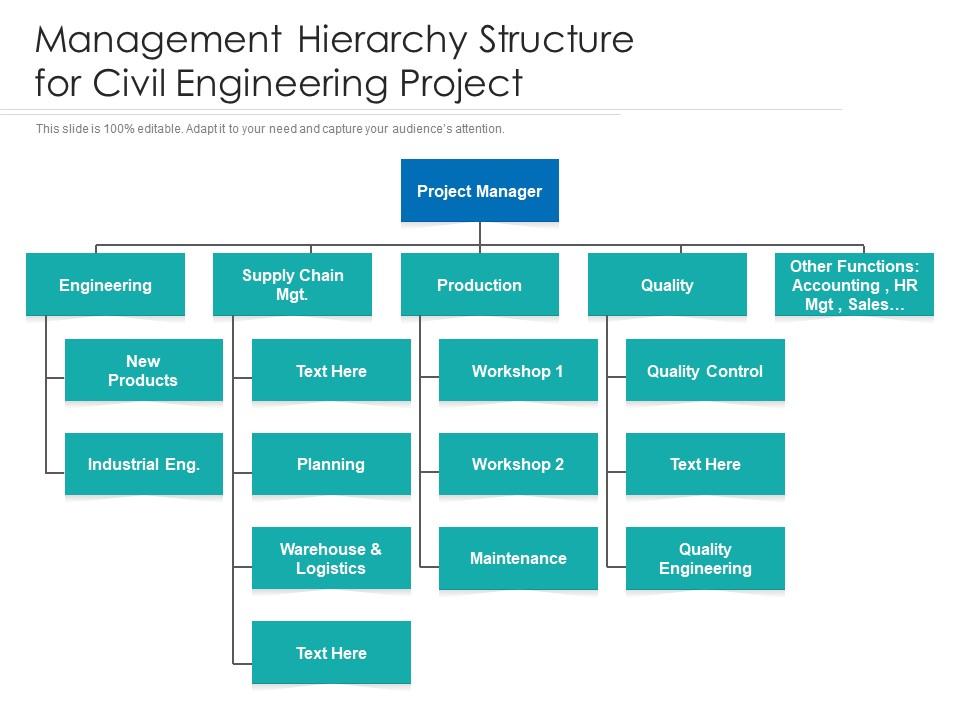
Clear accountability structures make large civil engineering projects far easier to manage. This PPT template maps the management hierarchy across program committees, project steering boards, and project managers. Site supervision and management teams can use this slide to clarify reporting lines before a project kicks off. It keeps every stakeholder aligned on who owns what decision. The template is 100% editable and customizable.
Download this PowerPoint Template
Template 5: Civil Engineering Construction Project Progress Status
Progress reporting on a civil construction project needs to be fast, clear, and defensible. This slide organizes the key project health indicators—name, status, schedule, budget, and risk flags—into a single, scannable view. It gives project managers a structured format for construction project monitoring and executive reporting. No guesswork about what to include; the layout does that work. Transform your progress reporting presentations today. Download this well-structured slide now and command every project status meeting with confidence.

Download this PowerPoint Template
Template 6: Civil Infrastructure Construction Management PowerPoint Presentation Slides
Large infrastructure projects generate a lot of information that needs to reach a lot of people. This PPT preset, spanning seventy-one slides, gives civil infrastructure teams a complete deck for communicating across every project phase and stakeholder group. Construction resource management, site updates, and delivery milestones all find a natural home in this deck. Bring it to your next infrastructure review and let the structure do the heavy lifting. The template is 100% editable and customizable.
[product_image id=350007]
Template 7: Civil Engineering Infrastructure and Construction Management PowerPoint Presentation Slides
Comprehensive coverage of civil engineering infrastructure demands a presentation that matches its complexity. This slide set captures the full scope of civil engineering infrastructure and construction management topics in one cohesive deck. Every layout is designed to translate dense technical content into clear, audience-friendly visuals. Whether you're presenting a structural engineering management update or a civil infrastructure development roadmap, this deck fits the brief. Transform your infrastructure presentations today. Download this adaptable template now and deliver authority at every meeting.
[product_image id=349715]
Template 8: Framework for Civil Construction Management Project
Good construction project management runs on clear methodology, not just good intentions. This slide lays out a five-section framework—project organization, planning, monitoring, control, and learning—giving teams a repeatable system for civil works management. Construction project lifecycle reviews become far easier when everyone shares the same structural reference. For complex multi-phase builds, this framework keeps the entire team oriented. The template is 100% editable and customizable.

Download this PowerPoint Template
Template 9: Civil Construction Project Management Presentation
First impressions in a client presentation matter, especially in competitive civil construction work. This deck balances simplicity with visual impact, letting the project's substance take center stage. Construction contract management briefings, project delivery reviews, and stakeholder updates all benefit from a deck that looks considered and professional. Switch the color theme to match your company's identity without losing the structure. The template is 100% editable and customizable.
[product_image id=1469905]
Template 10: Stages Involved in Construction Project Management Project Management Tools PPT Introduction
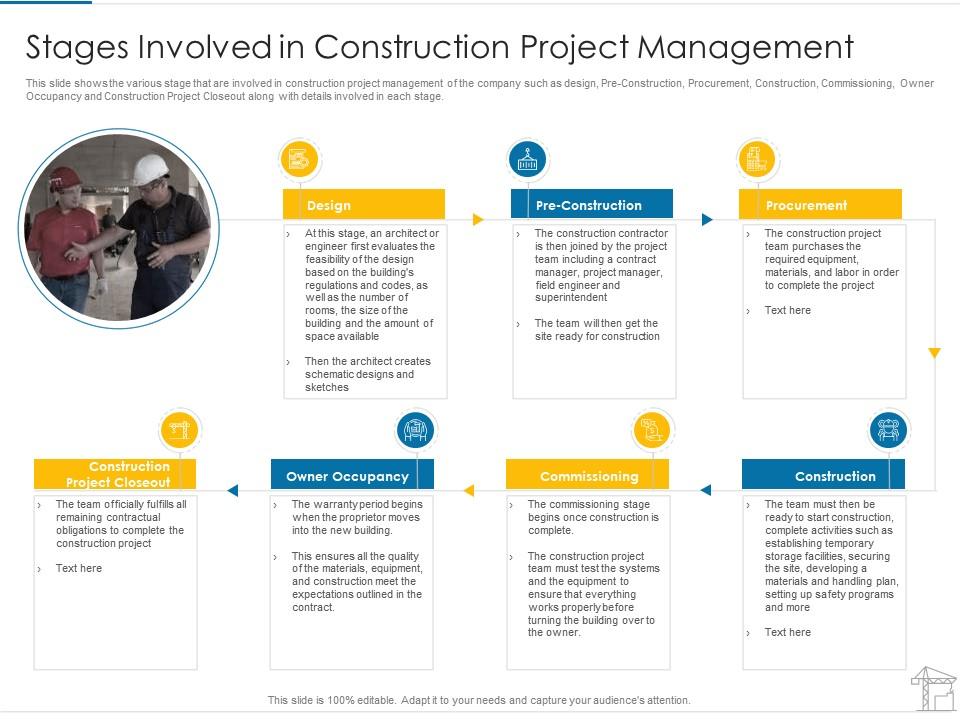
Construction project lifecycles rarely fail because of missing knowledge—they fail because of missing structure. This seven-stage slide walks through design, preconstruction, procurement, construction, commissioning, owner occupancy, and project closeout in one clear visual. Project managers get a ready-made framework for explaining the full construction project lifecycle to clients or executive sponsors. Every stage includes supporting detail for richer briefings. Transform your project lifecycle presentations today. Download this template now and set the stage for confident project delivery.
Download this PowerPoint Template
Template 11: Framework for Civil Construction Management PPT Structure
A repeatable management framework is what separates reactive project teams from consistent ones. This PPT preset gives construction managers a clean structural reference for organizing, planning, and controlling civil projects from initiation to close. It works well in team onboarding sessions or as a standing agenda reference for project governance meetings. Straightforward and adaptable to any civil construction context. The template is 100% editable and customizable.
[product_image id=1832864]
Template 12: Approaches for Civil Construction Project Management
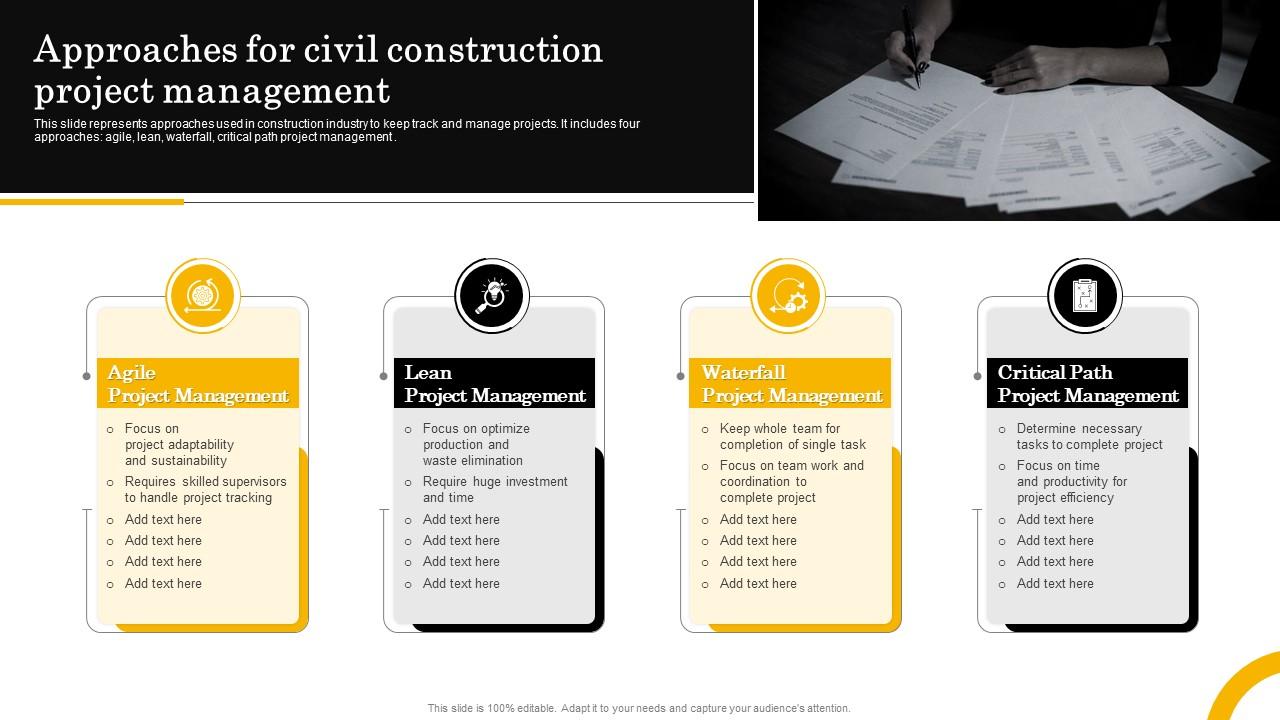
Choosing the right project management approach changes how a construction project behaves under pressure. This slide compares four approaches—agile, lean, waterfall, and critical path—giving teams a structured way to evaluate what fits their project type. Building construction management teams often need to explain methodology choices to clients or senior leadership. This visual makes that conversation specific and grounded. Transform your construction methodology presentations today. Download this slide now and lead smarter approach-selection discussions.
Download this PowerPoint Template
Template 13: Activity Schedule Roadmap for Construction Project Management
Activity scheduling is where construction project planning becomes real. This roadmap slide covers blueprint development, layout marking, column casting, wall construction, and roofing in a structured, time-oriented visual. Construction project scheduling for mid-scale builds benefits enormously from a clear activity-level view that everyone can track. Use it in site kickoff meetings or weekly progress reviews to keep teams anchored to sequence. Transform your scheduling presentations today. Download this slide now and drive on-time project execution.

Download this PowerPoint Template
Template 14: Civil Construction Project Management Icon
Visual identity in a deck matters more than most project managers admit. This slide provides dedicated civil construction project management iconography across four clear categories. Icons accelerate comprehension in data-heavy presentations—audiences process visual cues faster than text. For teams building reports on construction project documentation or site supervision, these icons bring professional consistency to every slide. The template is 100% editable and customizable.
Download this PowerPoint Template
Template 15: Scope of Work Project Management and Construction Plan
Scope definition at the start of a project prevents painful renegotiations later. This four-stage slide captures the scope of work, statement of work, work opportunities, and a building construction work program schedule in one structured layout. Construction stakeholder management conversations become sharper when scope boundaries are laid out visually from day one. Use it early and reference it often. Transform your scope management presentations today. Download this slide now and protect your project from costly scope drift.

Download this PowerPoint Template
Template 16: Stages for Civil Construction Project Management
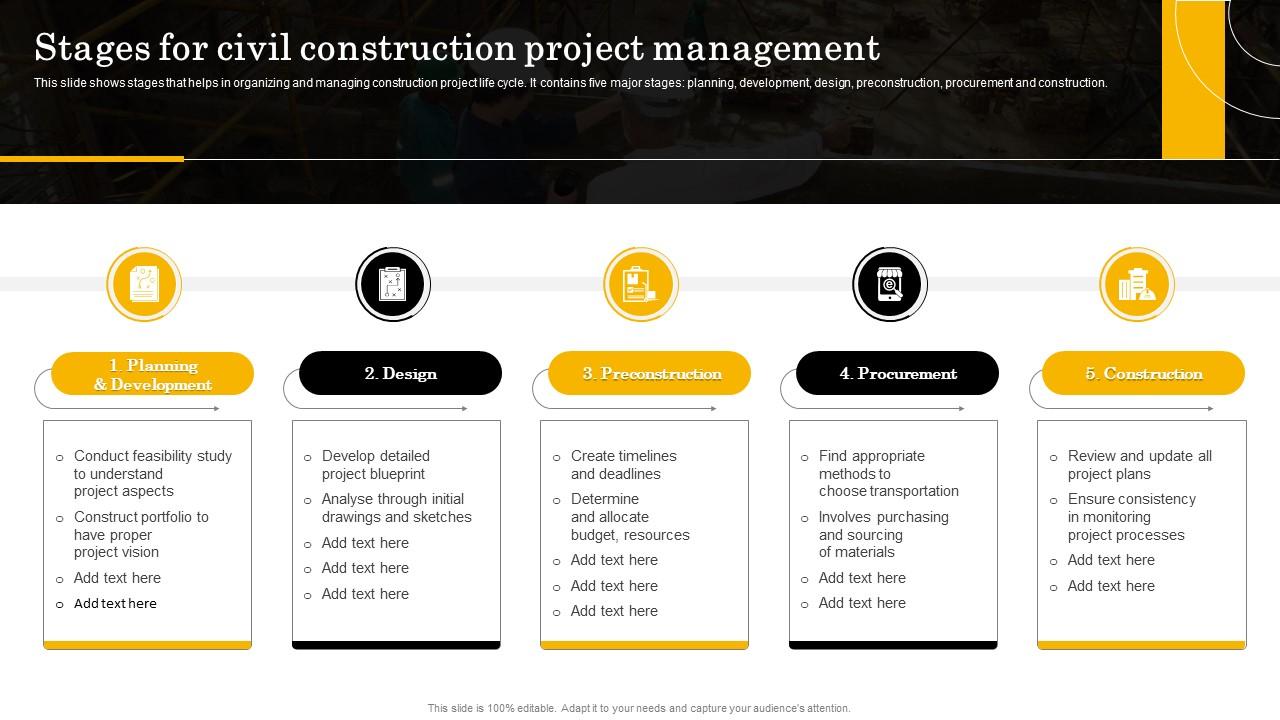
Organizing a construction project lifecycle starts with understanding its distinct stages. This PPT template walks through planning, development, design, preconstruction, procurement, and construction as a five-stage visual sequence. Project managers in civil infrastructure development use this slide to orient new team members and brief client stakeholders on what to expect at each phase. It creates a shared mental model fast. The template is 100% editable and customizable.
Download this PowerPoint Template
Template 17: Civil Construction Project Management Team
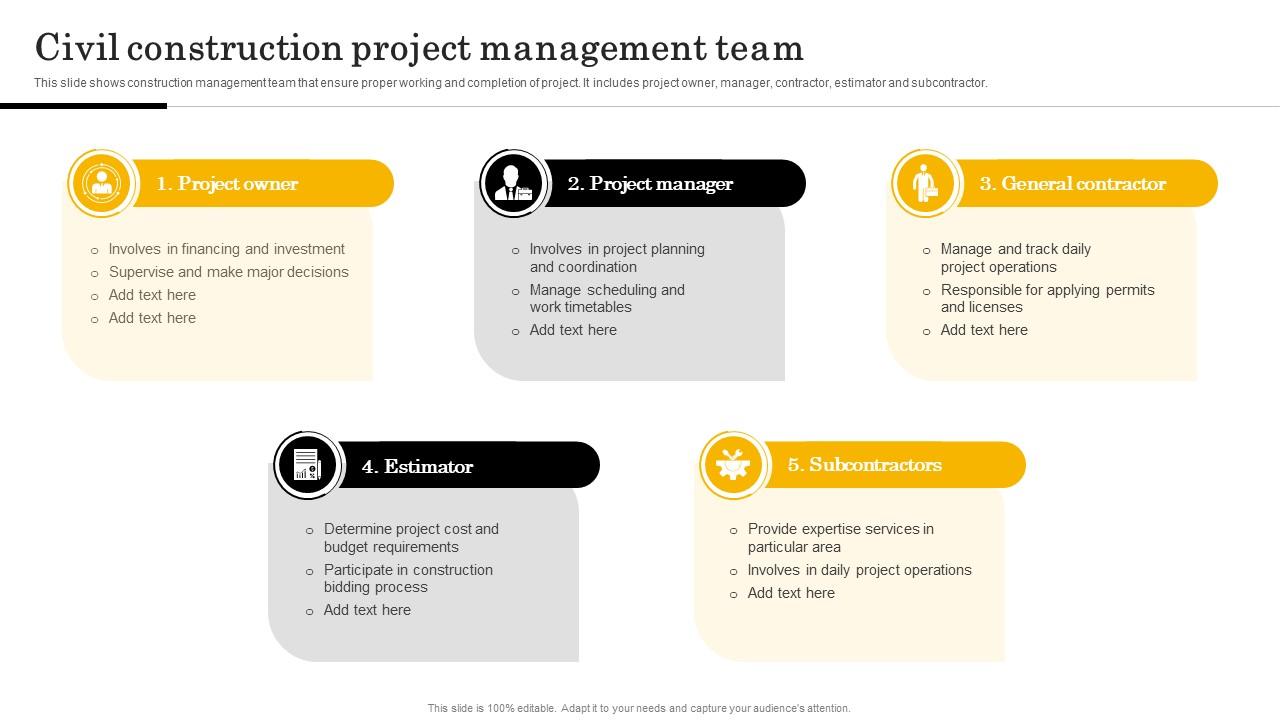
Every construction project needs clarity on who does what—before ground breaks. This slide maps the civil construction project management team across five roles: project owner, manager, contractor, estimator, and subcontractor. Project cost estimation and site delivery both improve when accountability is visible and agreed upon early. Use this slide in team formation meetings or include it in client-facing project documentation. Transform your team structure presentations today. Download this template now and build aligned, accountable project teams.
Download this PowerPoint Template
Template 18: Civil Construction Project Management Factors
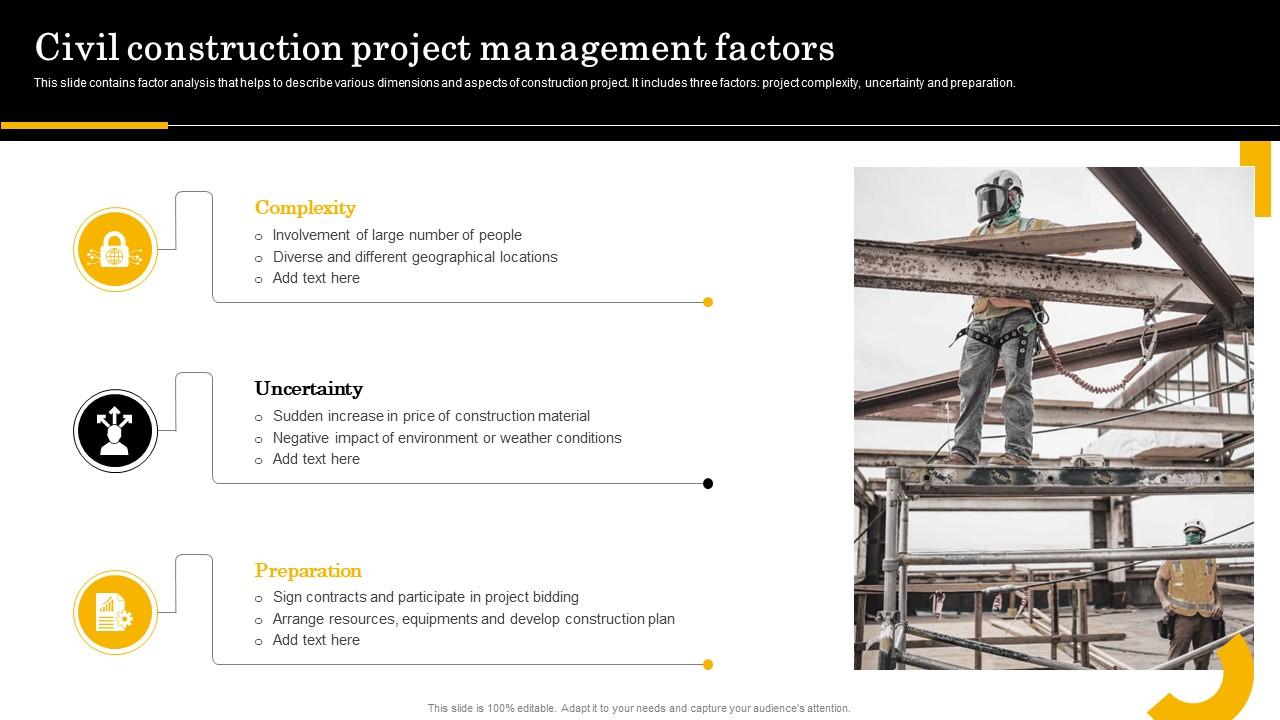
Understanding what makes a construction project hard is the first step to managing it well. This slide breaks project complexity into three analytical factors—complexity, uncertainty, and preparation—giving managers a framework for construction risk management conversations. Factor analysis at this level helps leadership allocate resources where exposure is highest. Use it in project initiation reviews or risk planning sessions. Transform your risk analysis presentations today. Download this template now and lead sharper, more honest project planning discussions.
Download this PowerPoint Template
Template 19: Solution for Civil Construction Project Management Challenges
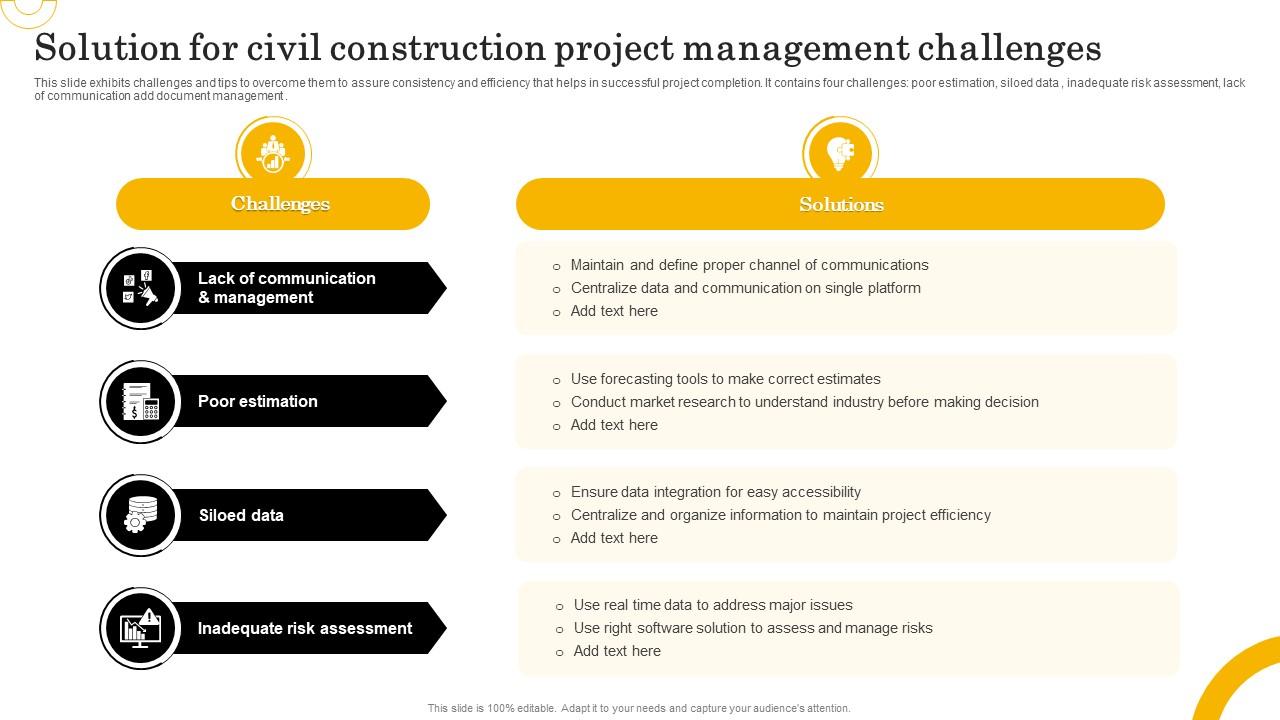
Every civil construction project hits the same four walls: poor estimation, siloed data, inadequate risk assessment, and communication gaps. This slide names each challenge and pairs it with a concrete solution, giving teams a practical reference for project quality control and delivery consistency. It's the kind of slide that earns credibility in a client meeting because it shows the team has thought ahead. Transform your challenge-management presentations today. Download this slide now and demonstrate construction delivery confidence from day one.
Download this PowerPoint Template
Template 20: Tips for Civil Construction Onsite Project Management
Onsite construction management is where plans meet reality, and gaps become expensive. This PPT slide covers four practical tips—addressing safety concerns, assessing work quality, resolving design issues, and supervising critical work. Site supervision and management teams can use this as a briefing tool at shift handovers or safety reviews. It keeps the focus on what actually matters when the crew is on the ground. The template is 100% editable and customizable.

Download this PowerPoint Template
Deliver Civil Construction Projects with Confidence with SlideTeam
SlideTeam's PowerPoint templates are the best in the industry for civil construction project management. These content-ready slides cover every phase—from infrastructure project planning and construction project scheduling to site supervision and risk management—saving teams hours of formatting time. Use these ready-made frameworks to communicate with clarity across every stakeholder and project stage. Grab these templates today and keep your construction projects on time, on budget, and on record.
FAQs on Civil Construction Project Management
What are the key differences between traditional and agile project management approaches in civil construction?
Traditional (waterfall) approaches fix scope, sequence, and deliverables upfront—useful for projects with stable designs and regulatory constraints. Agile breaks work into shorter cycles, allowing teams to respond to site changes or design revisions faster. Most large civil projects use a hybrid: waterfall for structural phases, agile for design iteration. The choice depends on how much the scope and site conditions are expected to shift during delivery.
How do project managers effectively handle scope creep in large-scale infrastructure projects?
Scope creep starts with undocumented change requests. Project managers must enforce a formal change control process—every scope addition requires written approval and a revised cost-and-schedule impact assessment before work begins. Baseline scope documents and weekly scope-versus-actual reviews catch drift early. On infrastructure projects, tying contract payment milestones to approved scope items is one of the most reliable controls available.
What role does Building Information Modeling (BIM) play in improving civil construction project outcomes?
BIM creates a shared 3D model that all project stakeholders—designers, engineers, contractors—work from simultaneously. This cuts rework caused by design clashes discovered on-site, which is one of the costliest problems in civil construction. BIM also supports quantity take-offs for more accurate cost estimation and enables clash detection before any ground is broken. Its biggest practical value is reducing surprises during the construction phase.
How can critical path method (CPM) scheduling be optimized for complex multi-phase construction projects?
CPM identifies the longest chain of dependent tasks—the path that directly controls the finish date. On multi-phase projects, update the CPM schedule after every major milestone, not just at the start. Float should be actively managed, not treated as a buffer for delays. Assign a dedicated scheduler to re-run the critical path whenever a significant scope change or delay occurs, so the team always knows which tasks are actually driving the end date.
What strategies help mitigate supply chain disruptions in civil construction project timelines?
The three most effective controls are: pre-qualifying multiple suppliers for every critical material category, building realistic procurement lead times into the baseline schedule, and holding buffer stock for long-lead items where storage is feasible. Early procurement packaging—buying materials before construction starts—reduces exposure significantly. Regular supplier status checks, not just order confirmations, give project managers earlier warning of emerging delays.
How do project managers balance cost control with maintaining construction quality standards?
Cost and quality are managed together through clear specification standards set before procurement, not after. Approved material submittals, independent site inspection at key milestones, and a non-conformance reporting process keep quality measurable. On the cost side, earned value tracking against the baseline budget shows whether money spent is producing proportional progress. The key is catching quality failures before rework costs exceed the savings from cheaper materials or faster methods.
What are the most common causes of budget overruns in civil construction projects and how can they be prevented?
The four most common causes are inaccurate quantity take-offs at estimation, design changes after construction starts, unforeseen site conditions (soil, utilities, groundwater), and contractor claims for delays caused by others. Prevention starts with thorough site investigation before bidding, detailed design freeze before procurement, and contingency allowances sized to the actual risk profile—not a flat percentage applied to every project regardless of complexity.
How does risk assessment methodology differ between urban and rural civil construction projects?
Urban projects carry higher risks around underground utilities, traffic management, community disruption, and confined workspaces—so risk registers weight logistics and regulatory compliance heavily. Rural projects face risks around remote access, labor availability, and supply chain reach. The methodology is the same—identify, assess likelihood and impact, assign ownership—but the risk register contents differ substantially. Urban projects typically require more stakeholder management; rural projects require more supply chain and weather contingency planning.