

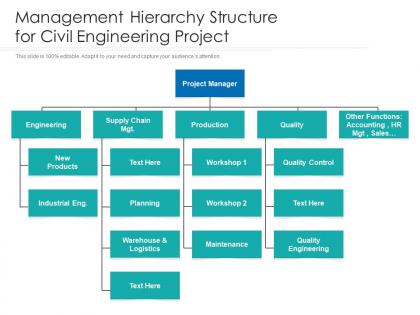
Management hierarchy structure for civil engineering project




Try Before you Buy Download Free Sample Product
 Impress Your
 Audience
 100%
100% Editable
 Save Hours
 of Time


Our Management Hierarchy Structure For Civil Engineering Project are topically designed to provide an attractive backdrop to any subject. Use them to look like a presentation pro.
People who downloaded this PowerPoint presentation also viewed the following :
Management hierarchy structure for civil engineering project with all 2 slides:
Use our Management Hierarchy Structure For Civil Engineering Project to effectively help you save your valuable time. They are readymade to fit into any presentation structure.

FAQs for Management hierarchy structure for
Honestly, the game-changer is accountability - suddenly nobody can play dumb about whose job something is. Decision-making gets way faster too since there's no more "well who should I even ask about this?" Plus your team actually has somewhere to grow, which keeps good people around longer than you'd think. Communication flows better through proper channels instead of everyone just... bothering whoever's nearby, you know? And when stuff hits the fan, at least someone's clearly in charge. I'd start by sketching out who reports to who right now, then spot where things get messy or overlap.
So basically flat orgs have way fewer management layers - you might report straight to a VP instead of going through like 3 different managers first. Traditional hierarchies are the opposite, they stack tons of management levels on top of each other. Think ranch house vs skyscraper, you know? Flat structures usually mean faster decisions and better communication, though managers end up overseeing way more people. Honestly depends what your team needs - some people thrive with autonomy, others need more hand-holding. What's the situation you're dealing with?
Honestly, communication is what keeps everything from falling apart. You get people working in silos and making terrible decisions when info isn't flowing both ways. Your team needs to know what matters most, and they want to feel heard too - otherwise they'll just check out mentally. Meanwhile, if you're not keeping leadership in the loop about what's really happening, they're basically flying blind. I'd start with regular one-on-ones (and actually listen during them, don't just go through the motions). Two-way dialogue makes all the difference.
Honestly, when everyone knows who makes what calls, things just move faster. No more hunting around for the right person to approve stuff or getting mixed signals from three different managers (ugh, been there). Decisions follow a clear path up the chain, so your team gets quicker answers and way less confusion about what actually matters. Plus escalating problems becomes so much cleaner. The trick though? Make sure your hierarchy reflects how work really happens, not just some fancy org chart that looks pretty but doesn't match reality.
Honestly, the worst part will be dealing with pushback from your team. People hate losing that direct line to you - suddenly there's all these layers between them and decisions. Everything slows to a crawl because info has to trickle up and down instead of just happening naturally. Your fastest workers will probably feel suffocated by all the new approval chains. Decision-making becomes this whole formal thing instead of just grabbing someone for a quick chat. My advice? Be really upfront about why you're doing this restructure and actually let people help design how it'll work. Trust me, involving them makes all the difference.
Honestly, clear hierarchy is actually motivating for most people. They know where they fit and what they need to do to move up. Career paths become obvious instead of this weird guessing game about promotions. When roles are defined, your team knows exactly who makes what decisions - no more confusion about who's actually in charge of stuff. Flat organizations sound cool in theory, but I've watched people just flounder around not knowing who's responsible for anything. Just don't let it turn into one of those places where buying office supplies needs three signatures, you know?
Ugh, rigid hierarchies are the worst for decision-making - everything crawls at a snail's pace. Communication gets all messed up too since info has to bounce up and down the chain constantly. You end up with departments that basically ignore each other, and all the smart ideas from your front-line people? They just disappear into the bureaucratic void. Innovation dies because nobody wants to rock the boat without getting like five approvals first. I've seen this kill so many good companies honestly. Try flattening some of those layers or get different teams working together more. Makes a huge difference.
Honestly, culture pretty much makes or breaks your whole hierarchy thing. When there's trust and people actually talk to each other, the chain of command works smoothly - ideas flow up, decisions come down, everyone's happy. But toxic workplaces? Total nightmare. Information gets hoarded, nobody wants to make waves, and suddenly your org chart is just decorative wall art. I've seen places where brilliant ideas die because Karen from accounting won't rock the boat, you know? Pay attention to how info actually moves around your company - that'll tell you if your structure's helping or just creating more bureaucratic BS.
Honestly, it's wild how much tech has changed workplace dynamics lately. Junior people can now jump straight into leadership conversations through Slack or Teams - no more going through five different managers first. AI handles a lot of the boring stuff middle management used to do, which is both cool and slightly terrifying if you think about it. Everyone gets the same data through digital dashboards now, so there's way less of that information hoarding BS. The companies doing well are the ones rolling with these changes instead of clinging to old structures. It's basically making everything flatter and more collaborative.
Look, transparency isn't about sending company-wide emails and calling it a day. Actually build it into how you operate. Do regular one-on-ones where people feel safe bringing up concerns. Document why you made big decisions so everyone gets it. Ask your direct reports what they're hearing from their teams - that feedback loop is huge. Oh, and when you screw something up? Own it publicly and tell them what you're fixing. I've watched too many managers think corporate-speak builds trust. It doesn't. People respect real honesty way more than polished BS.
Cross-functional teams work great - they cut through all that bureaucratic nonsense. Give your managers actual decision-making power instead of making them ask permission for everything. Matrix structures are solid for projects too, where people report to both their regular boss and the project lead. Skip-level meetings help info flow better (honestly, information bottlenecks are the worst). Flat management helps tons. You don't want five approval layers slowing everything down. Middle managers should be able to act fast while keeping leadership in the loop - just not micromanaging their every move.
So companies basically redesign their whole structure around what they actually need to do. Tech places? Super flat - nobody's got time to wait for five different managers just to fix a bug. Manufacturing stays pretty traditional though, since you can't mess around with safety stuff. Healthcare's weird because it's both - hospitals have crazy hierarchies but the actual medical teams work pretty collaboratively. Military's obviously the most rigid. Honestly, your best move is just checking out how the big players in your field do it and copying what works.
Honestly, hierarchies are such a double-edged sword for keeping good people around. Clear career paths? Amazing - ambitious folks eat that up. But then you get those awful bottlenecks where talented people are just... stuck. Waiting for their boss to finally move on or whatever. What actually works is when companies create real development - like throwing people into stretch projects or letting them work across different teams. Multiple ways to climb up, not just one boring ladder where you're trapped behind whoever's above you. The bureaucracy part still sucks though, can't really avoid that completely.
Don't let this stuff fester - call it out directly. People hate feeling bypassed or like their input doesn't matter. I'd schedule regular check-ins between different levels so everyone stays in the loop. When you make decisions, explain the reasoning behind them, not just what you decided. Give people some breathing room in their roles too - nobody wants to feel micromanaged. Oh, and be proactive about this instead of waiting for drama to blow up. Honestly, I'd get everyone together this week to talk through communication styles and set some basic ground rules you all can live with.
Look, when you've got diverse people in leadership roles, problems get solved way better because everyone brings different approaches to the table. Makes total sense from a hiring standpoint too - why limit yourself to a tiny talent pool? Your teams actually perform better when they see themselves represented up the chain. Honestly, I've seen this backfire when companies just hire for optics though. The real magic happens when those diverse voices actually get listened to and can influence decisions. Engagement goes up, people stick around longer, and you're not missing obvious solutions because everyone thinks the same way.
-
Best way of representation of the topic.
-
Excellent products for quick understanding.
-
Wonderful templates design to use in business meetings.
-
Very unique, user-friendly presentation interface.