


Governance Structure For Construction Company Reporting And Management




Try Before you Buy Download Free Sample Product
 Impress Your
 Audience
 100%
100% Editable
 Save Hours
 of Time


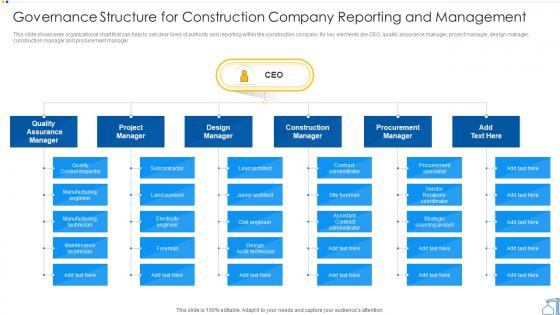
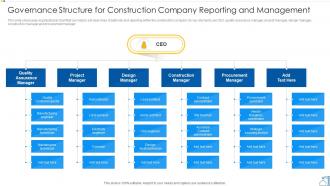
This slide showcases organizational chart that can help to set clear lines of authority and reporting within the construction company. Its key elements are CEO, quality assurance manager, project manager, design manager, construction manager and procurement manager.
People who downloaded this PowerPoint presentation also viewed the following :
Governance Structure For Construction Company Reporting And Management with all 6 slides:
Use our Governance Structure For Construction Company Reporting And Management to effectively help you save your valuable time. They are readymade to fit into any presentation structure.
-
Governance Structure For Construction Company Reporting And Management
-

Governance Structure For Construction Company Reporting And Management
-

Governance Structure For Construction Company Reporting And Management
-

Governance Structure For Construction Company Reporting And Management
-

Governance Structure For Construction Company Reporting And Management
-

Governance Structure For Construction Company Reporting And Management
FAQs for Governance Structure For Construction Company
Honestly, you'll want to nail down four big things. First, make super clear who's responsible for what - sounds basic but you'd be amazed how often this gets messy. Set up solid decision-making processes so people aren't just winging it. Then add some oversight, like boards or committees to keep things in check. Regular reporting helps with accountability too. Oh, and stakeholder engagement - that one catches everyone off guard. I'd start by mapping out who currently makes what decisions. You'll probably find weird gaps or people stepping on each other's toes, which shows you exactly where to focus first.
So governance is basically about who calls the shots and how fast stuff gets done. Flat structures? Super quick decisions, but sometimes you'll make mistakes without enough people checking your work. I've seen that backfire plenty of times. With hierarchical setups, you get way more oversight and someone's always accountable - but man, everything crawls because approvals take forever. Really depends what you need though. Startups can afford to move fast and break things, while banks and healthcare companies need those approval chains or they're screwed. Check where your biggest delays are happening and see if it's your governance slowing you down.
Honestly, stakeholder engagement is what makes or breaks your governance framework. You can't just sit in a room making policies and hope they'll work in the real world - that's a recipe for disaster. Getting people involved from the start means you'll catch stuff you never would've thought of. Plus, when stakeholders help build something, they actually want it to succeed. Map out who really matters first (not just the obvious players). Then create regular check-ins throughout the whole process. Don't make it one of those fake "we asked for input" situations though. People see right through that.
So basically it comes down to who they answer to. Public sector flows up to elected officials and citizens - tons of red tape, approval chains that go on forever, transparency requirements. Private companies answer to shareholders and boards who want profit. They can pivot way faster since there's no public hearings for every little decision. Government focuses more on compliance and serving public interest, while business is all about efficiency and ROI. Honestly, the bureaucracy in public sector can be mind-numbing sometimes. But yeah, just ask yourself "who's really calling the shots here?" and you'll figure out how their governance actually works.
First thing - nail down who does what. Board, staff, volunteers all need clear roles or you'll get that awkward "I thought you were handling it" mess. Term limits are clutch for boards (stagnant leadership is the worst). Document your processes but don't make them sound like legal jargon nobody reads. Actually enforce your conflict policies too. Performance reviews should happen regularly, not just when drama hits. Oh, and build in time to revisit everything as you grow - what works for 10 people won't work for 50. Start simple, then layer on complexity.
Honestly, tech can totally open up your governance processes. Instead of everything happening behind closed doors, you can digitize it all - automatic logging of decisions, real-time meeting minutes, voting patterns tracked automatically. Blockchain's actually pretty solid for this since you get that permanent record nobody can mess with later. Digital dashboards are game-changers too. Stakeholders get instant budget info and performance data instead of waiting months for reports. Just make sure whatever tools you pick actually get used consistently - I've seen too many systems that get set up once then collect digital dust.
Honestly? The hardest part is walking that tightrope between giving your board enough control without letting them micromanage everything to death. Regulations change constantly - I swear they update something new every month. Finding decent board members is a nightmare too. You need people who get your business but aren't too busy to actually show up and contribute. Oh, and just when you think you've got it figured out, your company grows and suddenly your whole governance setup feels outdated. Check in on your structure every year or so. Don't stick with something that's clearly not working anymore.
Yeah so governance totally depends on what industry you're in. Financial services gets hammered with regulations - they need specific board setups and risk committees. Healthcare has all that FDA stuff to worry about. Tech used to be pretty loose but data privacy issues are tightening things up now. Energy companies need board members who actually understand environmental regs, which makes sense I guess. Manufacturing is more about operational risks. Honestly, you should just look at what similar companies in your space are doing - that's probably your best starting point for figuring out what works.
Honestly, I'd start with decision speed - like how fast can your governance team actually approve or kill projects? Track stakeholder satisfaction too, because what's the point if everyone hates the process. Compliance rates are obvious but necessary. Meeting effectiveness is huge though - you don't want those soul-crushing committees that talk in circles for hours. Also check if decisions actually stick or if you're rehashing the same stuff every quarter (super annoying). Pick maybe 2-3 metrics that actually align with what you're trying to accomplish. Check them quarterly and you'll spot patterns pretty quick.
Build flexibility into your governance from day one. Quarterly reviews work great - that's when you assess new regs and tweak policies. Trust me, GDPR taught me this lesson the hard way when we spent months scrambling! Get board members who actually get regulatory trends, not just old-school industry folks. Quick decisions need clear escalation paths. Document everything too - regulators love seeing you're actively monitoring compliance. Oh, and map your current regulatory touchpoints first. Figure out which ones shift most often. That'll save you headaches later.
Honestly, culture trumps everything when it comes to governance. You can have the prettiest policies in the world, but if your team doesn't actually buy into them, they're worthless. When people feel safe being transparent and calling out problems, governance just works naturally. But toxic cultures? Forget it. Everyone finds workarounds or just ignores the rules completely - I've seen it happen so many times. The trick is getting your values and your actual governance structure to match up. Otherwise you're basically writing expensive paperwork that sits in a drawer somewhere.
Honestly, it's a total mess out there depending where you're operating. Germany's super rigid with their top-down stuff, while the UK goes more principle-based. SOX makes the US crazy prescriptive - like, painfully so. Nordic countries somehow make trust and self-regulation work (wish we could pull that off). Cultural context is huge though. Some places care way more about relationships than actually following every rule to the letter. I'd start by figuring out what each of your main markets actually requires first, then worry about the rest.
Start with fiduciary duty training - that's your legal backbone for conflicts of interest and all that formal stuff. Financial literacy is absolutely critical too, because board members who can't read financial statements are basically useless (sorry, but it's true). Then you want governance best practices covering board structure and decision-making. Industry-specific training matters a lot depending on your field. Most orgs do comprehensive orientation first, then yearly refreshers. Oh, and board certification programs are worth checking out if you've got the budget. The whole point is getting everyone on the same page from the start.
Look, good governance is like having guardrails on your business. When stuff hits the fan, everyone knows exactly who's responsible - no more of that "wasn't my department" BS. You'll have multiple people signing off on big decisions, which catches stupid mistakes early. Documentation becomes second nature, so problems don't spiral out of control. Honestly though, most companies treat it like a checkbox exercise. That's useless. Your governance needs real consequences and follow-through, or it's just expensive paperwork. Think of it as your company's immune system - it filters out the bad stuff before it makes you sick.
Honestly, remote work has completely changed how companies make decisions. Instead of managers hovering around, it's all about results now. Teams are way more spread out with decision-making - which is actually pretty refreshing. The whole "walk by your desk to check on you" thing obviously doesn't work when people are in different time zones. Everything has to be written down and transparent since you can't just grab someone for a quick chat. Companies that get this right are going heavy on digital tools and setting up clear communication rules. My advice? Start documenting how decisions get made if you haven't already. Informal stuff just falls apart when everyone's remote.
-
“I really like the convenient operation and professionalism I saw on the SlideTeam website. I want to express my regards and appreciation to the team.”
-
I was able to find the right choice of PPT template for my thesis with SlideTeam. Thank you for existing.