


Construction Group Organizational Structure Building Construction Company Profile




Try Before you Buy Download Free Sample Product
 Impress Your
 Audience
 100%
100% Editable
 Save Hours
 of Time


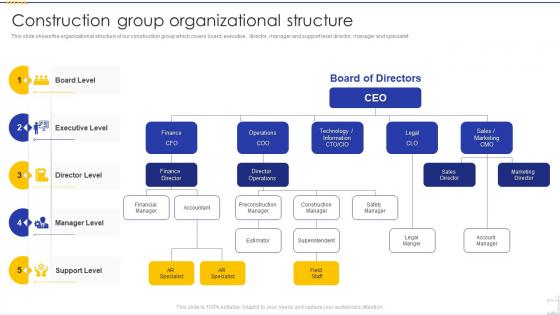
This slide shows the organizational structure of our construction group which covers board, executive, director, manager and support level director, manager and specialist.
People who downloaded this PowerPoint presentation also viewed the following :
Construction Group Organizational Structure Building Construction Company Profile with all 6 slides:
Use our Construction Group Organizational Structure Building Construction Company Profile to effectively help you save your valuable time. They are readymade to fit into any presentation structure.





FAQs for Construction Group Organizational Structure Building
Key components include executive leadership, project management divisions, field operations teams, quality control departments, and support services like procurement and safety. These divisions work together by coordinating resources across multiple projects, ensuring regulatory compliance, and maintaining operational efficiency, with many construction groups finding that clear hierarchical structures ultimately deliver faster project completion and enhanced profitability.
The hierarchical model enhances construction project management efficiency by establishing clear reporting lines, defined decision-making authority, and structured accountability frameworks. This organizational approach enables faster approvals, streamlined resource allocation, and coordinated task execution across multiple project phases, with many construction firms finding that hierarchical structures ultimately deliver reduced delays, improved cost control, and enhanced communication throughout complex building projects.
Project managers serve as critical coordinators in construction companies, overseeing project timelines, budgets, resource allocation, and stakeholder communication while bridging field operations with executive leadership. They streamline workflows by managing subcontractor relationships, ensuring regulatory compliance, and maintaining quality standards, with many construction firms finding that effective project management ultimately delivers faster project completion, reduced costs, and enhanced client satisfaction.
Organizational structure significantly impacts construction safety through clear accountability chains, defined communication protocols, streamlined reporting systems, and established oversight mechanisms. Well-designed hierarchies enable faster incident response, consistent safety training implementation, and effective resource allocation for protective equipment, with many construction firms finding that structured safety management ultimately reduces accidents, minimizes project delays, and enhances regulatory compliance.
Decentralized decision-making enhances construction group operations by enabling faster project responses, reducing bottlenecks, and empowering site managers to address issues immediately without lengthy approval processes. This approach streamlines project timelines, improves resource allocation, and enhances client satisfaction, with many construction firms finding that local autonomy ultimately delivers competitive advantage and operational efficiency.
Matrix organizational structures in construction deliver enhanced resource flexibility, improved cross-project communication, specialized expertise sharing, and streamlined project coordination across multiple sites. This approach enables construction companies to allocate skilled professionals dynamically between projects, reduce duplication of specialized roles, and maintain consistent quality standards, while project managers gain access to broader technical expertise, ultimately delivering faster project completion and improved operational efficiency.
Construction groups adapt their organizational structures through flexible project-based teams, specialized divisions for residential, commercial, and infrastructure work, and scalable resource allocation systems. While residential projects typically utilize smaller, streamlined teams, commercial and infrastructure developments require expanded hierarchies with specialized project managers, engineers, and compliance officers, ultimately enabling groups to optimize expertise deployment and maintain competitive advantage across diverse market segments.
Essential communication channels within construction groups include project management systems, daily huddles, progress reporting workflows, safety briefings, and cross-departmental coordination meetings. These channels streamline operations by facilitating real-time updates between field teams and management, ensuring regulatory compliance, and maintaining project timelines, with many construction organizations finding that structured communication reduces costly delays and enhances overall project delivery efficiency.
Technology significantly enhances construction group organizational structures by streamlining communication, automating project management, and enabling real-time data sharing across teams and job sites. Through digital platforms, construction companies achieve improved coordination between field crews and office staff, faster decision-making processes, and enhanced resource allocation, ultimately delivering reduced project timelines and increased operational efficiency.
Clear delegation in construction organizations involves establishing detailed job descriptions, implementing project-based authority matrices, creating standardized reporting hierarchies, and utilizing digital project management platforms. These methods streamline accountability by defining specific roles for site managers, project engineers, and subcontractors, while many construction firms find that combining clear documentation with regular communication protocols ultimately delivers faster project completion and reduced operational conflicts.
Collaboration between engineering, procurement, and construction departments functions through integrated project management systems, cross-functional teams, shared digital platforms, and standardized communication protocols that align timelines and deliverables. These departments streamline project execution by coordinating design specifications with material availability and construction schedules, ultimately reducing delays, minimizing cost overruns, and enhancing project quality across complex infrastructure developments.
Construction groups implementing flat organizational structures face challenges including reduced career advancement pathways, potential communication bottlenecks across large project teams, and difficulty maintaining specialized expertise oversight. However, many construction companies find that streamlined decision-making, enhanced cross-functional collaboration, and faster project responses ultimately deliver improved operational efficiency and competitive advantage in increasingly complex construction environments.
A construction group's structure can support sustainable practices by establishing dedicated environmental teams, integrating green building specialists across project divisions, implementing sustainability metrics in performance management, and creating cross-functional collaboration between design, procurement, and operations departments. This organizational approach enables streamlined resource allocation, consistent environmental standards, and knowledge sharing across projects, with many construction firms finding that structured sustainability integration reduces material waste, accelerates LEED certifications, and delivers competitive advantage in an increasingly environmentally-conscious market.
Key performance metrics include project delivery timelines, budget variance rates, resource utilization efficiency, communication effectiveness scores, and safety incident frequencies. These indicators help construction groups evaluate whether their organizational structure streamlines operations, enhances coordination between field and office teams, and ultimately delivers improved project outcomes, with many firms finding that well-structured organizations achieve 15-20% better performance across these critical areas.
Cultural considerations significantly influence international construction companies through localized management approaches, region-specific communication protocols, adaptive leadership styles, and culturally aligned project methodologies. These companies strategically modify their hierarchical frameworks, decision-making processes, and operational procedures to accommodate diverse cultural expectations across different markets, ultimately enhancing project success rates and stakeholder relationships while maintaining competitive advantage in global construction landscapes.
-
It's always a delight to see new templates from you! I am extremely pleased with the fact that they are easy to modify and fit any presentation layout in seconds!
-
A beautiful, professional design paired with high-quality images and content that is sure to impress. It is a must-use PPT template in my opinion.