


Organizational Structure Engineering Services And Consultancy Company Profile Ppt File Inspiration




Try Before you Buy Download Free Sample Product
 Impress Your
 Audience
 100%
100% Editable
 Save Hours
 of Time


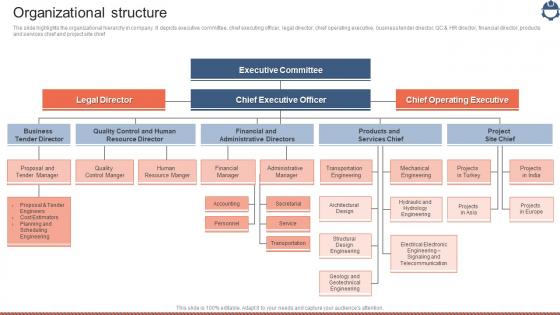
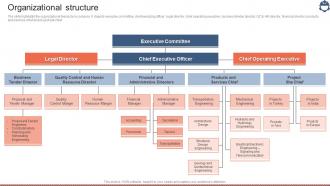
The slide highlights the organizational hierarchy in company. It depicts executive committee, chief executing officer, legal director, chief operating executive, business tender director, QC and HR director, financial director, products and services chief and project site chief
People who downloaded this PowerPoint presentation also viewed the following :
Organizational Structure Engineering Services And Consultancy Company Profile Ppt File Inspiration with all 6 slides:
Use our Organizational Structure Engineering Services And Consultancy Company Profile Ppt File Inspiration to effectively help you save your valuable time. They are readymade to fit into any presentation structure.





FAQs for Organizational Structure Engineering Services And Consultancy Company Profile
So there's basically four types you'll see. Functional organizes by department - marketing, finance, whatever. Divisional splits by products or regions. Matrix is where people report to multiple bosses (honestly kind of a nightmare). Then flat structures have barely any hierarchy. Each has trade-offs though. Functional's great for expertise but creates those annoying silos. You get flexibility with divisional but end up duplicating stuff. Matrix helps with projects but confuses everyone about who's actually in charge. Flat structures make decisions faster, just don't overwhelm your managers. Really depends on your company's size and what you're trying to accomplish.
Look, when everyone knows who's in charge of what and who they report to, you avoid so much unnecessary drama. Your team can actually focus on their work instead of playing office politics all day. Clear roles mean less overlap and faster decisions too. I've seen places where people just wander around confused about basic stuff - it's painful to watch. Workers feel way more motivated when they understand their career path and see how they fit into the company's goals. Map out those reporting lines first, then figure out who makes which decisions.
So organizational structure basically controls how info moves around your company. Flat structures? Way faster communication since there aren't a million layers to go through. Hierarchical ones though - ugh, messages get stuck or watered down as they bounce up and down the chain. People also love staying in their own department bubbles instead of talking across teams (shocking, I know). The trick is figuring out your company's communication patterns. Once you do that, you can dodge the bottlenecks and find quicker ways to get info where it actually needs to be.
You'll get way faster decisions with a flat structure - no more waiting for approvals to crawl up the chain. Just talk directly to whoever can actually say yes. First time I saw this work was honestly mind-blowing. But here's the thing - since more people get a voice, meetings can spiral out of control if you're not careful. Everyone suddenly has opinions, you know? The trick is nailing down who actually owns each decision from day one. Otherwise you end up with those endless "let's circle back" situations that defeat the whole purpose.
Here's the thing - your company's structure totally makes or breaks how change actually happens. Clear reporting lines? People know who's calling the shots and what they're supposed to do. But when everything's a mess organizationally, forget about getting anyone on the same page. Communication flows way better in flatter companies too since there aren't like five layers where messages get lost or twisted. I've seen so many change initiatives crash because nobody bothered checking if their org chart would even support what they wanted to do. Definitely figure out what you're working with first.
Honestly, start by mapping out what you've got now, then figure out exactly what you want it to look like after. Communication is everything - nobody wants to get blindsided by changes that mess with their daily routine. Test it with just one department first because trust me, weird stuff always comes up that you didn't expect. Get some people in each team who are actually excited about the change to help sell it to everyone else. Oh, and don't rush it. Create a timeline but check in constantly to see how it's actually going versus what you planned.
So it really depends on your company size and what you're trying to do. Big companies usually need more formal structures, but smaller ones can get away with staying flat and moving fast. Your industry matters a ton too - like if you're in tech and constantly pivoting, rigid hierarchies will just slow you down. Market changes and regulations also factor in. Honestly though, I've seen companies waste months trying to copy what worked somewhere else. Better to look at where your current setup is actually breaking down first, then build around those specific problems. Nothing's permanent anyway - you'll probably need to adjust it later.
Dude, flexible structures are a game-changer for startups. You can pivot fast, move people around when fires pop up, make quick decisions without waiting for approval from like 5 different managers. Your team gets to try different roles too - honestly some of the smartest people I know grew the most during those "everyone does everything" phases. But don't just wing it completely. You still need clear communication and someone has to own the big calls, even if everything else is fluid. Otherwise you'll just have chaos with extra steps.
Ugh, hierarchies are the worst for innovation. Every single idea has to climb this endless ladder of approvals, and by the time it reaches the top, all the momentum is dead. People get scared to pitch anything risky because they don't want to look stupid in front of their boss's boss's boss. The employees actually seeing the problems day-to-day? They can't even get five minutes with decision-makers. It kills collaboration too since everyone's stuck in their little departmental silos. You could try setting up some informal brainstorming sessions or maybe push for skip-level meetings - anything that cuts through the bureaucratic nonsense honestly.
Look, it totally depends on your industry. Tech companies usually go flat - lots of cross-functional teams because they need to pivot fast. But manufacturing? They stick with traditional hierarchy since you need clear command chains for safety stuff. Healthcare's weird though - it's this matrix thing where doctors, nurses, and admin all report to different people but somehow work together on patients. I actually find it pretty cool how structure really does follow what each industry needs. Don't just copy what Google does, you know? Figure out what actually drives results in your space first.
They're pretty much connected - your org structure totally shapes how people interact and make decisions, which then influences your culture. Super hierarchical setups usually create more formal, top-down vibes. Flatter structures tend to be more collaborative and innovative, though I've seen some flat orgs that were complete disasters honestly. Here's the thing - they keep reinforcing each other in this constant loop. So when you're trying to change culture, don't just focus on the touchy-feely stuff. Sometimes you actually need to shift reporting lines or how decisions get made first.
Honestly, remote work flips organizational structure on its head. You get flatter hierarchies since info spreads easier digitally, but decisions drag without those random hallway chats. Command-and-control stuff? Total disaster remotely - you can't micromanage when people aren't physically there. Teams doing well are the autonomous, cross-functional ones. Oh, and middle management gets weird too since their role changes completely. I'd look at your current setup and figure out if it actually works for remote people or if you're just making everyone's life harder for no reason.
Honestly, start with decision-making speed - how fast do choices actually move through your org? Communication flow matters too. Are messages getting stuck somewhere? I'd also check employee engagement scores and span of control ratios. Your budget tells the real story though - bloated structures always show up there first. Role clarity surveys help, plus notice how often people say "not my job" or seem confused about ownership. Oh, and track cross-functional project timelines. Teams constantly waiting for approvals? That's your red flag right there.
Look, your leadership style pretty much dictates what structure will actually work. Hands-on types do better with hierarchical setups where they can keep tabs on everything. Delegators? Go flatter or decentralized – micromanaging in that environment is just torture for everyone involved. Matrix structures work great if you're collaborative by nature. Visionary leaders need flexibility to pivot fast (learned that one the hard way at my last job). Honestly, just pick whatever matches how you naturally operate instead of what sounds impressive in meetings.
Honestly, I'd start by figuring out where your current setup is actually screwing you over - like where decisions get stuck or teams can't talk to each other properly. Then rebuild around what you're actually trying to accomplish instead of the usual department silos. Flatter structures work better, cross-functional teams, that kind of thing. The paperwork part sucks but you gotta update job descriptions and reporting chains or nothing will stick. Get your people involved in redesigning this stuff though - they'll hate it less if they help build it. Oh, and test everything small first before you blow up the whole company.
-
My search for complete decks ended with SlideTeam. Such a surplus collection of HD PowerPoints. Moreover, their standard and widescreen formats have helped me in delivering bullseye presentations.
-
Helpful product design for delivering presentation.