


Business Management Consultancy Company Profile Organizational Structure




Try Before you Buy Download Free Sample Product
 Impress Your
 Audience
 100%
100% Editable
 Save Hours
 of Time


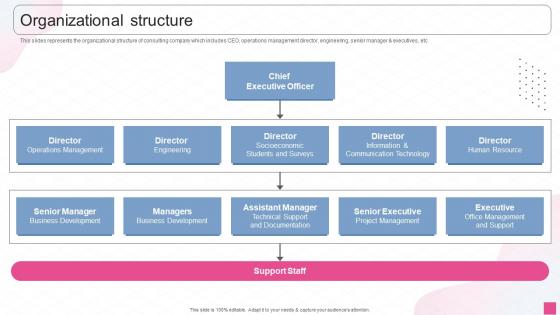
This slides represents the organizational structure of consulting company which includes CEO, operations management director, engineering, senior manager and executives, etc.
People who downloaded this PowerPoint presentation also viewed the following :
Business Management Consultancy Company Profile Organizational Structure with all 6 slides:
Use our Business Management Consultancy Company Profile Organizational Structure to effectively help you save your valuable time. They are readymade to fit into any presentation structure.





FAQs for Business Management Consultancy Company
Honestly, start with clear hierarchy and make sure everyone knows their role - sounds basic but you'd be shocked how many places mess this up. Communication channels need to be solid too. Don't let managers have like 15 people reporting to them (recipe for chaos). Map out who reports to whom so decision-making isn't a guessing game. You'll need some coordination between departments and processes that actually make sense. Oh, and don't go overboard with rigid structure - find what works for your company size and industry. I'd literally draw out your current setup first and spot where people seem most confused.
Honestly, it's all about how info moves around your team. Hierarchical stuff means everything goes through managers - slower but you've got clear control. Flat structures? People just talk directly to whoever they need. Way faster, though sometimes it gets messy. Matrix is weird because you're answering to like three different people (been there, not fun). Really depends what you need though. Quick decisions = go flatter. Need to keep tight control over everything? More hierarchy makes sense. Don't overthink it too much.
Honestly, your leaders are probably the biggest factor here. They're the ones deciding if you'll have tons of management layers or keep things flat. Centralized control vs letting teams make their own calls? That's on them too. Your boss's style totally shapes whether you get stuck with rigid reporting chains or if departments actually work together. I mean, some leaders love micromanaging every little thing - you can guess how that turns out. The whole culture they create affects whether your structure feels super formal or more relaxed day-to-day. So if something's broken structurally, start there.
First, figure out how work actually moves through your company - not the fantasy version on paper, but what really happens. Most org charts are total BS anyway. Where do decisions get stuck? Communication fall apart? People doing the same work twice? Then think about your company size and whether you need more innovation or efficiency. Honestly, don't do some massive restructuring right away. Test small changes first - way less risky. Your industry matters too. The best structure? Whatever gets your specific work done faster with less headaches.
Honestly, flat structures are pretty great for quick decisions - no waiting around for approval from five different managers. Your team feels more trusted too since they can actually talk to leadership directly. But it gets messy fast if people don't know exactly what they're supposed to be doing. Some managers totally freak out without clear hierarchy to hide behind (which is kinda telling, right?). Growing gets weird too because coordinating everyone becomes this whole thing. Just make sure you've got your communication game tight before jumping in, or it'll be chaos.
Honestly, your team structure makes a huge difference in how people feel about work. Flat setups usually work better - people feel heard and can actually make decisions. Too many layers? That's where motivation goes to die. You still need some organization though (I've seen startups with zero structure and it's a mess). Clear reporting helps, but don't overdo the hierarchy thing. Maybe ask your team what's bugging them about how things work now? They'll tell you exactly what's broken. Then you can fix the real problems instead of guessing.
Honestly, start with decision-making speed - like how long approvals actually take. Employee engagement scores matter too since they show if people feel valued. Communication flow is critical (seriously, bad structures turn updates into chaos). Check spans of control so managers aren't drowning or bored. Cross-functional collaboration gets tricky to measure, but project completion rates work well enough. Don't overwhelm yourself though - pick maybe 2-3 metrics that match your biggest headaches right now. You'll get better data focusing on what's actually broken.
Oh man, this is huge for multinationals. Asian offices tend to be way more hierarchical while Scandinavian ones are super flat - totally different vibes. Some cultures expect clear boss-to-employee chains, others want everyone collaborating on decisions. Communication styles are key too. High-context cultures need different reporting setups than places where people just say what they mean directly. Honestly, companies that try to copy-paste the same structure everywhere usually mess up. Way better to adapt your org chart to match what actually works locally in each country.
Honestly, tech has completely demolished those old-school corporate pyramids. Middle management is disappearing fast because teams can just talk directly now - no more playing telephone through six different people. Remote work tools broke down all those stupid departmental walls too. Marketing can hop on a call with developers instantly instead of waiting weeks for approvals. The shift happened crazy fast after 2020, which honestly caught a lot of companies off guard. You do lose some of that face-to-face mentorship though, which kinda sucks. My take? Roll with the flexibility but don't let communication turn into chaos. You still need someone keeping track of who's doing what.
Honestly, don't try to change everything overnight - I've watched that blow up spectacularly. Pick a couple pilot teams first. Break down those department walls that make everyone territorial. Let cross-functional groups actually make decisions instead of waiting around for manager approval chains. Your leadership has to stop micromanaging and start coaching people instead. Training is huge - get everyone comfortable with agile methods and the tools they'll need. Oh, and totally rethink how you measure wins. Forget just hitting old targets. Focus on real outcomes and how well teams adapt when things change.
Honestly, remote work changes everything about how teams actually function. Your boss can't just walk by your desk anymore, so suddenly it's all about what you deliver, not how long you look busy. I've worked with amazing people I've literally never seen in real life - geography just doesn't matter for collaboration now. The tricky part? Those random coffee conversations that used to spark ideas don't happen naturally. Everything becomes more formal and documented, which is great for records but slows down quick decisions. You really have to work at building relationships intentionally. Start by mapping out where those spontaneous moments used to happen and figure out digital replacements.
Tech companies usually go flat - they want those cross-functional teams moving fast on innovation. Manufacturing? Total opposite. They stick with traditional hierarchies because safety and efficiency need clear command chains. Consulting firms are wild though - matrix structures everywhere. You'll report to project leads AND practice managers, which honestly gets confusing but somehow works for client stuff. Healthcare stays super hierarchical too, mainly because of all the regulations and specialized roles. Just peek at what your industry leaders are doing, then tweak it based on your company's actual size and vibe.
Honestly, start with what you're actually trying to fix - like, what can't your org do right now that it needs to? Then dig into the real problems: communication sucks, nobody knows who's responsible for what, or maybe you've got skill gaps everywhere. The people stuff is huge though - I've watched so many restructures crash and burn because they ignored that part. Figure out which roles actually matter vs ones that just... exist. Look at how teams work together and if your reporting structure makes any sense. Oh, and don't forget about costs and timing - you can't change everything overnight. Map out where you want to end up, then reverse-engineer the steps to get there.
Honestly, silos are the worst - they kill collaboration before it even starts. What works is setting up cross-functional teams for actual projects, not those committee meetings that drag on forever. Give people tools where they can see what other departments are doing (transparency helps a ton). Also create specific "bridge" roles - someone whose literal job is connecting different parts of the company. Here's the thing though: you've got to build collaboration into job descriptions and reviews. Can't just hope it magically happens. Start with one small pilot project between teams to show it actually works first.
Honestly, everyone's going way flatter now - like, goodbye middle management layers. Remote work basically forced companies to rethink everything, and most are sticking with it. Cross-functional teams are huge too, where you'll have designers working directly with engineers and product people. The whole "agile" thing is kinda overused at this point, but the concept works. Teams form for specific projects then break apart when they're done. Slack and similar tools run everything now since we can't just walk over to someone's desk anymore. If you're redoing your structure, just cut out as many approval layers as possible. Decision-makers need to be closer to the actual work happening.
-
I am not the best at presentations but using SlideTeam’s PPT template made it easier for me. Thank you SlideTeam!
-
Extremely professional slides with attractive designs. I especially appreciate how easily they can be modified and come in different colors, shapes, and sizes!