


Engineering Company Profile Organizational Structure




Try Before you Buy Download Free Sample Product
 Impress Your
 Audience
 100%
100% Editable
 Save Hours
 of Time


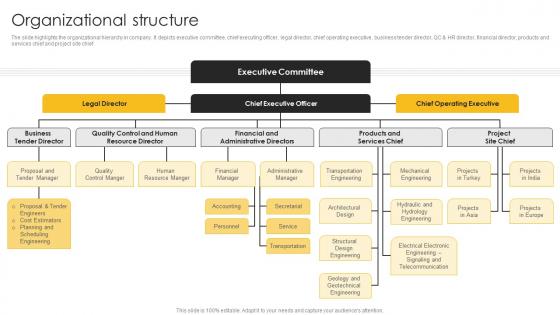
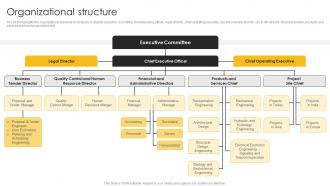
The slide highlights the organizational hierarchy in company. It depicts executive committee, chief executing officer, legal director, chief operating executive, business tender director, QC and HR director, financial director, products and services chief and project site chief
People who downloaded this PowerPoint presentation also viewed the following :
Engineering Company Profile Organizational Structure with all 6 slides:
Use our Engineering Company Profile Organizational Structure to effectively help you save your valuable time. They are readymade to fit into any presentation structure.





FAQs for Engineering Company
You'll need clear hierarchy and defined roles first - that's basic stuff. Communication channels matter too, plus how decisions actually get made. Don't overcomplicate it though! I've watched companies totally bomb this by making it way too complex. Map out who reports to whom and how many people each manager handles. Oh, and make sure departments can actually coordinate - that gets messy fast. Build in flexibility because things change constantly. Most crucial part? Your structure needs to match what your business is trying to do, not just look pretty on some chart.
Yeah, flat structures are great for speed - no waiting around for approvals to trickle down through five different managers. You can actually talk to people without all that bureaucratic nonsense getting in the way. The downside? You'll end up doing more coordination work yourself since there aren't as many managers handling that stuff. I'd suggest figuring out your communication flows early - like who handles what between departments. Otherwise you'll waste time hunting down the right person every time you need something done.
Look, your org structure is basically the blueprint for your whole culture. It shapes who talks to who, how fast decisions happen, whether people feel empowered or totally micromanaged. Flat structures usually breed more openness and innovation - hierarchical ones tend to be formal and process-heavy, though I've definitely seen weird exceptions to both. Here's the thing: if you're trying to change your culture but your structure doesn't actually support the behaviors you want? You're fighting an uphill battle. Start there first.
Honestly, most companies just steal whatever structure looks cool without thinking it through - huge mistake. Start by figuring out your actual pain points first. What's your team size? Do you need people making quick decisions or is everyone waiting around for approvals? Fast-growing companies usually do better with flatter structures instead of those old-school hierarchies. Also consider if you need specialists or people who can wear multiple hats. Regulated industries are different though - they kinda have to be more formal. Map out how work actually moves through your company, then build around fixing those specific problems.
Matrix structures are pretty solid when you need both specialized skills and project teams working together. But honestly, the dual reporting thing is a nightmare - people constantly get pulled between two different bosses with competing priorities. Decision-making slows down because everyone has to coordinate with everyone else. Plus you'll spend half your life in meetings just trying to keep communication flowing. That said, if you're in a fast-moving industry where cross-functional work matters, it might be worth the headache. Just nail down who has authority over what from day one or you're asking for trouble.
So basically, who reports to who totally affects how fast decisions get made. Flat companies? Decisions happen super quick since you're not waiting for like 5 different managers to sign off. I mean, at some startups you literally just text the founder. But hierarchical places have more layers, which yeah slows things down, though honestly sometimes that catches mistakes flat teams miss. There's no "right" structure - depends what you're doing. A bank probably shouldn't move as fast as a tech startup, you know? Just don't design something that fights against how you actually want things to work.
So here's the thing - tech totally changes how teams can be structured. You don't need all those middle managers anymore since info flows way faster now. Remote tools mean you can actually organize people by their skills instead of just whoever lives nearby. Automation wipes out whole layers of boring decision-making jobs too. The cool part is AI lets junior people make calls that used to need a VP's approval or whatever. Just don't make the mistake of slapping new tech onto your same old setup. Pick tools that match the structure you're going for.
Dude, biggest mistake? Racing ahead without talking to your team first. People freak out when they don't know why changes are happening. I've seen companies blow up teams that actually worked great together - like, why would you do that? Also, nobody thinks about how work actually moves between departments, so suddenly you've got these weird bottlenecks everywhere. Honestly though, half the time the real issue isn't even structure. It's culture or crappy processes, but leadership thinks shuffling boxes on a chart will magically fix everything. Talk to people first and map out how stuff actually gets done before you start moving people around.
Honestly, good structure is a game-changer for performance. People know exactly what they're doing and who's in charge of what. No more of that "uh, is this my responsibility?" confusion that wastes everyone's time. Your team can actually focus on getting stuff done instead of playing organizational detective. Plus accountability becomes way clearer when everyone's role is defined. I've seen teams fall apart without it - total chaos. The trick is making sure your structure reflects how work actually happens, not some theoretical org chart that looks perfect but doesn't work in practice.
Honestly, cross-functional teams are your best bet here - they can skip most of those annoying approval chains. Give people actual decision-making power at their level instead of making them escalate everything (seriously, that kills momentum). Matrix structures are kinda chaotic but they're great for getting departments to actually talk to each other. Maybe throw in some "innovation hours" where teams can mess around outside the normal rules? Oh, and pilot programs work too. The trick is figuring out what needs to stay rigid versus where you can let people just... adapt as they go.
Honestly? Your org structure is probably why people keep leaving. Clear reporting lines and well-defined roles make employees feel way more secure. But when the hierarchy's a mess or nobody knows who makes what decisions, people get frustrated fast and bail. Flat structures aren't always better either - sometimes people need more guidance than they're getting. I've seen this at my last job too. The companies that keep people longest have obvious career paths and decision-making that actually works. If turnover's bad, your org chart might be the real problem.
Don't just copy what other companies are doing - that's where most people mess up. Map out your actual strategic priorities first, then build around those. Need innovation? Go flatter with cross-functional teams. Focused on growth? Maybe centralize some functions for efficiency. The whole thing should follow how work actually flows, not some org chart that looks pretty. I'd probably check every quarter or so to make sure you're still aligned with where you're headed. It's honestly one of those things that sounds obvious but companies get backwards all the time.
Honestly, flat structures win most of the time for innovation stuff. Your engineers can just talk to product managers directly instead of waiting for three approval layers - makes everything way faster. Hierarchical setups bog you down with bureaucracy, though I've seen some work okay if they set up cross-functional teams that skip the usual chain. Teams need room to mess around and fail quickly, that's the real trick. Oh and ignore the org chart - just watch how decisions actually happen day-to-day. That'll tell you what's really going on.
Honestly, start with communication flow - how fast does info actually move between teams? That's usually where things break down first. Employee engagement scores are clutch too, since people check out when the structure sucks. Decision-making speed matters a lot, plus how often departments actually work together (spoiler: it's probably less than you think). Track productivity per person and what each layer costs you. Oh, and span of control ratios if you're into that stuff. Pick maybe 2-3 that match your biggest headaches right now instead of trying to measure everything.
Here's my take: Start with the "why" - people freak out when you just drop news without context. What problems are you actually fixing? Small group sessions work way better than company-wide announcements because people can actually ask questions. Honestly, most pushback comes from fear, not the change itself. Find those unofficial leaders everyone listens to and win them over first. They'll do half your work for you. Oh, and don't rush it - give people time to wrap their heads around things or you'll just create more drama.
-
Every time I ask for something out-of-the-box from them and they never fail in delivering that. No words for their excellence!
-
SlideTeam is the best in the business. Their templates are engaging and customizable. You can rely on them.