

Engineering Company Profile Powerpoint Presentation Slides





Try Before you Buy Download Free Sample Product
 Impress Your
Audience
 100%
Editable
 Save Hours
of Time


Check out our efficiently designed Engineering company profile PowerPoint presentation. It gives stakeholders the organizations business strategy with fundamental operations data to provide the clients with comprehensive information on company management, work culture, and business purpose. This template offers an executive summary to give an abstract of the contents of the profile. It also highlights the company overview, mission, vision, and business model to convey the purpose and business revenue generation methods. This Engineering Company Overview template also showcases a wide range of services offered by the organization, including product engineering, manufacturing engineering, operations engineering, and engineering consultancy. Furthermore, the profile also lists products provided along with the sales data. Additionally, it displays strategic partners, valuable clients, client testimonials, industry served, project portfolio, and ownership structure. Moreover, it highlights the organizational structure, leadership, and workforce diversity to describe the work culture within the company. It also showcases the company timeline along with international presence, competitor comparison, SWOT analysis, expansion strategies, and CSR activities. Finally, the profile represents company revenue, gross profit, operating profit, net profit, and margin for exhibiting company financials. Download our 100 percent editable and customizable deck to know more in detail.
People who downloaded this PowerPoint presentation also viewed the following :
Content of this Powerpoint Presentation
Slide 1: This slide introduces Engineering Company Profile. State Your Company Name and begin.
Slide 2: This slide presents Table of Content for the presentation.
Slide 3: This slide shows executive summary to present brief details of company.
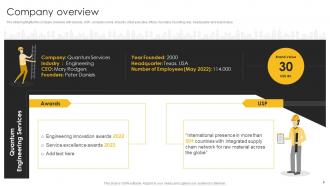
Slide 4: This slide presents company overview with awards, USP, company name, industry, etc.
Slide 5: This slide displays guiding principles of company which describes mission, vision, goals, etc.
Slide 6: This slide represents business model which illustrates key partners, key activities, key resources, etc.
Slide 7: This slide showcases major services provided by engineering company across serving areas.
Slide 8: This slide shows products offered by engineering company illustrating API casing, non API casing, etc.
Slide 9: The slide showcases the details of product and services sales split.
Slide 10: This slide shows top product and services by sales volume in 2022.
Slide 11: This slide presents company timeline and milestones illustrating incorporation, global expansion, acquisition, etc.
Slide 12: This slide displays international presence of the company.
Slide 13: This slide represents organizational hierarchy in company.
Slide 14: The slide showcases the management team of the engineering company.
Slide 15: This slide shows workforce diversity and total employee count.
Slide 16: This slide presents engineering company ownership structure for current year.
Slide 17: This slide displays strategic partners of engineering company to leverage the core competencies.
Slide 18: This slide represents valuable business clients providing major service orders.
Slide 19: This slide showcases client testimonials post for company products and services to build credibility.
Slide 20: This slide shows key industries served by engineering companies through various products and services.
Slide 21: This slide presents product portfolio of engineering company service with time taken for each project.
Slide 22: This slide displays annual revenue growth of the company with the CAGR for last five financial years.
Slide 23: This slide illustrates a graph of gross profit in US$ and gross margin in percentage for engineering company.
Slide 24: This slide showcases graph of operating profit in US$ and gross margin in percentage.
Slide 25: This slide shows graph of net profit in US$ and gross margin in percentage.
Slide 26: This slide presents competitor comparison for top competitors.
Slide 27: This slide displays SWOT analysis for engineering company.
Slide 28: This slide represents expansion strategies and future plan for engineering company.
Slide 29: This slide showcases major corporate social responsibility activities performed by company.
Slide 30: This slide shows case study which includes business challenge faced by client for cooling water piping system replacement.
Slide 31: This slide displays Icons for engineering company profile.
Slide 32: This slide is titled as Additional Slides for moving forward.
Slide 33: This is About Us slide to show company specifications etc.
Slide 34: This is Our Mission slide with related imagery and text.
Slide 35: This is Our Team slide with names and designation.
Slide 36: This slide shows Post It Notes. Post your important notes here.
Slide 37: This is a Timeline slide. Show data related to time intervals here.
Slide 38: This slide provides 30 60 90 Days Plan with text boxes.
Slide 39: This slide displays Column chart with two products comparison.
Slide 40: This slide describes Line chart with two products comparison.
Slide 41: This slide displays Mind Map with related imagery.
Slide 42: This is a Thank You slide with address, contact numbers and email address.
Engineering Company Profile Powerpoint Presentation Slides with all 47 slides:
Use our Engineering Company Profile Powerpoint Presentation Slides to effectively help you save your valuable time. They are readymade to fit into any presentation structure.









FAQs for Engineering Company Profile
So we do four main things: structural design and analysis, mechanical system stuff, project management, and regulatory compliance. Honestly, the structural work is where we make most of our money - residential buildings, industrial facilities, you name it. HVAC, plumbing, electrical integration is handled by our mechanical team, which is huge because nobody wants to deal with coordinating a bunch of different contractors. That's a nightmare. We can also take your project from those rough sketches all the way to final inspections. Best bet? Just schedule a consultation first so we can figure out what you actually need.
Honestly, three things make us different from everyone else out there. First, we're crazy fast with turnaround times - like, ridiculously fast. Our specialty is sustainable infrastructure, green building systems, that whole space. Most companies either try to do everything or get way too narrow, but we hit this perfect middle ground. Oh, and here's the big one - we actually stick around. Instead of just handing you a report and bouncing, our engineers work directly with your teams throughout the whole project. It's way more collaborative that way. You should definitely look at our case studies to see what I mean.
Dude, we crushed it with the downtown metro expansion last year - handled structural engineering for three new stations. That bridge retrofit over the river was a total headache but looks amazing now. The renewable energy facility's been all over the news too, which is cool. Hospital seismic upgrades were probably the most important work though, that stuff really matters. Oh and there's way more projects than I can remember off the top of my head. Check our website's project gallery for photos, or I can send you the full case studies if you're putting together a proposal or whatever.
Dude, the software stack is pretty sweet. AutoCAD and SolidWorks handle all the 3D modeling stuff. MATLAB does the heavy math - honestly ANSYS gave me nightmares for like 3 months but now I love it for simulations. Project management runs through Microsoft Project plus some internal dashboard thing. Python's your friend for scripting and data stuff, which you'll probably use more than you think. Don't worry if you're rusty on any of it though - they've got licenses and training materials. Just bug your team lead when you need help getting started.
So we've got certified engineers who keep up with ASME, IEEE, all that stuff. Our project system has these checkpoints at every phase - kinda annoying but it works. Internal audits happen regularly, plus we bring in outside consultants for the tricky projects. Honestly the biggest thing? Flag regulatory questions super early in design. I can't tell you how many times I've seen teams scramble because they waited until final review to catch something obvious. Way easier to deal with upfront than when you're already deep into it.
So we do staged reviews at every milestone, which honestly saves everyone's headache later. Plus there's independent audits and these standardized checklists for deliverables. Your PM will explain the testing stuff during kickoff. Peer reviews are huge though - seriously, when you've been looking at the same thing for hours you miss obvious stuff. We're ISO certified too so there's that accountability factor. Bottom line: nothing reaches the client without two people signing off. You'll always have someone backing you up when you present, which is honestly pretty reassuring.
So we do this mix of Agile sprints plus the usual milestone stuff - keeps things flexible but clients still get their precious deadlines. Two-week sprints with daily check-ins (I actually don't hate these ones). Honestly, we pad estimates by like 15-20% because something always breaks or takes longer than expected. You get weekly updates and can creep on our dashboard whenever you want. Oh, and if things start going wrong? You'll hear about it right away instead of waiting months for some formal report. Communication beats paperwork every time.
So we've actually built sustainability into pretty much everything we do now. Started as more of a "nice to have" thing, but honestly? It's become a huge selling point with clients. Our buildings are LEED-certified, we use renewable energy, and we're picky about working with suppliers who actually care about this stuff too. The cool thing is we get teams thinking about environmental impact from day one instead of scrambling to add it later. Oh, and definitely hit up our sustainability team early if you're starting a new project - they'll spot opportunities you probably wouldn't think of.
So there's actually some decent stuff here for development. Most people burn through like $3-5k yearly on training and conferences - company covers it. You can get paired with senior engineers for mentorship, which is clutch. Project rotations are probably the best part since you bounce around different departments. Oh and there's these quarterly lunch sessions where people present their work, though honestly some are way better than others lol. I'd figure out which certs you want first, then just talk to your manager about what makes sense. The conference circuit is pretty solid too if you're into that.
Honestly? Block out 20% of your week for whatever random project gets you excited. Sounds crazy but our best stuff comes from these side experiments. Monthly "failure parties" are genius too - teams just share what bombed and why. Takes the pressure off trying risky things. Every few months we mix engineers with different teams, which always leads somewhere unexpected. The real trick is making sure people don't immediately trash wild ideas. I'd start by literally putting innovation time on your calendar and don't let meetings creep in. You'll be amazed what happens when you actually protect that time.
So we're basically in touch with clients the whole time - regular check-ins during planning, then weekly updates once things get rolling. Milestone reviews happen at the big moments too. There's this collaborative platform thing where clients can see progress happening live and drop feedback, which honestly saves everyone's sanity later. Your project manager is always available for urgent stuff or random questions that pop up. The cool part is we just match however your team likes to communicate - some people want formal reports, others prefer jumping on quick video calls. Way better than guessing what's working, you know?
So first thing - you'll have that initial consultation to figure out what they actually want and if it's doable. Design phase comes next with sketches and CAD work. Once they approve everything, detailed engineering starts along with permitting (which honestly always drags on forever). Then you're juggling procurement and construction management - coordinating vendors, overseeing installs, the usual chaos. Testing and commissioning wrap things up before you hand it over. Oh, and definitely keep everyone in the loop throughout because fixing stuff early costs pennies compared to mid-construction changes that'll destroy your timeline.
Ugh, scope creep is the worst - clients always want "just one more thing." I handle it with change orders and constant check-ins so there's no surprises. Timeline issues? Front-load your critical stuff and sneak in buffer time wherever you can. Resource conflicts are trickier, but cross-training helps big time. Keep good contractors on speed dial too. Being proactive saves your sanity later. Oh, and write down what went wrong after each project - you'll notice the same crap keeps happening and can actually prevent it next time.
Honestly, we just make learning part of the job instead of waiting until we're behind. Regular training keeps everyone sharp, plus I actually let people mess around with new tools - some of our best ideas come from that random experimenting. We hit up conferences and stay tight with our tech vendors to catch trends early. Oh, and after every project we do this "what's next" thing where we figure out what could've made things better. Sounds cheesy but it works. The key is making it routine, not something you panic-do when change hits.
Honestly, you can't deliver anything complex if everyone's stuck in their own bubble. We're always pulling people from different teams - structural, mechanical, electrical, you name it. Some of our best ideas actually come from those chaotic whiteboard sessions where everyone's interrupting each other (which sounds terrible but somehow works). Clients get looped in early too because otherwise you end up solving the wrong problem entirely. Oh, and don't wait around for scheduled meetings - just grab whoever you need for quick chats when you're stuck.
-
“Ample and amazing variety of templates available, really helpful for making professional PPT for day to day workings.”
-
“Superb. What a great finding. Thankful for SlideTeam. We were paying people to make slides which went all in vain. We are so happy to have found you.”