

Organization Structure Interior Design Company Profile Ppt Graphics




Try Before you Buy Download Free Sample Product
 Impress Your
 Audience
 100%
100% Editable
 Save Hours
 of Time


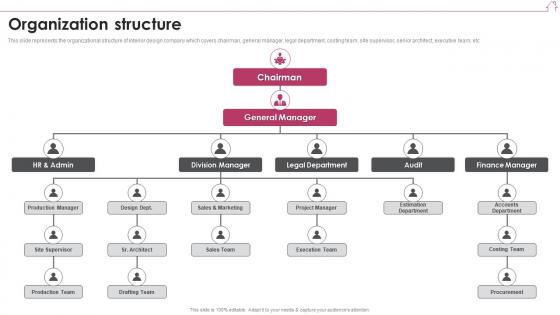
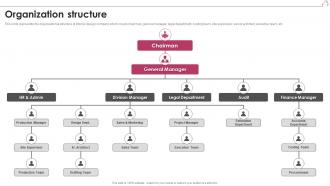
This slide represents the organizational structure of interior design company which covers chairman, general manager, legal department, costing team, site supervisor, senior architect, executive team, etc.
People who downloaded this PowerPoint presentation also viewed the following :
Organization Structure Interior Design Company Profile Ppt Graphics with all 6 slides:
Use our Organization Structure Interior Design Company Profile Ppt Graphics to effectively help you save your valuable time. They are readymade to fit into any presentation structure.





FAQs for Organization Structure Interior Design Company
Look, people just need to know who they report to and what their actual job is - sounds obvious but you'd be surprised how often this gets messed up. Push decisions down so your executives aren't approving every tiny thing (total nightmare). Balance specialization with teams that actually talk to each other. Flat enough for good communication, but not so flat that nobody's accountable when things go sideways. Oh and here's the thing - don't just copy Google's structure because it worked for them. Your org needs to match what you're actually trying to do, not what looks cool on paper.
Look, your org structure can make or break your team's daily grind. People work way better when they know exactly who makes decisions and what they're supposed to be doing. But - and this is huge - don't go overboard with rigid hierarchies. Too many approval layers? Your team will hate coming to work. I've seen it happen so many times. You want enough structure so nobody's confused about their role, just not so much that getting anything done becomes impossible. Take a hard look at what you've got now. Is it actually helping people do their jobs?
So functional means grouping by what people do - marketing together, finance together, all that. Divisional is more like organizing around products or regions. Here's the thing though - functional gives you crazy good specialization, but getting departments to actually talk to each other? Good luck with that mess. Divisional structures let you move faster and someone's clearly responsible when things go wrong, though you'll probably waste money duplicating stuff. Honestly, if your industry doesn't change much and you need deep expertise, go functional. But if you're dealing with different customer types or need to pivot quickly, divisional's your best bet.
So flat structures cut out all those middle manager layers - info just goes straight between the people who need it. Decision-making gets way faster since you're not waiting for approvals to bounce around forever. People actually speak up more too when they don't have to go through like four bosses to reach leadership. Honestly, traditional hierarchies are kind of outdated anyway. Sure, it can get messy if your team's huge, but smaller groups? Works amazing. You should sketch out how communication flows in your company right now - bet you'll find some ridiculous bottlenecks immediately.
So hybrid structures are pretty cool - you get central control over the big decisions like budgets and strategy, but teams can still make their own calls on daily stuff. The trick is being crystal clear about who decides what, otherwise people get stuck wondering if they need permission for everything. I'd start by mapping out those decision boundaries first - that's honestly where most places screw it up. Done right though? Your teams stay flexible while you keep oversight on what actually matters. Just don't overthink the setup initially.
Look, your org structure is basically what makes or breaks strategy execution. When reporting lines are crystal clear and everyone knows their role? Strategies actually happen. But messy structures with overlapping duties and endless approval chains? Total nightmare - I've seen brilliant plans die in bureaucratic hell. Information flow matters too since leadership needs feedback to pivot when needed. Here's the thing though: you gotta match your structure to your strategic goals first. Otherwise you're setting yourself up to fail before you even start. It's honestly one of those things companies overlook way too often.
Start with your industry - what do customers expect? How much regulation are you dealing with? Tech companies can get away with flat, agile setups. Banks? Not so much - they need hierarchy for compliance stuff. Check out your competitors too, see what's working for them. Your company size matters a lot here. Are you prioritizing innovation or just trying to run efficiently? Honestly, the regulatory thing is such a pain but you can't ignore it. Best move is probably testing a new structure in just one department first before you mess with the whole company.
So matrix structures are pretty cool - you get specialized expertise AND project focus, which speeds up decisions on tricky stuff. Sharing resources becomes way easier too. But man, the downsides are real. People get confused about who they actually report to, and you'll be in meetings constantly. Managers start fighting over your time, which gets old fast. I'd say the biggest thing is nailing down who has what authority right from the start. Otherwise you're just playing office politics instead of doing actual work, and nobody wants that mess.
Look, company culture pretty much determines how your team actually wants to work together. Collaborative, high-trust environments? They tend to go with flatter structures and way more cross-functional teams. Meanwhile, traditional places usually love their hierarchies and clear chains of command - which honestly makes total sense for them. The real problem happens when your structure clashes with your culture. That's when things get messy and confusing for everyone. So before you design anything, figure out what your culture actually rewards. How do people really prefer operating? Start there instead of forcing some structure that sounds good on paper but fights against how your team naturally works.
Honestly, most companies are ditching those old-school hierarchies with tons of management layers. Teams are way more cross-functional now. Results matter more than clocking hours - which is refreshing, right? There's this whole network approach where teams just form around specific projects, then break apart when it's done. Managers can handle way bigger teams since they're not breathing down everyone's necks constantly. Oh, and definitely look at your current setup - I bet there's some pointless hierarchy slowing everything down. It's wild how much faster decisions happen when you cut out the middlemen.
So basically, the more layers you have, the slower decisions get made. Startups move fast because the CEO's literally sitting next to everyone - no approval chains. Big corporate hierarchies? Everything crawls up and down the ladder. Sure, sometimes that extra vetting catches stupid mistakes, but honestly, half the time it's just bureaucratic BS that kills momentum. If your company takes forever to decide on simple stuff, count how many people need to sign off. That's usually your problem right there. Flat structures aren't perfect either though - sometimes you actually need someone to pump the brakes.
Ugh, you know that awful "wait, I thought YOU were doing this" feeling? Role clarity totally kills that. Everyone knows their lane, so there's way less confusion and people aren't doing the same work twice. Decisions happen faster too since nobody's sitting around wondering if it's actually their call to make. Honestly, it makes the whole accountability thing so much cleaner - you can actually tell who's crushing it and who's dropping the ball. Your team feels better knowing exactly what they own and how much authority they have. Just write down who's handling what in your current stuff and share it around. You'll probably find some weird gaps.
Honestly, flatten things out first - cut those endless management layers that make everything take forever. Cross-functional teams are where it's at because different departments actually start talking to each other instead of working in bubbles. Let teams run experiments without asking permission from half the company (seriously, the approval chains are innovation killers). Matrix structures work too - people report to both their regular boss and project leads, which sounds confusing but creates way more flexibility. I'd start by tracking where your good ideas currently die in the approval maze. That'll show you exactly what needs fixing.
Start with what's actually broken right now - where are decisions stuck? Who's constantly confused about who does what? Map out those mess-ups first. Your team size matters a ton here since 20 people vs 200 is completely different ballgame. Also think about your people's personalities - some love the chaos of flat orgs, others need that clear chain of command or they freak out. Before restructuring anything, I'd honestly just track your workflows for like a week. You might be surprised what the real bottlenecks are vs what you think they are.
So basically, small companies under 50 people? Pretty flat - everyone reports to like 2-3 managers max. It's kinda chaotic but works. Once you hit bigger numbers though, you need actual hierarchy or communication falls apart completely. Large companies end up with tons of management layers and formal processes because coordinating thousands of people is honestly a nightmare without structure. My rule of thumb - start adding management layers when you've got 20-30 people per manager. That's when one person can't keep track of everything anymore and things get messy fast.
-
Wow! The design and quality of templates on SlideTeam are simply the best.
-
Very unique and reliable designs.