


Trading Enterprise Organizational Structure Export Company Profile




Try Before you Buy Download Free Sample Product
 Impress Your
 Audience
 100%
100% Editable
 Save Hours
 of Time


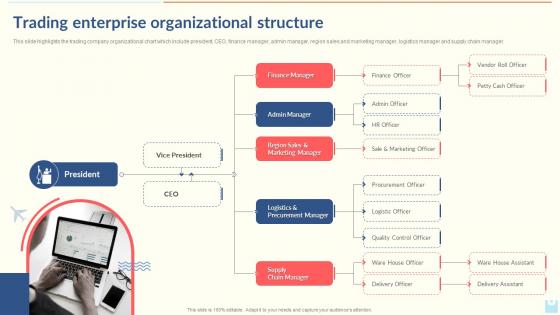
This slide highlights the trading company organizational chart which include president, CEO, finance manager, admin manager, region sales and marketing manager, logistics manager and supply chain manager.
People who downloaded this PowerPoint presentation also viewed the following :
Trading Enterprise Organizational Structure Export Company Profile with all 6 slides:
Use our Trading Enterprise Organizational Structure Export Company Profile to effectively help you save your valuable time. They are readymade to fit into any presentation structure.





FAQs for Trading Enterprise Organizational Structure
Dude, your org structure is literally make-or-break for trading ops. Clear roles mean traders aren't scrambling around asking "who approves this?" every five minutes. Info flows smooth between front office, middle office, risk teams - no bottlenecks killing your speed. I swear I've watched firms bleed money because their org chart looked like spaghetti and nobody knew their job. Fast execution wins in this game. Map out responsibilities and clean up those communication lines. Otherwise you'll miss opportunities while everyone's playing phone tag.
So basically you're giving your front-line traders and desk heads the power to make calls without waiting for approval from like three different bosses. Makes total sense honestly - markets move fast and by the time you get permission, that sweet opportunity is long gone. Your people can adjust positions and hedge risks instantly. The trick is setting solid risk limits upfront so everyone knows exactly what they can and can't do. Then just let them run with it. Way better than those painful approval chains that slow everything down.
So basically you've got CEO/Managing Director at the top, then division heads for Trading, Risk, Operations, Finance. Trading desk heads manage specific areas underneath them - like certain asset classes or regions. Individual traders and analysts report up through there. Support stuff like Compliance, IT, HR usually sits parallel to trading rather than under it. Risk management needs to report independently from trading though - that's pretty crucial. Honestly every firm does this differently depending on size and what they focus on. Some places are way more hierarchical than others. You should probably just ask someone there to walk you through their specific setup since it varies so much.
Dude, flat structures are a game changer in trading. No bureaucratic BS when you need to talk to a senior trader or PM - just walk over. Markets move crazy fast, so getting quick decisions matters way more than proper channels. You'll skip all that telephone game nonsense between management layers. Yeah, sometimes you get hit with too much info since there's less filtering, but honestly? Better than missing something important. Oh and the chaos during volatile sessions - way more manageable when everyone can just talk directly. Trust me, use those direct lines whenever you can.
Honestly, cross-functional teams are a game changer for execution speed. You're basically killing those stupid silos between risk, ops, and trading - no more waiting around for approval chains when markets are moving. Your traders can actually pivot quickly because compliance is already there giving input in real-time. Operations catches settlement issues before they become headaches too. It's wild how much smoother everything runs when people aren't playing telephone between departments. I'd start small though - just stick one risk analyst with your busiest trading team first. You'll see the difference immediately.
Dude, rigid hierarchies are absolutely brutal for trading. Every decision gets stuck waiting for approvals while the market keeps moving. Critical info crawls up the chain so slowly that by the time it reaches someone who can actually do something, the opportunity's gone. Plus different departments barely talk to each other - trading, risk, ops all doing their own thing when they should be working together. Oh and your best traders get frustrated because they can't make quick calls on smaller trades. If you're dealing with this mess, maybe set up some direct lines between key people and let your traders handle the routine stuff without asking permission first.
Honestly, tech changes everything about how trading companies work. AI handles the boring stuff automatically, so you don't need those massive trading floors anymore. Smaller teams can do way more complex work now with better data tools. Cloud systems are pretty sweet - your people can work from anywhere instead of being crammed into one office. Information moves so fast that junior traders basically have access to the same data as the veterans, which flattens out all that old-school hierarchy. Real-time decisions become possible too. I'd start by figuring out what manual tasks are just burning time for your team.
Don't get caught up in vanity metrics - focus on stuff that actually tells you if things are working. How fast can you make decisions and get approvals? That's huge. Track how quickly issues get resolved and whether teams are actually talking to each other. P&L obviously matters, but honestly, talent retention might be even more telling since good traders bail fast when the structure sucks. Also watch how your team handles market chaos - can they respond to volatility without losing their minds? Pick maybe 3 or 4 of these to start and get your baseline before changing anything.
So basically you want a Head of Trading calling the shots on strategy and P&L. Then break it down by whatever makes sense - asset classes, regions, whatever. Each desk needs a senior guy managing risk and teaching the newbies (seriously, so many places skip this part and wonder why everything's chaos). Operations and compliance leads who can actually make calls without running to mommy every five minutes - that's huge. Oh, and make sure everyone knows exactly what they're responsible for. When stuff hits the fan, you don't want people pointing fingers trying to figure out whose mess it is.
Old school trading floors are all about hierarchy - you know, everything goes through like three different managers before anyone can actually do anything. Takes forever. Modern setups are way flatter, traders get more freedom to make calls on the spot, and teams can actually talk to each other without jumping through hoops. Honestly, the traditional way just can't keep up anymore. Markets move too fast. When you've got cross-functional teams that can pivot quickly, you're not missing opportunities while waiting for some VP to sign off. If you're dealing with the old structure, push for direct lines between desks. Game changer.
Honestly, team specialization is kinda tricky. Your FX traders become absolute wizards with currency flows, and the derivatives guys know their market inside out - which is awesome. Problem is, everyone ends up in their own bubble. Like, the bond team might have killer insights that could totally flip your equity approach, but they're not talking to each other. You really need those regular check-ins between teams and tech that actually lets people share info easily. Otherwise you're missing huge opportunities when different desks should be connecting the dots. It's frustrating when you think about it.
Honestly, you gotta bake compliance into everything from day one. Have them report straight to the CEO so they can actually push back on sketchy trades. Front office traders need regular check-ins with compliance people - not just those awkward quarterly meetings everyone dreads. Too many places treat compliance like the fun police that everyone dodges. Build approval checkpoints right into your workflows and give compliance live access to trading data. Oh, and tie compliance violations directly to bonuses. Trust me, nothing changes behavior faster than hitting someone's wallet.
Look, your team culture basically determines whether traders blow up accounts or not. When people feel safe speaking up, they'll actually tell you about sketchy positions before things go sideways. But if everyone's scared of getting fired for mistakes? That's when you get traders hiding losses and praying for miracles - never works out well. Honestly, the teams that handle stress well and actually help each other tend to make way more money. You want people who can say "I screwed up" without fear. That psychological safety thing isn't just HR fluff, it shows up directly in your profits.
M&A is brutal - you can't just smoosh two trading desks together and hope it works. First thing? Map out your critical functions because revenue can't stop flowing. Then comes the messy part: cutting duplicate roles, picking which risk systems to keep, merging strategies without everything exploding. Everyone's gonna be fighting to prove they're essential while you're trying to run day-to-day ops. Most places end up with some weird hybrid structure that somehow works. Oh, and the politics will be insane, but honestly that comes after keeping the money machine running.
Dude, you absolutely need someone who won't panic when markets go crazy - decision-making under pressure is everything. Risk management skills are mandatory because one terrible call destroys you. Communication matters tons since they're juggling traders, analysts, and clients constantly. The pace is honestly nuts compared to other jobs, but that's the fun part I guess? Strategic thinking helps when markets flip overnight and leadership has to pivot fast. Oh, and try finding someone who's actually traded before - they get what your team deals with every day.
-
It is my first time working with them and that too on a friend's recommendation. I would say, I am not expecting such a worldly service at this low price.
-
I’ve been your client for a few years now. Couldn’t be more than happy after using your templates. Thank you!