

Organizational Structure For Smooth Business Operations Fashion Boutique Business Plan BP SS




Try Before you Buy Download Free Sample Product
 Impress Your
 Audience
 100%
100% Editable
 Save Hours
 of Time


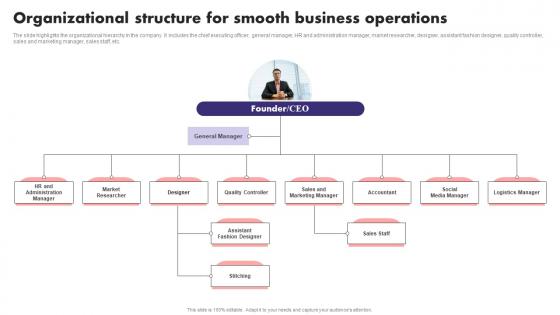
The slide highlights the organizational hierarchy in the company. It includes the chief executing officer, general manager, HR and administration manager, market researcher, designer, assistant fashion designer, quality controller, sales and marketing manager, sales staff, etc.
People who downloaded this PowerPoint presentation also viewed the following :
Organizational Structure For Smooth Business Operations Fashion Boutique Business Plan BP SS with all 9 slides:
Use our Organizational Structure For Smooth Business Operations Fashion Boutique Business Plan BP SS to effectively help you save your valuable time. They are readymade to fit into any presentation structure.








FAQs for Organizational Structure For Smooth Business Operations Fashion Boutique Business
Clear reporting lines are huge - people need to know who their boss is. Map out roles so there's no confusion about who's doing what. Don't make your hierarchy crazy complicated though, I've watched companies tie themselves in knots over this stuff. Communication has to flow both ways too. Your structure should actually fit your company size - like, why would a 20-person startup copy Google's org chart? Test it by seeing if decisions move smoothly. Oh and span of control matters - one manager shouldn't have 15 direct reports, that's just asking for chaos.
Honestly, flat structures are pretty great for engagement. You get way more autonomy and don't have to wait forever for approvals - like, actually being able to make decisions without going through three different managers first. Your ideas reach the top quickly, which feels amazing compared to those soul-crushing corporate hierarchies. Direct access to leadership means you're actually heard. Oh, and you'll probably get more interesting responsibilities since there's less role compartmentalization. The tricky part though? Career paths get murky. There's no clear "climb this ladder" situation, so you kinda have to focus on expanding your skills sideways instead of just moving up.
Your org structure totally shapes how decisions happen and who gets what info. Flat companies move faster - fewer people to run things by. But sometimes coordination gets messy. Hierarchies give you better oversight, though they're slow as hell when you need to pivot quickly. The real trick is matching your structure to the decisions you actually make day-to-day. I've seen too many companies where people spend half their time working around their own org chart just to get basic stuff done. That's when you know something's gotta change.
Honestly, hybrid is the way to go here. You keep your marketing team together for the deep expertise stuff, but then they can hop into those cross-functional project teams with engineering and sales when you're launching something big. Works really well for growing companies - you're not stuck being super rigid about everything. Plus you get efficiency from people staying in their lanes, but also flexibility when complex projects pop up that need everyone involved. I'd start by figuring out which teams need to stay stable versus which projects would actually benefit from mixing people up.
Ugh, functional structures can be such a pain. Each department turns into its own little bubble, so getting anything done across teams takes forever. Decision-making crawls because everything has to bounce up and down the hierarchy. People end up super specialized but kinda narrow in their skills - which isn't always great. Customer needs? They get totally lost as requests ping-pong between departments. Cross-functional projects are the worst for this. My advice would be regular cross-department meetings or maybe dedicated project teams. It's annoying to set up initially, but breaks down those stupid silos.
So here's the thing - culture totally changes how you should set up your team. Some cultures are super comfortable with strict hierarchies and clear bosses, while others work better when everyone's more equal. You've got cultures that want to discuss everything to death before deciding (which can be... a lot), and others where people prefer individual ownership. The trick is actually looking at who's on your team and what feels natural to them. Don't just copy what some other company does because it sounds impressive. What works for a Silicon Valley startup might bomb with your crew.
Honestly, start with how fast decisions get made - if approvals are taking forever, that's your first red flag. Employee engagement scores tell you a ton too since people hate working in messy structures. I'd track turnover by department because that usually shows problems way before they blow up. Communication flow is another big one, plus basic stuff like productivity per person. Oh and span of control ratios if you're feeling fancy. Don't overthink it though - pick maybe 3 metrics that actually matter for your goals and check them every quarter. You'll spot the patterns pretty quick.
Dude, it's all about who can actually talk to who without jumping through hoops. Those old-school hierarchies? Total nightmare when you need a quick answer - everything crawls up the ladder and back down. Flat structures are way better for speed since people just... talk to each other directly. Though sometimes it gets messy figuring out who's actually in charge of what (learned that one the hard way). Matrix stuff tries to split the difference but honestly just confuses everyone. I'd say look at how info actually flows in your place and see if the structure's screwing it up.
So matrix structures are actually pretty smart - you get specialists from different departments working on projects together. Resource sharing becomes way easier, and people pick up skills outside their usual area. Honestly, I think it's one of the better ways to break down those annoying departmental walls that slow everything down. Quick pivots happen when market stuff changes too, which is huge. Your employees get exposed to different managers and projects, so they grow faster. Just... seriously make sure everyone knows who they're reporting to on each project. That's where I've seen it go sideways.
Dude, having a solid org structure is a game-changer for onboarding. New people can actually see where they belong and who they're working with instead of wandering around lost. Map out those reporting lines and show them how departments connect - saves everyone headaches on day one. Training gets way more targeted too since you know exactly what skills each level needs. No more boring generic programs that help nobody. Oh, and you can assign clear mentors at each stage. Honestly wish more companies did this right. Just make some visual charts and role docs before your next hire shows up.
Honestly, restructuring can totally tank morale if you mess it up. People get stressed when they don't know if they'll still have a job next month. Productivity goes down the drain because everyone's just worried instead of actually working. But here's the thing - good communication changes everything. Be upfront about why stuff is changing. Get your team involved in decisions when you can. I've seen it work where people actually felt better about changes because they understood the reasoning behind it all. Just don't spring surprises on people and give them time to adapt.
Yeah, so companies totally shape their org charts around what actually matters for their success. Tech goes flat with mixed teams - gotta move fast and innovate, right? Manufacturing sticks with the classic hierarchy since they need tight quality control. Healthcare's all about functional divisions because you can't have a cardiologist doing neurosurgery (obviously). Financial firms love those matrix setups to juggle compliance and clients, though honestly that gets messy with everyone reporting to like three different people. Just look at what your competitors are doing - there's usually a pattern that makes sense for your industry's specific headaches.
Honestly, communication is gonna be your biggest headache. Video calls just aren't the same - you miss all those random conversations that actually fix stuff. Time zones will make you want to pull your hair out. Performance management gets weird when you can't see what people are up to, and your culture starts falling apart without everyone being together. Some folks will feel super isolated too. I'd say over-communicate like crazy and do regular check-ins with everyone. Oh, and those spontaneous brainstorming moments? Yeah, those basically disappear.
Honestly, remote work tools completely changed the game - teams can collaborate instantly from anywhere now. Slack and similar apps basically flattened those old corporate hierarchies (remember when you had to email your boss's boss?). Cloud platforms mean you're not tied to a desk anymore. What's really cool is how project management software lets you build temporary teams for specific projects, then break them apart when you're done. No more being stuck in the same department forever. AI handles the boring stuff now, so people can focus on actual strategy. My advice? Start by figuring out where communication gets stuck in your company, then find tools to fix those specific problems first.
Your leader's style basically dictates how the whole company gets set up. Autocratic types? They love those old-school hierarchies with everyone knowing exactly who's boss. Democratic leaders usually go for flatter structures where people actually get to weigh in on decisions. Then you've got transformational leaders who create these matrix setups that sound cool but honestly can turn into total chaos if someone's not keeping track of who reports to whom. Oh, and here's the thing - fighting your leader's natural tendencies with the wrong structure is just asking for headaches.
-
Attractive design and informative presentation.
-
Fantastic collection of visually appealing PowerPoint templates. They certainly uplift the look of the presentation.