


Governance Structure Powerpoint Presentation Slides





Try Before you Buy Download Free Sample Product
 Impress Your
 Audience
 100%
100% Editable
 Save Hours
 of Time


Slide Team presents you Governance Structure PowerPoint Presentation Slides for project scope management. The project governance PowerPoint complete deck includes set of ready to use slides such as project brief and description, project management lifecycle, project process, risk identification, risk management report, project team, budgeting and time management, timeline, work breakdown structure, activities sequence, project risk and communication plan cost and human resource management, quality management and progress summary etc. It has templates with professional background images and relevant content. Demonstrate project status report planned and actual performance comparison, project health card with project structure and governance framework PowerPoint templates. Showcase roles and responsibilities and work plan using governance framework PPT visuals. Outline all the important aspects without any hassle. The presentation can be used as a project management tool to enhance the knowledge of your team. Download governance structure Presentation design for project execution and task management.
People who downloaded this PowerPoint presentation also viewed the following :
Content of this Powerpoint Presentation
Slide 1: This slide introduces Governance Structure with imagery.
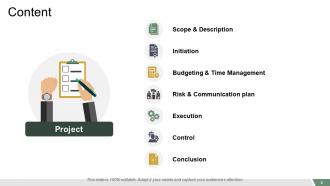
Slide 2: This is a Content slide showcasing- Scope & Description, Initiation, Budgeting & Time Management, Risk & Communication plan, Execution, Control and Conclusion.
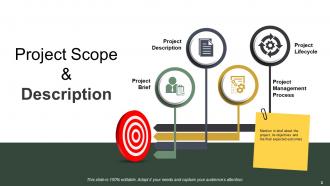
Slide 3: This slide shows Project Scope & Description. Describe project nuances like Project Brief, Project Description, Project Lifecycle, Project Management Process etc. here.
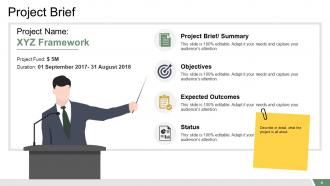
Slide 4: This slide displays Project Brief in Governance Structure. It includes Project name and the entire framework. The framework description includes Project Brief Summary, Objectives, Expected Outcomes and Status of the Project. It also showcases Project Fund and Project Duration.
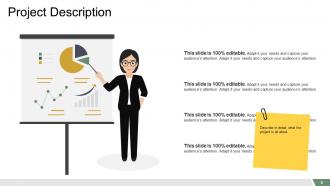
Slide 5: This slide shows Project Description. It also presents female showing charts and graphs and text boxes for you to provide a detailed explanation of your project.
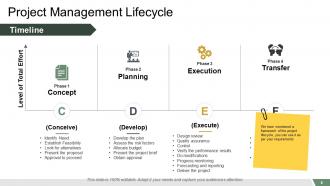
Slide 6: This slide presents Project Management Lifecycle and its phases in a timeline form. We have also mentioned a framework of the project lifecycle which you can use as per your requirements.
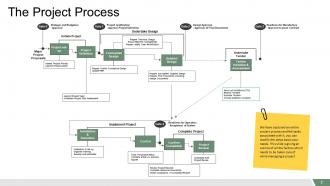
Slide 7: This slide shows The Project Process outline of all the factors which needs to be taken care of while managing a project. Every aspect of the project is stated here along with the tasks and steps. You can modify these steps as per your requirement.
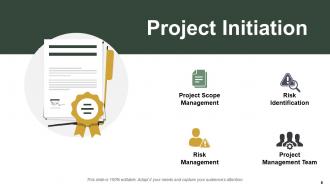
Slide 8: This is a Project Initiation slide showing the following aspects. Project Scope Management, Risk Identification, Risk Management, Project Management Team. It also shows icons of each of these aspects.
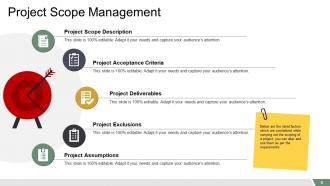
Slide 9: This slide shows Project Scope Management factors such as- Project Deliverables, Project Assumptions, Project Exclusions, Project Scope Description, Project Acceptance Criteria. You can alter and use them as per the requirements.
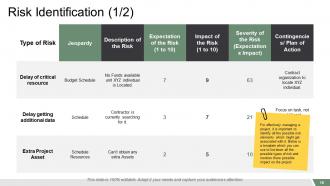
Slide 10: This is a template slide showing Risk Identification. Use it to list down all the possible types of risk and mention their possible impact on the project.
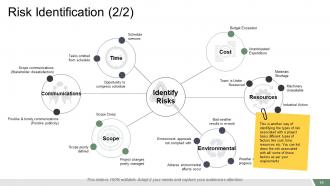
Slide 11: This slide covers Risk identification in terms of Time, Cost, Resource, Communication, Scope and Environmental factors. Each of these points further contains sub points as mentioned.
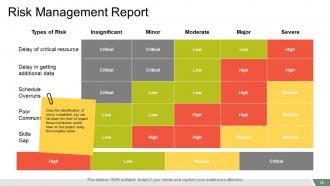
Slide 12: This slide shows Risk Management Report. This report mentions the types of risk and the risk associated with each of them on the basis of Insignificant, Minor, Moderate, Major and Severe parameters.
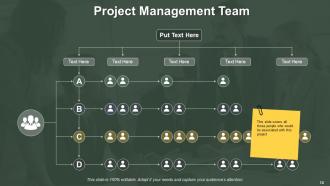
Slide 13: This slide shows Project Management Team with four rows and text boxes which can be used to describe the entire team.
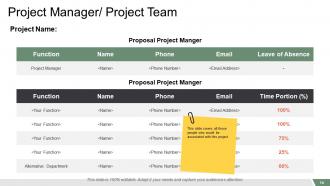
Slide 14: This slide contains the detailed variation of the Project Management Team. It displays Proposal/Project Manager’s function, name, phone, email and leave of absence (if any). It also displays the same for the team with an additional sub heading of Time portion allotted for the team members.
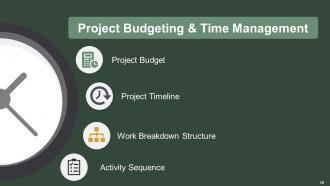
Slide 15: This slide shows the following factors of Project Budgeting & Time Management- Project Budget, Project Timeline, Work Breakdown Structure, Activity Sequence.
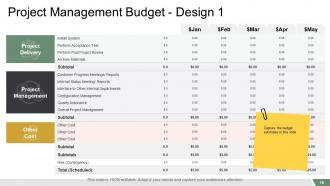
Slide 16: This slide shows the very first Project Management Budget Design to capture your budget estimates efficiently.
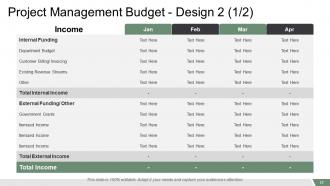
Slide 17: This slide shows the second Project Management Budget Design with Income in terms of months.
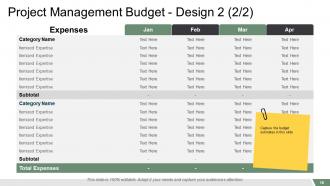
Slide 18: This slide shows the second Project Management Budget Design covering your monthly expenses.
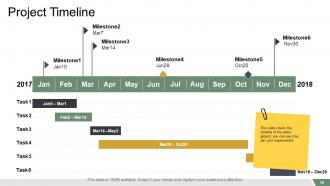
Slide 19: This slide shows the Project Timeline to add milestones. You can use it as per your requirements.
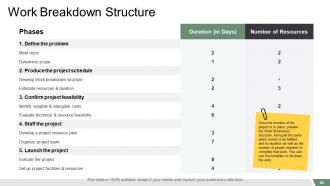
Slide 20: This slide shows Work Breakdown Structure. Once the timeline of the project is in place, prepare the Work Breakdown structure, listing all the tasks which needs to be fulfilled and its duration as well as the number of people required to complete that work. You can use this template to list down the work.
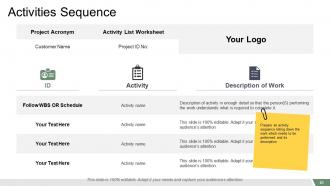
Slide 21: Prepare an Activity Sequence using this slide listing down the work which needs to be performed and its description.
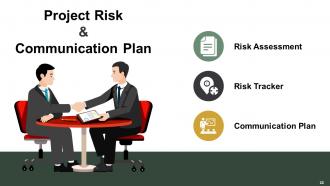
Slide 22: This slide shows Project Risk & Communication Plan with- Risk Assessment, Risk Tracker, Communication Plan.
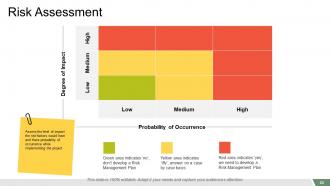
Slide 23: This slide shows Risk Assessment level using a matrix with high, low and medium parameters.
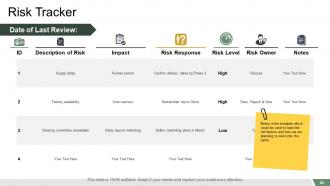
Slide 24: This slide presents a Risk Tracker. It can be used to track the risk factors and how you are planning to overcome the same.
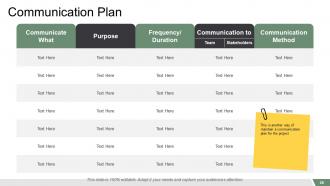
Slide 25: This slide shows a way to maintain Communication Plan.
Slide 26: This slide presents a detailed version of the Communication Plan which could be shared with the project team to list down there activities.
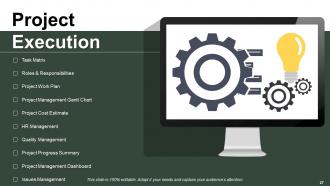
Slide 27: This is a Project Execution slide with Task Matrix, Roles & Responsibilities, Project Work Plan, Project Management Gantt Chart, Project Cost Estimate, HR Management, Quality Management, Project Progress Summary, Project Management Dashboard, Issues Management.
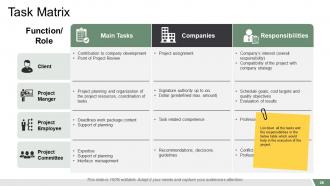
Slide 28: This slide presents a table tiled Task Matrix. List down all the tasks and the responsibilities in this table which would help in the execution of the project.
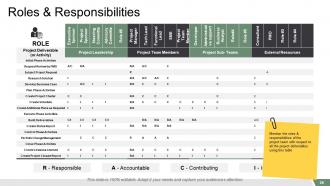
Slide 29: This slide shows Roles & Responsibilities. Mention the roles & responsibilities of the project team with respect to all the project deliverables by making use of the table provided.
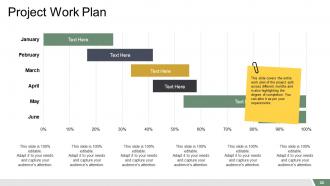
Slide 30: This slide covers the entire Project Work Plan split across different months. It also highlights the degree of completion which can be altered by you.
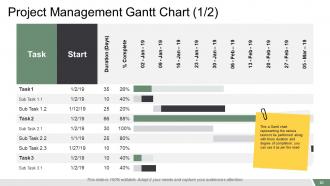
Slide 31: This slide shows Project Management Gantt Chart representing the various tasks to be performed along with their duration and degree of completion.
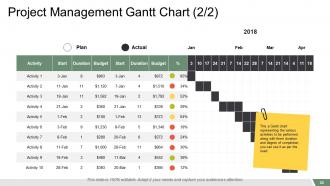
Slide 32: This slide also shows Project Management Gantt Chart. Use as per your requirement.
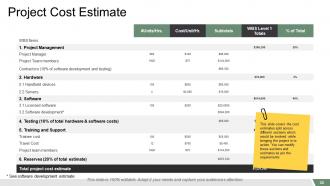
Slide 33: This slide shows Project Cost Estimate covering the cost estimates split across different sections which would be involved while bringing the project into action. You can modify these sections and estimates as per the requirements.
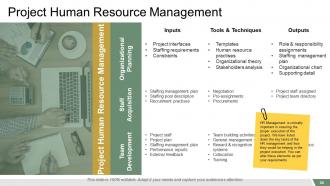
Slide 34: This slide shows Project Human Resource Management. HR Management is critically important in ensuring the proper execution of the project. We have listed the key tasks of the HR management and how they would be helping in the project execution. You can alter these elements as per your requirements.
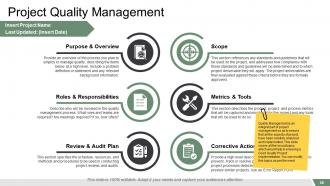
Slide 35: This slide shows Project Quality Management. Quality Management is an integral part of project management so as to ensure that all the aspects of project have been carefully analysed and implemented. This slide also covers all the broad topics which would help in ensuring a Good Quality Project implementation. You can modify these topics as per the need.
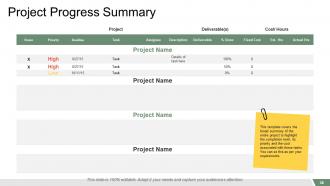
Slide 36: This is a template slide showing Project Progress Summary. It covers the broad summary of the entire project to highlight the completion level, its priority and the cost associated with these tasks. You can use this slide as per your requirement.
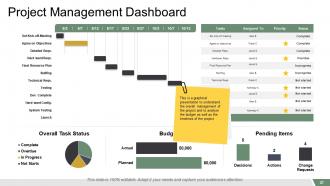
Slide 37: This slide shows a graphical representation of Project Management Dashboard to understand the overall management of the project and to analyse the budget as well as the timelines of the project. Use as per your requirement.
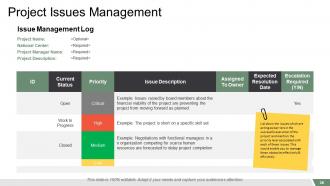
Slide 38: This is Project Issues Management slide showing Issue Management Log. List down the issues which are acting as barriers in the successful execution of the project and mention the priority level associated with each of these issues.
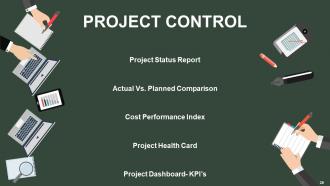
Slide 39: This is a Project Control slide showing- Project Status Report, Actual Vs. Planned Comparison, Cost Performance Index, Project Health Card, Project Dashboard- KPI’s.
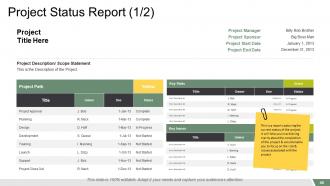
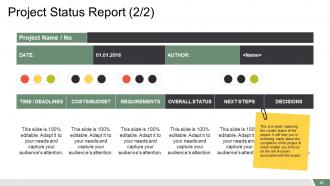
Slide 40: This slide showcases Project Status Report. This is a report capturing the current status of the project. It will help you in achieving clarity about the completion of the project & would enable you to focus on the risk & issues associated with the project.
Slide 41: This slide also shows Project Status Report with Project Name / No mentioned.
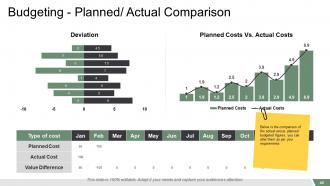
Slide 42: This slide shows Budgeting - Planned/ Actual Comparison in charts and graphs form. You can alter them as per your requirements.
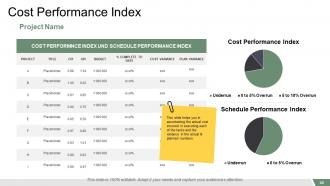
Slide 43: This slide presents Cost Performance Index. This slide also helps you in ascertaining the actual cost incurred in executing each of the tasks and the variance in the actual & planned numbers.
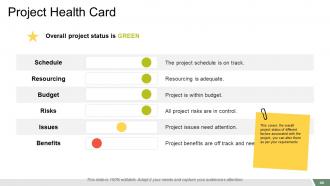
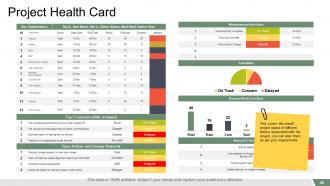
Slide 44: This slide displays a Project Health Card showing- Schedule, Resourcing, Budget, Risks, Issues, Benefits. This covers the overall project status of different factors associated with the project, you can alter them as per your requirements.
Slide 45: This slide also shows Project Health Card. Use as per your requirement.
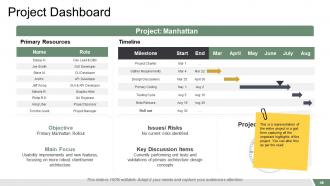
Slide 46: This slide shows a Project Dashboard. This is a representation of the entire project in a gist form capturing all the important highlights of the project. You can alter this as per your need.
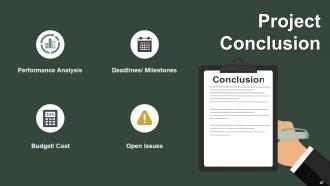
Slide 47: This slide presents Project Conclusion with- Deadlines/ Milestones, Performance Analysis, Budget/ Cost, Open Issues.
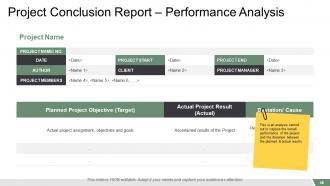
Slide 48: This slide shows Project Conclusion Report – Performance Analysis. This is an analysis carried out to capture the overall performance of the project and the deviation between the planned & actual results.
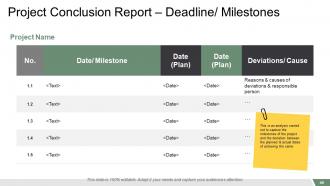
Slide 49: This slide shows Project Conclusion Report – Deadline/ Milestones This is an analysis carried out to capture the milestones of the project and the deviation between the planned & actual dates of achieving the same.
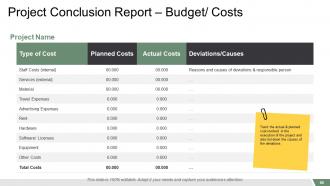
Slide 50: This slide displays Project Conclusion Report – Budget/ Costs Track the actual & planned cost involved in the execution of the project and also list down the causes of the deviations.
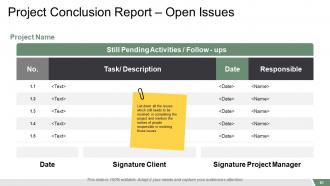
Slide 51: This slide shows Project Conclusion Report – Open Issues, Date, Signature Client, Signature Project Manager. List down all the issues which still needs to be resolved in completing the project and mention the names of people responsible in resolving those issues.
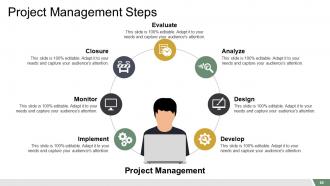
Slide 52: This slide shows Project Management Steps which include- Closure, Monitor, Implement, Develop, Design, Analyze, Evaluate.
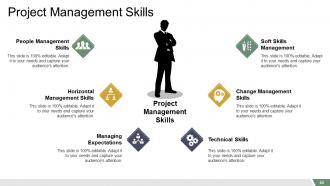
Slide 53: This slide shows Project Management Skills- People Management Skills, Soft Skills Management, Horizontal Management Skills, Change Management Skills, Managing Expectations, Technical Skills.
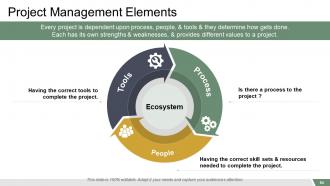
Slide 54: This slide shows Project Management Elements in a circular arrow image form.
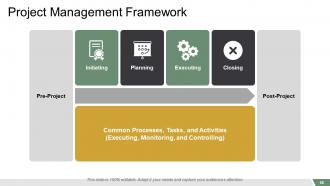
Slide 55: This slide shows the Project Management Framework divided into two categories- Pre-Project, Post-Project. It also shows the steps included under each of the category Initiating, Planning, Executing and Closing.
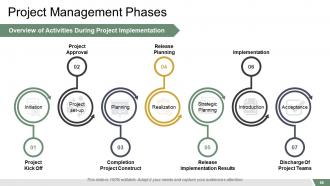
Slide 56: This slide shows Project Management Phases.
Slide 57: This is a Governance Model Icon Slide. Alter as per need.
Slide 58: This slide is titled Additional Slides to move forward. You can change the slide content as per need.
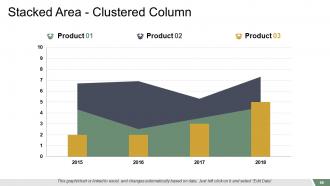
Slide 59: This slide represents a Stacked Area - Clustered Column charts for the products to compare.
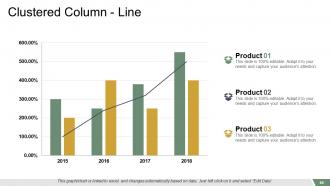
Slide 60: This is a Clustered Column - Line slide to present product/ entity comparison, specifications etc.
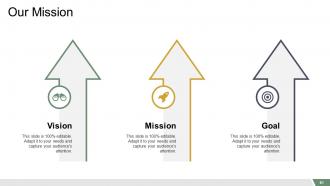
Slide 61: This slide represents Our Mission. It also shows three arrows further showing mission, goals and vision.
Slide 62: This is an About Us slide where you can show-Professional, Creative or Talented aspects of your company.
Slide 63: This is a Mind Map image slide to show behavioural segmentation, information or anything relative.
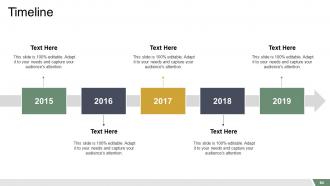
Slide 64: This is a Timeline slide to present important dates, journey, evolution, milestones etc.
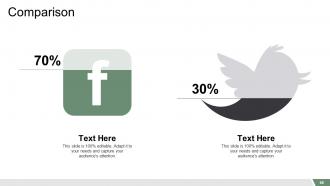
Slide 65: This is a Comparison slide to compare product/ entities etc.
Slide 66: This is a Thank You image slide with Address, Email and Contact number.
Governance Structure Powerpoint Presentation Slides with all 66 slides:
Act to ensure a fair chance for all with our Governance Structure Powerpoint Presentation Slides. It helps address inequality.



FAQs for Governance Structure
Honestly, start by figuring out who makes what decisions - that's your foundation. You'll need solid oversight with the right board mix and committees for audit/risk stuff. Communication has to flow both ways though, or everything breaks down (learned that one the hard way at my last job). Clear roles are huge, plus accountability frameworks so people can't just wing it. Performance reviews keep everyone on track. The transparency piece is tricky but worth it. Map out responsibilities first, then build your reporting structure around that.
So basically, governance is all about who makes decisions and how quickly stuff happens. Boards and execs handle the big strategic moves - that can drag on for months honestly. Middle managers deal with budgets and project priorities, which involves some back-and-forth but moves faster. Day-to-day operations? That's usually up to frontline teams, though some companies micromanage everything (super annoying). The trick is figuring out where your decision sits in the food chain. Then you'll know who to talk to and whether you're waiting weeks or days for an answer.
Look, stakeholder engagement isn't just some box to tick - it literally shapes your whole governance setup. Getting people involved from the start means you'll hear what actually works instead of building something that only sounds good in theory. Here's the thing though: most companies totally underestimate who their stakeholders are. Map out everyone who's affected (probably way more people than you first think). Give them real ways to contribute during development, not just at the end. Trust me, people will actually support frameworks they helped build rather than ones dumped on them.
Look, you've gotta bake flexibility into your governance from day one. Agile decision-making, cross-functional tech committees - that stuff matters. Ditch the annual review nonsense and do them quarterly or even monthly. Get board members who actually know tech (shocking concept, right?). Fast-track approval processes are clutch for digital initiatives that can't wait six months. Also set up clear triggers that automatically kick off governance updates when major tech shifts happen in your space. The "set it and forget it" days are over, honestly.
Oh man, you're in for it! Cultural stuff will drive you nuts - what kills it in New York totally flops in Tokyo. Time zones make communication a nightmare. Each country has their own regulations too, which gets expensive fast when you're juggling multiple frameworks. Reporting standards? Good luck getting everyone on the same page. You need centralized control but also local flexibility, and honestly that balance is tricky as hell. My take? Build something flexible from day one that adapts regionally. Also - and this might sound obvious - but seriously invest in cross-cultural training for your teams.
Look, your governance setup is everything when it comes to risk management. Strong reporting lines mean people actually do their compliance work instead of just checking boxes. When governance is messy, everything falls apart - and trust me, that's awkward when auditors walk in. The board decides your risk appetite, then that trickles down through committees to department heads. They're the ones monitoring what risks you'll accept. Here's what matters: figure out who's responsible for each type of risk and give them real power to fix problems when they pop up.
Honestly, start with getting crystal clear on who makes what decisions - that's where most companies totally mess up. Regular board evaluations help too, and you want different types of people at the table, not just the usual suspects. Make sure your risk management isn't some separate thing you do once a year (huge mistake). Communication between leadership levels matters more than people think - silos will wreck everything fast. Oh, and create reporting that people actually read instead of just shoving in a drawer. I'd probably audit how decisions get made right now and see where things are getting bottlenecked.
Dude, this is actually super interesting stuff. Cultural differences totally reshape how companies do governance globally. Japanese firms are all about that consensus-building vibe on their boards, while Americans just give their CEOs way more power. Germany does this weird thing where they put workers on boards - which honestly sounds pretty cool but would freak out other cultures. Your "normal" way of running things might be completely wrong in another country. So when you're setting up global operations, figure out what each culture expects first. Don't just copy-paste the same structure everywhere because it'll backfire.
You'll need both hard numbers and softer measures to see if your governance is actually working. Track decision-making speed - like how long from idea to approval. Check compliance rates and if you're hitting strategic goals on time. Meeting attendance matters too, but honestly, quality of participation is way more telling than just butts in seats. Nobody learns anything from zombie board members! Transparency stuff like info access and communication effectiveness are worth measuring. But here's the thing - don't go overboard. Pick 3-4 metrics that match what you're trying to achieve. Start with whatever's easiest to track consistently, then build from there.
Honestly, start by mapping out who reports to whom - that's your foundation right there. Regular board meetings with actual agendas and minutes you can find later (not buried somewhere ridiculous). Document decisions and share them with stakeholders through formal channels. Conflict of interest policies are huge, plus independent oversight if you can swing it. Performance reviews and external audits should happen regularly too. The whole thing falls apart without clear communication flowing where it needs to go. Make information accessible. Structure first, then transparency follows naturally.
So boards of directors are basically the company's watchdogs - they set strategy, oversee management, and keep executives accountable to shareholders. To judge if they're doing their job well, look at whether they actually challenge management instead of just nodding along to everything. Diverse expertise helps a lot too. Meeting frequency matters, but honestly, quality of those meetings is way more important. The really good boards aren't afraid to ask uncomfortable questions or push back when things aren't working. Check their recent decisions against actual business results - that'll tell you everything.
Look, first thing - map out what you're actually trying to accomplish, then figure out who needs to be making which decisions. Your board should have people who get your strategy (like if you're going digital, maybe don't stack it with old-school industry vets... though experience obviously counts). Set up committees around your big strategic areas. Create accountability stuff that connects back to your main goals. And honestly? Design reporting that lets you move fast instead of getting buried in bureaucracy. The whole point is making governance work FOR your strategy, not against it.
Dude, regulators basically run the show when it comes to how companies set up their boards. Public companies need audit committees because of SOX. Banks have to create risk management boards. Healthcare orgs build clinical governance - energy companies get stuck with environmental oversight stuff. It's kinda crazy how much control they have over org charts, honestly. But here's what kills me: companies think they can just slap on some compliance roles and call it done. Wrong move. You've gotta weave this stuff into actual decision-making, or when regulators show up, you're toast.
Boards are totally changing how they make decisions because of all this CSR pressure. They're adding ESG committees, tying exec pay to social metrics, and demanding regular impact reports. Honestly, the speed of this shift is crazy - like, three years ago most boards barely touched this stuff. You need to build clear accountability chains for CSR and actually get stakeholder voices into your decision-making process. Create metrics that track social outcomes, not just profit margins. My advice? Start with auditing your current board setup against what's expected now. Don't wait on this one.
Think of good governance like having clear house rules when you live with roommates - everyone knows who does what and how decisions get made. No more "wait, who's supposed to handle this?" moments that kill momentum. Your stakeholders actually trust you because they can see what's happening. I've watched so many companies implode just from unclear roles (it's honestly painful to watch). Short sentences work. Longer ones help you maintain standards over time instead of constantly putting out fires. Map out who currently makes decisions and you'll probably spot the gaps pretty quickly. Game changer for any org.
No Reviews