

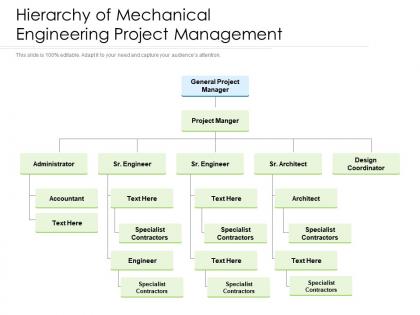
Hierarchy of mechanical engineering project management




Try Before you Buy Download Free Sample Product
 Impress Your
 Audience
 100%
100% Editable
 Save Hours
 of Time


Our Hierarchy Of Mechanical Engineering Project Management are topically designed to provide an attractive backdrop to any subject. Use them to look like a presentation pro.
People who downloaded this PowerPoint presentation also viewed the following :
Hierarchy of mechanical engineering project management with all 2 slides:
Use our Hierarchy Of Mechanical Engineering Project Management to effectively help you save your valuable time. They are readymade to fit into any presentation structure.
FAQs for Hierarchy of mechanical
Look, hierarchy basically means everyone knows who's boss and who makes the calls. Prevents total chaos when decisions need to happen fast. Yeah, it can feel stuffy sometimes, but honestly? During a crisis, you'll be grateful someone's actually in charge. Communication flows better up and down, roles are clearer, less "wait whose job is this?" moments. The trick is balance though - too flat and decisions drag forever, too many layers and creative ideas die a slow death. I'd map out your current setup and spot where things get bottlenecked. Trust me on this one.
Okay so visual hierarchy is basically about making your audience look at the important stuff first. Size, color, and where you put things - that's what guides people's eyes. I hate presentations where everything screams for attention equally, you know? Makes my brain hurt. Your main points should pop while the supporting details chill in the background. Bigger headlines, bright colors for key info, white space so things can breathe. Pick your top 3 points and make those way more obvious than everything else. It's honestly game-changing once you get it right.
So there's basically three main types you'll run into. Functional is the classic one - everyone's grouped by department like marketing or finance, pretty straightforward chain of command. Matrix gets weird because you end up reporting to like 2-3 different managers, which honestly sounds like a nightmare but apparently works well for big projects. Flat hierarchy cuts out most of the middle management layers so stuff actually gets decided quickly. Most companies mix and match these anyway. But yeah, definitely figure out what yours does early because it changes everything about how you actually get shit done there.
Dude, culture totally changes how people see authority. Japanese and Mexican workplaces? Super formal, you don't question the boss. But places like Denmark or Australia are way more chill about challenging higher-ups. I noticed this working with international teams - some people freeze up around managers while others treat them like buddies. Your upbringing matters too. Some see hierarchy as keeping things organized, others think it's just power tripping. When you're managing mixed teams, you gotta read the room and adjust your approach accordingly.
So hierarchy controls who decides what and how quickly stuff gets done. Most places handle day-to-day decisions at lower levels, but big strategic stuff goes up to senior people. Here's the thing though - too many layers and you're waiting forever for approvals (I've literally seen simple requests bounce around for weeks). But cut too much structure and teams start making random conflicting choices. You want decisions made as low as possible while keeping clear paths for when things need to go up. Just figure out who should own what decisions on your team and you'll save yourself tons of headaches.
Size matters for hierarchy - make your headers way bigger than body text. Put your main point up top, then stack supporting details underneath. Bold colors or boxes help key points pop. I learned this the hard way after bombing a presentation last year lol. White space saves you from cramped, messy slides. Indent related ideas so they look connected. Here's a quick test: glance at your slide for 3 seconds. Can you instantly see what's most important? If not, keep tweaking the visual flow until it clicks.
Honestly, org charts are your best bet - Lucidchart or even PowerPoint can handle those no problem. Tree diagrams work really well too, especially if you're mapping out decisions or categories. I'm totally obsessed with pyramid diagrams when you need to show authority levels. Oh, and nested boxes are pretty sleek if you want something modern-looking. Sometimes I just use indented lists with different font sizes because I'm lazy like that. Really depends what you're working with though. Pick whatever won't confuse people - there's nothing worse than a diagram that makes everyone squint and tilt their heads.
Okay so flat structures are great for fast innovation and people actually talking to each other. But hierarchies? They give you clear accountability and everyone knows their role. The problem is when it gets too rigid - people start thinking they can't share ideas without going through five layers of management first, which is honestly such a waste. What really matters is whether your leadership actually wants to hear from everyone or just pretends they do. Even in a steep hierarchy, if there's psychological safety and people feel heard, it works way better. Structure matters less than culture, tbh.
Honestly, the worst thing you can do is go more than 3-4 levels deep - people just bail at that point. I see this all the time where similar stuff gets scattered everywhere because there's no consistent logic. Mobile users especially hate digging through endless nested menus. Your category names need to be crystal clear so people aren't sitting there wondering "wait, does this go here or there?" But here's the thing - not everyone thinks the same way. Some folks want to search, others browse by tags. Always throw in breadcrumbs and search as backup options because your perfect hierarchy won't match how everyone's brain works anyway.
Honestly, you want transparency without turning everything into a free-for-all. I've watched "flat" organizations become total disasters because nobody knew who was actually making decisions. Build real channels for input - skip-level meetings, anonymous feedback, let junior people run some projects. Your leaders should explain their thinking, not just hand down orders. Also set up cross-functional teams where hierarchy matters less. The whole point is amplifying good ideas no matter who has them. Start by looking at your current meetings - who's actually talking? Work backwards from there to fix the quiet spots.
Honestly, just start modeling what you want to see in your own team - flatten decision-making, encourage people to disagree with you, promote the good performers over the long-timers. Push for communication that skips the usual gatekeepers. I've actually seen leaders rearrange office layouts to break down barriers (sounds dumb but it totally works). Champion different voices in meetings. Create cross-functional teams that blur those departmental lines. The thing is, you've gotta be patient - these hierarchies didn't build overnight and they won't crumble fast either. Start small, then expand your influence upward.
So basically, hierarchies aren't stuck being these rigid pyramids anymore. Tech's making them way more fluid - structures can flatten or expand based on real-time data, and AI handles tons of decisions automatically. Spotify does this cool thing where it creates temporary hierarchies from your listening habits (kind of blows my mind honestly). Your org can actually respond to data instead of being carved in stone. Start small though - just look for routine decisions where automation could take over some of the hierarchical stuff you're doing now.
Honestly, the trick is setting up feedback that goes every direction - not just top-down. Regular one-on-ones are clutch, plus anonymous suggestion boxes (I know, sounds old school but they work). Skip-level meetings help too so stuff doesn't get filtered out by middle management. 360 reviews are amazing but yeah, total nightmare to organize. Most important thing? Train your managers not to get all defensive when they hear criticism. Oh, and actually DO something with the feedback you collect - people can smell BS from a mile away if you're just going through the motions.
Honestly, just copy what Steve Jobs did with iPhone launches - dude was a master at this stuff. He'd always start big picture ("we're making history today"), then get into the actual features, and finish with live demos. Simon Sinek does something similar in his TED talks, moving from concept to real examples. McKinsey follows the same pattern too - executive summary up front, then all the supporting data. The whole thing basically comes down to: lead with your main point, back it up with proof, then tell people what's next. Map out your presentation that way and you'll be golden.
So flattening hierarchies is just cutting out management layers - fewer people sitting between you and the big bosses. Decision-making gets way faster since you're not waiting for approval from like three different managers. Employees get more freedom to actually fix stuff themselves. Communication improves too because there aren't as many people playing telephone with your ideas. The catch? Some people totally freak out without clear boss-employee chains - honestly feels like chaos at first. If your company's doing this, work on those peer relationships and get comfortable making calls without constantly running upstairs for permission.
-
Professional and unique presentations.