

 0 Comment
 Customer Reviews

The meeting's on the calendar. Someone has to explain why the numbers don't match.
Not the data—the data's probably fine. But somewhere between the source system and the executive dashboard, something got lost. A join that didn't quite work. A transformation nobody documented. A pipeline that ran at 2 AM and nobody checked the logs.
Data warehouse projects have this specific failure mode. The infrastructure gets built. The ETL jobs run. The reports load. And then someone asks a simple question—"where does this number come from?"—and the room goes quiet.
It's not a technology problem, mostly. It's a communication problem. And it compounds. Because the people who know the architecture can't always explain it. And the people who need to trust the data can't verify it themselves.
That gap—between how a data warehouse actually works and how it gets presented to stakeholders—is where things go wrong. Business intelligence solutions don't fail because of bad queries. They fail because teams can't get everyone aligned on what's being built, why, and how to trust the outputs.
Governance frameworks, data modeling techniques, cloud migration plans, scalability decisions—all of this eventually has to be communicated. In a meeting. To people who didn't build it. With slides.
That's why pre-designed frameworks exist. Not because data architects can't build decks from scratch—they can—but because the structure of the conversation matters as much as the content. A well-organized slide on data warehouse architecture or ETL best practices does something a whiteboard sketch can't: it forces the argument into a format other people can actually follow.
SlideTeam's data warehouse practices templates handle exactly this. Ready-made layouts for implementation roadmaps, architecture overviews, security compliance, cloud deployment, and more—so you're not starting from a blank slide when the meeting's tomorrow.
Here are the templates that cover the ground that matters.
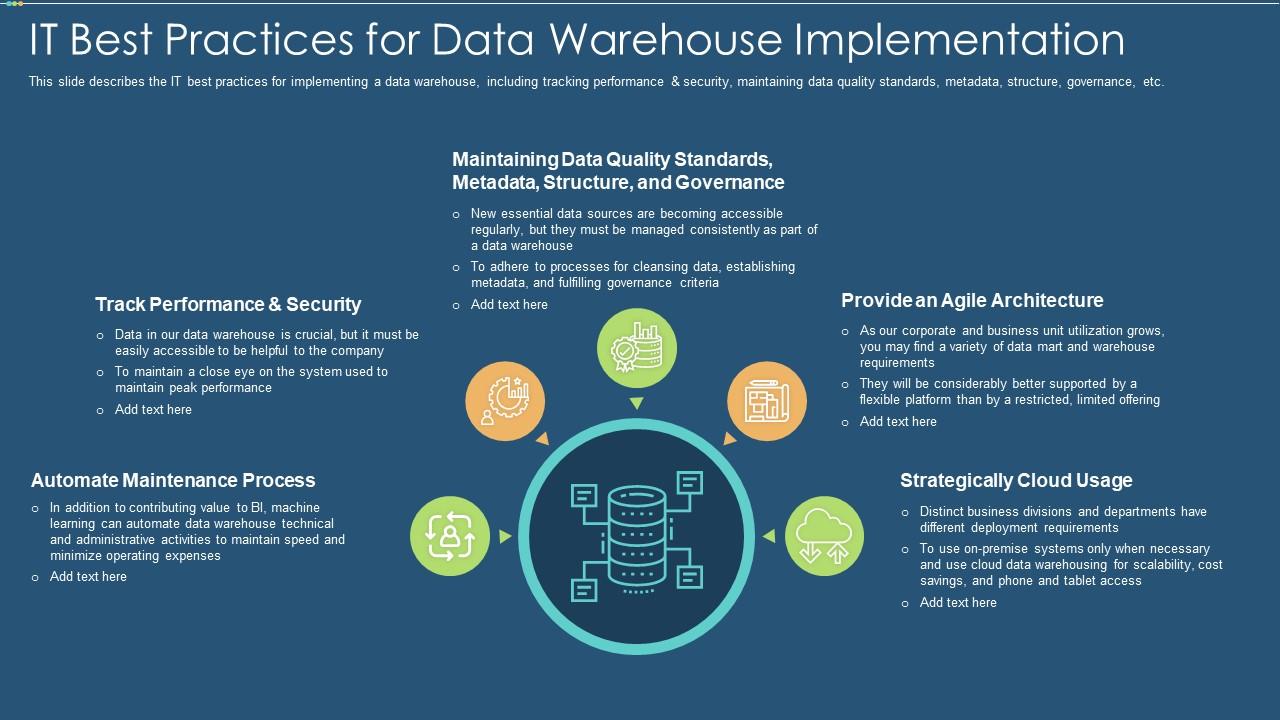
Template 1: Data Warehouse IT Best Practices for Data Warehouse Implementation
Implementing a data warehouse without clear IT guardrails tends to unravel quickly. This PowerPoint slide is built for IT architects and data leads who need to present governance structures credibly. It covers five core practice areas: performance and security tracking, maintenance automation, strategic cloud usage, agile architecture, and data quality standards. Whether you're presenting to a CIO or aligning an internal team, this PPT gives the conversation a solid, structured frame. The template is 100% editable and customizable.
Download this PowerPoint Template
Template 2: Data Warehouse Best Practices Staging and User Layers PPT Designs
Staging and user layers are where most data warehouse implementations either hold together or quietly break down. This PPT template is designed for data engineers and analytics managers who need to visualize how raw data moves through staging before it reaches end users. It's a practical slide for architecture reviews, sprint planning, or stakeholder walkthroughs of data flow. For more structured frameworks on this topic, explore SlideTeam's data warehouse best practices blog for additional context. The template is 100% editable and customizable.
[product_image id=1574494]
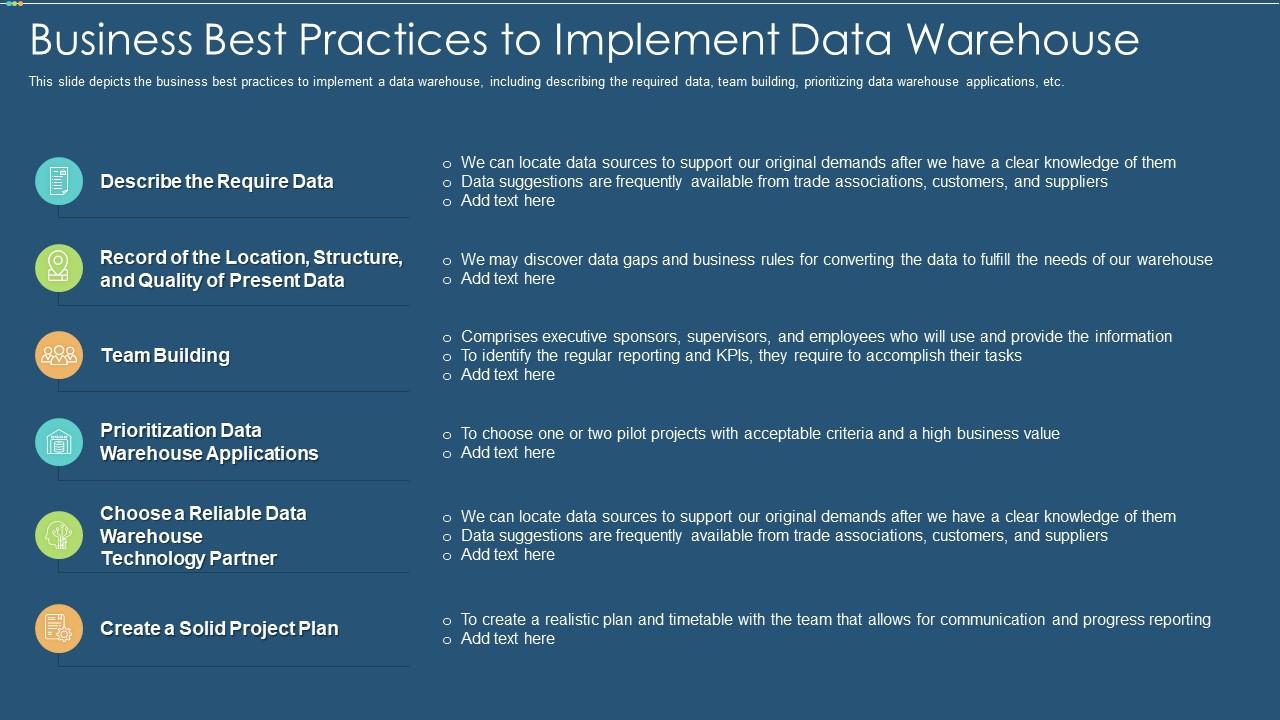
Template 3: Data Warehouse IT Business Best Practices to Implement Data Warehouse
Getting business buy-in for a data warehouse build requires more than a technical pitch. This PPT preset is built for project leads and data managers presenting the business case for implementation. It walks through describing required data, recording data location and quality, team-building priorities, technology partner selection, and project planning. So, whether the audience is a steering committee or a cross-functional team, this slide keeps the conversation grounded and actionable. The template is 100% editable and customizable.
Download this PowerPoint Template
Template 4: Data Warehouse Architecture from Raw Data to End Users PPT Outline
Most stakeholders understand data flows better when they see the full journey—raw inputs to end-user outputs. This PPT template is built for data architects and BI leads presenting data warehouse architecture to mixed audiences. It maps the end-to-end pipeline visually, making it easier to explain where data enters, how it's transformed, and where it lands. A useful slide for architecture sign-offs, onboarding sessions, or executive briefings on data infrastructure. The template is 100% editable and customizable.
[product_image id=1574493]
Template 5: Data Warehouse Architecture Key Components and Their Functions PPT Mockup
Clarity on key components separates a credible data warehouse architecture presentation from a confusing one. This deck maps each architectural component to its specific function, giving your audience a clear mental model of how the system works. Visual precision ensures stakeholders understand dependencies without needing a technical background. You can tailor the structure to reflect your organization's specific Data Warehouse Architecture, saving hours of design time. Use this to anchor data strategy reviews, technical onboarding, or executive briefings with confidence. Transform your architecture presentations today. Download this dynamic template now and unlock sharper stakeholder alignment.
[product_image id=1837828]
Template 6: Data Warehouse Overview and Benefits PPT Guidelines
Before any data warehouse build gets funded, someone has to make the business case clearly. This deck is designed for analysts and data leads presenting the value of a data warehouse to leadership teams. It covers the core overview and business benefits in a format that's easy to follow without a technical background. For context, this kind of slide works well alongside ROI discussions or Big Data Analytics roadmaps. The template is 100% editable and customizable.
[product_image id=1858679]
Template 7: Data Driven Warehouse Performance and Analytics Insights PPT Guidelines
Performance data without clear visual context rarely drives decisions. This PPT template is built for analytics managers and BI leads who need to present warehouse performance metrics and operational insights in a structured way. It's a practical slide for quarterly reviews, data governance reporting, or internal performance audits. To be clear, the value here is in framing numbers as a narrative—not just a table. The template is 100% editable and customizable.
[product_image id=1805522]
Template 8: Data Warehouse Best Practices for Scalability PPT Designs
Scalability conversations tend to stall when there's no shared visual frame. This PPT template is built for data engineers and infrastructure leads presenting scalable data infrastructure plans to technical and non-technical audiences alike. It covers the key practices teams need to communicate when planning for growth—partitioning, load management, and capacity design. A solid slide for architecture reviews, cloud migration planning, or pre-build alignment sessions. The template is 100% editable and customizable.
[product_image id=1837829]
Template 9: Data Warehouse Architecture Explained Simply PPT Sample
Not every audience needs the full technical depth of a data warehouse architecture. This PowerPoint slide is built for data leads who need to explain architecture simply—to product teams, finance stakeholders, or new analysts. It strips the concept to its essentials without losing accuracy, making it a reliable slide for onboarding, executive summaries, or cross-functional alignment. Btw, clear framing here often prevents more complicated questions later. The template is 100% editable and customizable.
[product_image id=1805553]
Template 10: Data Warehouse Security and Compliance Best Practices PPT Summary
Security and compliance in a data warehouse aren't optional—but they're hard to present without sounding like a legal disclaimer. This deck turns compliance requirements into a clear, structured visual narrative your audience can actually follow. Each slide reinforces your organization's commitment to Data Governance Framework and regulatory standards. The polished design builds instant credibility with compliance officers, auditors, and executive sponsors. Elevate your security posture presentations today. Download this dynamic template now and unlock confident, compliance-ready communication.
[product_image id=1494712]
Template 11: Data Warehouse Best Practices PPT Mockup
A general-purpose data warehouse best practices deck needs to cover a lot of ground without losing the thread. This template delivers a structured, professional framework for presenting implementation standards, operational guidelines, and governance principles in one cohesive flow. The design balances visual clarity with content depth, ensuring your audience stays engaged through every best practice. Use this to lead internal workshops, present to data leadership, or align cross-functional teams on warehouse standards. Transform your data warehouse presentations today. Download this dynamic template now and unlock structured, audience-ready delivery.
[product_image id=1396002]
Template 12: Data Warehouse Best Practices PPT Mockup
Some teams need a best practices deck that works across multiple contexts—not a single-use presentation. This PPT preset is built for data leads and project managers who return to the same core frameworks across different audiences and meetings. It's a flexible, reusable slide for internal reviews, client briefings, or stakeholder check-ins on Data Quality Management and warehouse operations. For context, having a consistent visual frame across these conversations builds institutional credibility over time. The template is 100% editable and customizable.
[product_image id=1805554]
Template 13: Cloud Data Warehouse Implementation PPT Presentation
Cloud data warehouse adoption decisions rarely fail on technology—they fail on alignment. This deck is built for data architects and IT leads presenting Cloud Data Warehouse implementation plans to leadership and cross-functional teams. It gives the implementation journey a clear visual structure, covering key phases, dependencies, and decision points. A practical slide for cloud migration planning sessions, vendor evaluations, or executive briefings on infrastructure modernization. The template is 100% editable and customizable.
[product_image id=1792845]
Template 14: Data Lake vs Data Warehouse Key Differences PPT Example
The Data Lake vs Data Warehouse decision comes up in nearly every modern data strategy conversation—and it usually needs a visual to cut through the confusion. This deck presents the key differences in a clean, side-by-side format that works for technical and non-technical audiences alike. Each comparison slide drives home the trade-offs clearly, so decision-makers can align on the right architecture for their use case. The structured layout ensures no critical distinction gets buried in dense text. Transform your data architecture presentations today. Download this dynamic template now and unlock sharper decision-making clarity.
[product_image id=1838675]
Template 15: ETL Pipeline Best Practices for Data Warehousing PPT Sample
ETL pipeline design decisions have downstream consequences that are easy to underestimate early in a project. This PPT template is built for data engineers and pipeline architects who need to present ETL Best Practices to technical teams or project sponsors. It gives the pipeline design conversation a structured visual frame—covering ingestion, transformation, load sequencing, and error handling. So yeah, it's a practical slide for sprint planning, architecture reviews, or onboarding new team members to existing pipelines. The template is 100% editable and customizable.
[product_image id=1842520]
Template 16: Building End to End Data Mining Pipelines in the Cloud PPT Mockup
End-to-end data mining pipelines in the cloud are complex to build and even harder to explain clearly. This PPT preset is built for data engineers and cloud architects presenting pipeline design to technical leads or business sponsors. It maps the full pipeline journey—from ingestion through processing to output—in a visual structure that's easy to follow. A useful slide for cloud architecture reviews, Data Pipeline Optimization discussions, or project kickoffs. The template is 100% editable and customizable.
[product_image id=1866598]
Template 17: Data Validation and Cleaning Data Processing PPT Example
Data quality problems usually start before anyone notices them—at the validation and cleaning stage. This deck surfaces the data processing steps that most presentations skip, giving your team a clear visual framework for communicating data hygiene practices. The structured layout drives accountability across data engineering and analytics roles, making quality a shared team standard. Every slide translates a technical process into a clear organizational decision your stakeholders can act on. Transform your data quality presentations today. Download this dynamic template now and unlock cleaner, more trustworthy data pipelines.
[product_image id=1716232]
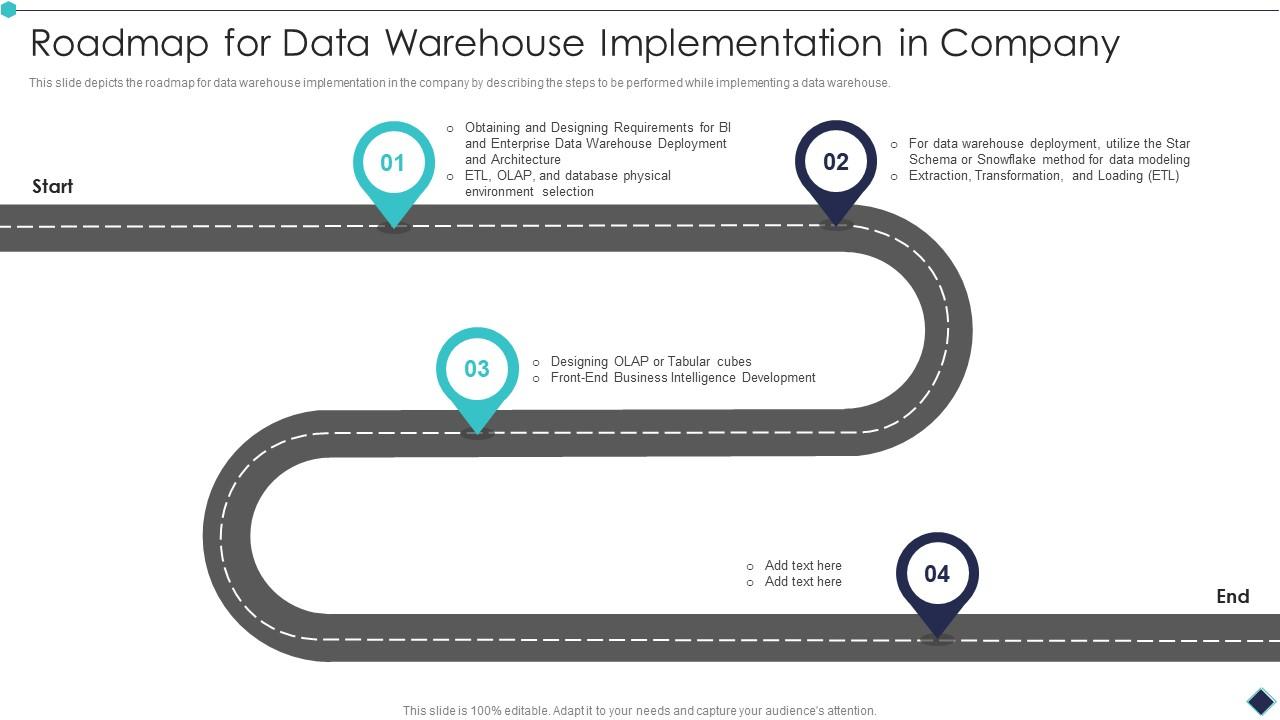
Template 18: Roadmap for Data Warehouse Implementation in Company Analytic Application PPT Formats
Data warehouse implementation without a visible roadmap tends to drift. This PPT template is built for project managers and data leads presenting a phased implementation plan to company stakeholders. It covers four key stages of the implementation journey, giving leadership a clear view of sequencing, dependencies, and delivery milestones. Whether you're presenting to a steering committee or aligning an analytics team, this slide keeps everyone on the same page. The template is 100% editable and customizable.
Download this PowerPoint Template
Template 19: Best Practices to Ensure Effective Data Warehouse Implementation
Effective data warehouse implementation depends on stakeholder involvement, governance, and clear data attributes—not just technical execution. This PPT preset is built for data leads and analytics managers presenting implementation best practices to business and IT stakeholders. It covers four core approaches that improve access to business data for analytics and business intelligence. A straightforward slide for implementation planning sessions, governance workshops, or project kick-off meetings. The template is 100% editable and customizable.
[product_image id=1157853]
Elevate Your Data Warehouse Presentations with SlideTeam
SlideTeam's PowerPoint templates are the best in the industry for communicating data warehouse practices with clarity and confidence. These content-ready slides cover everything from Data Warehouse Architecture and ETL Best Practices to cloud migration and data governance—saving your team hours of design work. Use these PowerPoint slides to align stakeholders, present implementation roadmaps, and turn complex technical decisions into clear visual narratives. Deploy these pre-designed frameworks today and drive faster, smarter data decisions across your organization.
FAQs on Data Warehouse Practices
What are the key differences between a data warehouse and a data lake, and when should each be used?
A data warehouse stores structured, processed data optimized for querying and reporting. A data lake stores raw data in any format, structured or not. Use a warehouse when your analytics needs are defined and query speed matters. Use a data lake when you need to store large volumes of raw data for exploratory analysis or ML workloads. Many organizations run both in parallel.
How does schema-on-read differ from schema-on-write in data warehouse design?
Schema-on-write enforces structure before data is stored—used in traditional data warehouses. Schema-on-read applies structure only at query time—common in data lakes. Schema-on-write gives faster, more reliable queries. Schema-on-read offers more flexibility for raw or evolving data. The right choice depends on whether your use case values query performance or ingestion flexibility more.
What strategies can organizations adopt to optimize query performance in large-scale data warehouses?
Partition large tables by date or key columns to reduce scan volume. Use columnar storage formats to speed up aggregation queries. Avoid SELECT and filter early in your queries. Materialize frequently used aggregations as views or summary tables. In cloud platforms like Amazon Redshift or Snowflake, distribution keys and clustering also matter significantly for query performance.
How does a star schema differ from a snowflake schema, and what are the trade-offs of each?
A star schema links a central fact table directly to dimension tables—simple, fast to query. A snowflake schema normalizes those dimension tables further, reducing data redundancy. Star schemas are easier to query and perform better for most BI reporting tools. Snowflake schemas save storage but add join complexity. Most analytical workloads favor the star schema unless storage is a hard constraint.
What role does data lineage play in maintaining data quality within a warehouse environment?
Data lineage tracks where each data point comes from and how it was transformed. It helps teams identify the root cause of data quality issues quickly. Without lineage, fixing a broken metric means guessing which upstream step failed. With it, audits and compliance checks become far faster. Lineage is especially critical in complex ETL pipelines with multiple transformation layers.
How should organizations approach slowly changing dimensions (SCDs) to preserve historical accuracy?
Slowly changing dimensions (SCDs) track how dimension data changes over time. Type 1 simply overwrites old values—no history preserved. Type 2 adds a new row for each change, preserving full history. Type 3 stores only the previous value alongside the current one. Most organizations default to Type 2 when historical accuracy matters, such as customer records or product attributes.
What are the best practices for partitioning and indexing tables in a modern cloud data warehouse?
Partition tables by the column most commonly used in WHERE clauses—usually a date field. In cloud data warehouses, use clustering or sort keys to co-locate related rows. Avoid over-partitioning, which increases metadata overhead. Index selectively; not every column benefits. On platforms like Snowflake or Amazon Redshift, rely on automatic optimization features before adding manual indexes.
How can data warehouse teams effectively manage and reduce storage costs without compromising accessibility?
Archive or compress historical data that's rarely queried. Use tiered storage—move cold data to cheaper storage automatically. Drop redundant staging tables after transformation jobs complete. Review and retire unused schemas and reports regularly. In cloud environments, right-size your compute clusters and use auto-suspend features to avoid paying for idle resources.