

 0 Comment
 Customer Reviews

The emergency plan's been filed. Laminated, even. Sitting in a binder somewhere on a shelf nobody opens.
That's the uncomfortable truth about most mitigation and preparedness work. The documentation exists. The checklists got done. Someone attended a training, someone else approved the budget. And then nothing changed—until something went wrong.
Here's what's actually hard: it's not identifying the hazard. Most teams can do that. The hard part is translating the risk into a structure someone will actually follow when there's smoke in the building, or a flood warning at 3am, or a chemical spill on a Thursday afternoon. Knowing what to do and having it ready to present, rehearse, and act on are very different things.
There's also the gap between departments. Safety teams speak one language. HR speaks another. Operations has its own framework. And somehow a single preparedness plan has to make sense to all of them—without turning into a 60-page document nobody reads before the emergency response protocols are needed.
Add to that the newer pressures: climate change adaptation, pandemic preparedness, AI-assisted hazard assessment, warehouse risks, construction site vulnerabilities. Each context demands its own logic. Each audience needs a different level of detail. The plan that works for a factory floor doesn't look like the one for a corporate office or a community evacuation drill.
So people build templates. Not because it's the easy way out—it usually isn't—but because the problem is common enough that someone figured out a structure worth reusing. Mitigation frameworks, preparedness checklists, risk management dashboards: these exist because every organization eventually faces the same gap between knowing the risk and communicating it clearly.
SlideTeam's pre-designed mitigation and preparedness templates tackle that gap directly. They're built around real scenarios—chemical spills, workplace hazards, event emergencies, wildfire prevention, construction sites—so you're not starting from a blank slide when the stakes are high.
Here's what's available across 20 of those templates.
Template 1: Mitigation and Preparedness PowerPoint PPT Bundles
A credible, twenty-five-slide presentation bundle built for serious mitigation and preparedness communication. This PPT covers stats, figures, and data charts across a wide range of risk scenarios. It gives presenters a thorough, structured framework to support disaster risk reduction conversations. Safety leads, operations managers, and compliance officers all reach for this deck. Whether presenting a vulnerability assessment or walking a team through a full emergency management cycle, this slide handles the structure. The template is 100% editable and customizable.
[product_image id=1145381]
Template 2: Psychosocial Hazard Preparedness and Mitigation Strategies
Psychosocial hazards—low job control, poor support, lack of recognition—are real workplace risks that rarely get structured airtime. This PPT preset lays out mitigation and preparedness strategies across three clear stages. HR leads and occupational health practitioners use it to present psychosocial risk management plans to leadership. It makes a difficult, often abstract topic concrete and actionable. The template is 100% editable and customizable.
[product_image id=1145400]
Template 3: Mitigation and Preparedness for Chemical Spill Risk
Chemical spill preparedness demands a clear action sequence, not a wall of text. This PowerPoint slide maps emergency mitigation steps—developing response plans, conducting training sessions—across two focused stages. Safety officers and environmental health teams use it to communicate chemical spill risk protocols clearly. It fits well inside a broader environmental hazard management presentation. The template is 100% editable and customizable.
[product_image id=1145395]
Template 4: Planning and Organizing Educational Management Processes PPT Outline
Structured learning frameworks are hard to present without the right visual anchor. This Planning and Organizing Educational Management Processes layout delivers exactly that clarity. Clear section flow guides the audience through complex planning and organizing concepts effortlessly. Flexible color themes let you align each slide to your organization's identity. Grab these ready-made slides to present educational management processes with professional impact and save hours of design work. Download this dynamic template now and unlock a new level of presentational precision.
[product_image id=1790720]
Template 5: Mitigation Strategies and Contingency Plans PPT Outline
Contingency planning conversations often stall because the slide structure isn't ready. This PowerPoint slide is built for risk managers and operations leads who need to present mitigation strategies and contingency plans quickly. It pairs well with business continuity planning discussions where both creativity and clarity count. Explore more mitigation and preparedness PPT templates with samples and examples to find the right fit for your scenario. The template is 100% editable and customizable.
[product_image id=1550788]
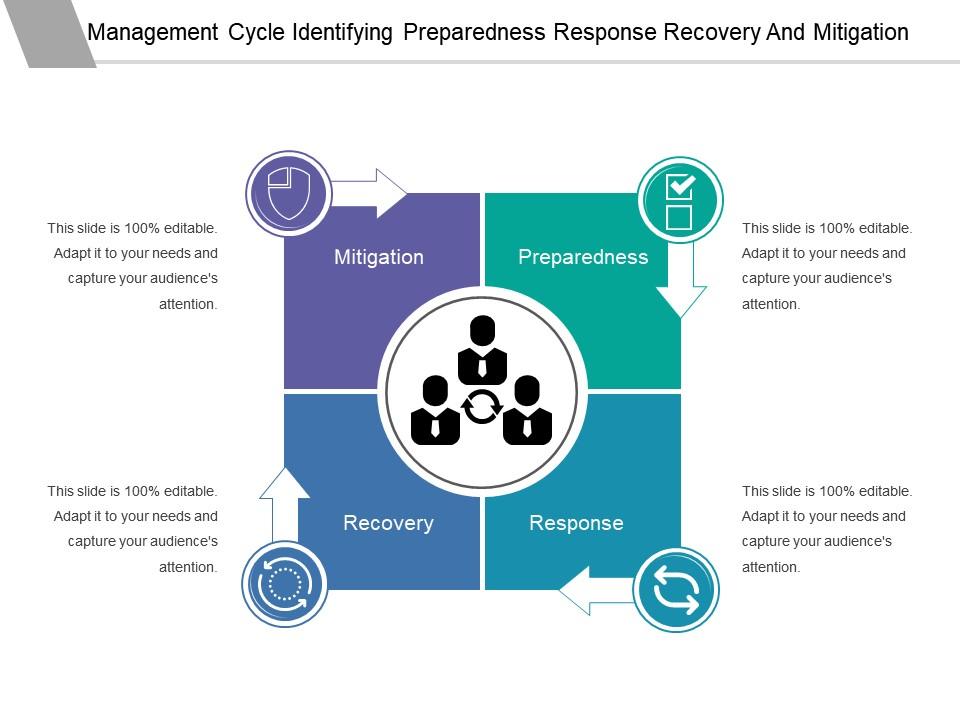
Template 6: Management Cycle Identifying Preparedness Response Recovery and Mitigation
Emergency management works in cycles—preparedness, response, recovery, and mitigation are not separate events. This deck makes that four-stage cycle visible in one clean, structured slide. Emergency managers and crisis management leads use it to present the full management cycle without losing the audience in complexity. It's a reliable anchor slide for any risk management framework presentation. The template is 100% editable and customizable.
Download this PowerPoint Template
Template 7: Plan for Event Emergency Mitigation and Preparedness
Event emergencies follow a predictable pattern, but the planning rarely does. This PPT template maps the mitigation and preparedness plan for event emergencies across four stages: risk assessment, procedure development, plan communication, and plan updates. Event safety coordinators and operations planners reach for this when they need to present evacuation planning and response protocols to stakeholders. It keeps the conversation focused on action, not theory. The template is 100% editable and customizable.
[product_image id=1145398]
Template 8: Checklist for Environmental Hazard Mitigation and Preparedness
Checklists drive compliance, but only when they're readable and clearly assigned. This Environmental Hazard Mitigation and Preparedness checklist layout captures phases, responsible persons, department status, and emergency management stages in one structured view. Safety auditors and environmental managers use it to track and present hazard readiness without ambiguity. Transform your environmental safety presentations today. Download this dynamic template now and ensure your hazard checklist lands with clarity and accountability.
[product_image id=1145384]
Template 9: AI Applications for Hazard Mitigation and Preparedness
AI is reshaping hazard mitigation—predictive maintenance, real-time surveillance, and AI-driven risk assessment are now practical tools, not future concepts. This PowerPoint slide maps four AI applications in workplace hazard management clearly and concisely. Safety technology leads and operations analysts use it to brief decision-makers on where AI adds real value in preparedness planning. It grounds a technical topic in concrete use cases. The template is 100% editable and customizable.
[product_image id=1145383]
Template 10: Workplace Hazard Mitigation and Preparedness Plan
Falls from height, machinery malfunction, and fires are persistent workplace hazards that need structured mitigation, not just awareness. This PPT preset presents a workplace hazard mitigation and preparedness plan covering those specific risks with clear preparedness strategies. Safety managers and HR leads use it to communicate hazard plans in team briefings and compliance reviews. It keeps the focus on action steps, not generic policy language. The template is 100% editable and customizable.
[product_image id=1145405]
Template 11: Hazard Mitigation and Preparedness Plan for Factory Workers
Factory worker safety depends on training that's rehearsed, not just documented. This PowerPoint slide lays out a hazard mitigation and preparedness plan with required actions, simulation drills, and overall impact assessments for factory environments. EHS leads and operations managers use it to present worker safety plans to floor supervisors and senior leadership alike. It makes the case for preparedness investment in clear, measurable terms. The template is 100% editable and customizable.
[product_image id=1145394]
Template 12: Construction Risk Mitigation and Preparedness Plan
Construction sites carry layered risks—moving objects, airborne materials, excessive noise—that demand site-specific mitigation plans. This PPT template structures those risks with handling guidelines and harmful material protocols in a clean, scannable format. Site safety officers and project managers use it to communicate construction risk mitigation plans at toolbox talks and stakeholder briefings. For context, it works equally well in contractor compliance presentations. The template is 100% editable and customizable.
[product_image id=1145385]
Template 13: Risk Management Software for Emergency Mitigation and Preparedness
Choosing a risk management software platform is a real procurement decision, not an abstract one. This PowerPoint slide compares emergency mitigation and preparedness software options—including Noggin and Omnigo—across pricing, supported platforms, and free version availability. Operations leads and IT procurement teams use it to present software shortlists to decision-makers quickly and clearly. It removes the need to build a comparison table from scratch. The template is 100% editable and customizable.
[product_image id=1145401]
Template 14: Evacuation Planning for Hazard Mitigation and Preparedness
Evacuation planning breaks down when the steps aren't sequenced and visible. This eight-stage Evacuation Planning layout captures hazard assessment, evacuation need analysis, area identification, and training delivery in a logical, linear flow. Safety coordinators and facilities managers use it to walk leadership through a complete evacuation preparedness framework. Every slide delivers a precise stage in the process. Download this dynamic template now and give your evacuation planning presentations the clarity they need to drive real action.
[product_image id=1145393]
Template 15: Mitigation and Preparedness Plan Icon for Fire Emergency
Fire emergency preparedness needs a clear visual anchor that teams recognize under pressure. This PPT preset is built for safety leads who need a structured, immediately recognizable fire mitigation and preparedness icon slide. It fits inside larger fire safety decks and emergency response protocol presentations without disrupting the flow. So yeah, sometimes the right icon slide does more work than a full page of text. The template is 100% editable and customizable.
[product_image id=1145396]
Template 16: Warehouse Hazard Mitigation and Preparedness Action Plan
Warehouse hazards—lifting and handling injuries, fire safety gaps, pallet and racking failures—require action plans that are specific, not generic. This PowerPoint slide presents a structured warehouse hazard mitigation and preparedness action plan covering those three risk areas clearly. EHS coordinators and warehouse operations managers use it to assign responsibilities and track readiness in one view. It supports community resilience and infrastructure protection conversations at the facility level. The template is 100% editable and customizable.
[product_image id=1145404]
Template 18: Training Icon for Chemical Spill Mitigation and Preparedness
Chemical spill training needs a visual cue that signals seriousness without overwhelming the room. This PPT preset provides a clean, three-stage icon slide for chemical spill mitigation and preparedness training sessions. Safety trainers and compliance officers use it as an opener or section marker inside broader hazard training decks. Btw, icon slides used well reduce cognitive load significantly in high-stakes training environments. The template is 100% editable and customizable.
[product_image id=1145403]
Template 19: Dashboard for Workplace Hazard Mitigation and Preparedness
Risk preparedness dashboards work when they surface the right metrics at a glance. This Dashboard for Workplace Hazard Mitigation and Preparedness captures incidents per year, evacuation time, health and safety training progress, and incident location data in one structured view. Safety managers and compliance leads use it to present KPIs to leadership without burying the numbers in narrative. Transform your workplace safety reporting today. Download this dynamic template now and deliver hazard preparedness data with the clarity decision-makers need.
[product_image id=1145387]
Template 20: Planning Icon for Medical Emergency Mitigation and Preparedness
Medical emergency planning requires a clear, calm visual structure that works under pressure. This PPT template provides a three-stage icon slide for planning medical emergency mitigation and preparedness. First responder coordinators and workplace health leads use it as a reference anchor in emergency response protocol presentations. It signals structure without adding noise to an already high-stakes conversation. The template is 100% editable and customizable.
[product_image id=1145399]
Deliver Confident Preparedness Presentations with SlideTeam
SlideTeam's PowerPoint templates are the best in the industry for mitigation and preparedness planning. These content-ready slides cover everything from evacuation planning and hazard assessment to AI-driven risk management and workplace safety dashboards—saving hours of design time. Each ready-made framework gives your presentation the structure it needs to move stakeholders from awareness to action. Deploy these PowerPoint slides to build credibility, communicate risk clearly, and drive real preparedness outcomes.
FAQs on Mitigation and Preparedness
What are the key differences between mitigation and preparedness in disaster risk management?
Mitigation reduces the severity of a hazard before it happens—think flood barriers or fire-resistant construction. Preparedness focuses on readiness to respond when a hazard occurs—training, plans, and early warning systems. Both are distinct phases in the disaster risk reduction cycle. Mitigation is long-term and structural; preparedness is operational and continuous. Together, they form the front half of the emergency management cycle.
How can communities effectively integrate mitigation strategies into long-term urban planning?
Start by embedding hazard assessment results directly into zoning and land-use decisions. Restrict development in flood plains and high-risk seismic zones. Require climate resilience standards in building codes and infrastructure projects. Fund community-level preparedness programs through city planning budgets. The most effective cities treat disaster risk reduction as a planning input, not an afterthought to a finished development plan.
What role does risk assessment play in developing a robust preparedness framework?
Risk assessment identifies which hazards are most likely and most damaging for a given community or organization. That prioritization determines where resources—training, equipment, protocols—get allocated first. Without it, preparedness frameworks cover everything equally and protect nothing effectively. A solid vulnerability assessment also reveals gaps in current response capacity, making it the practical starting point for any emergency preparedness plan.
How do early warning systems contribute to reducing disaster-related casualties?
Early warning systems give people time to act before a hazard peaks. Even a 15-minute warning for a tornado or flash flood can reduce casualties significantly. They work best when paired with clear evacuation routes and pre-drilled community response plans. The warning alone isn't enough—communities need to know what to do with the information. Public safety planning must treat warning dissemination and response as a single system.
What are the most common barriers organizations face when implementing mitigation measures?
The most common barriers are budget constraints, lack of leadership buy-in, and poor cross-department coordination. Organizations also struggle with outdated risk assessments that don't reflect current hazards. Training fatigue is real—staff complete drills once and rarely reinforce them. Mitigation measures also tend to compete with short-term operational priorities. Addressing these requires clear ownership, dedicated budget lines, and regular review cycles built into normal operations.
How can public-private partnerships enhance disaster preparedness at the community level?
Public-private partnerships work best when each side brings what the other lacks. Government provides regulatory authority, public communication channels, and community access. Private organizations contribute technology, logistics capacity, and trained personnel. Joint exercises and shared early warning systems close the gap between plans on paper and actual response capability. The key is formalizing the partnership before a disaster, not during one.
What metrics are used to evaluate the effectiveness of a mitigation plan post-disaster?
The most used metrics are response time, evacuation completion rate, and the ratio of projected versus actual losses. Reviewers also track how many mitigation measures were activated correctly and how quickly normal operations resumed. Infrastructure downtime and casualty counts relative to historical baselines give a longer-term picture. These figures feed directly into the next planning cycle and help prioritize where risk mitigation investment should go next.
How does climate change influence the evolution of preparedness strategies?
Climate change shifts the frequency and intensity of hazards—storms, wildfires, and floods now exceed historical baselines. Preparedness strategies built on past data become inadequate faster. Organizations need to update vulnerability assessments more frequently and plan for hazard combinations, not single events. Climate change adaptation now requires scenario planning for conditions that haven't been experienced before, which demands more flexible and regularly reviewed preparedness frameworks.