

 0 Comment
 Customer Reviews

The validation report's sitting in the shared drive. Has been for two weeks.
Not because the testing is incomplete. It probably is complete. But someone has to turn it into a presentation that makes sense to a regulator who wasn't in the room. Someone has to explain why every test case maps to a requirement, why every requirement traces to a user need, and why none of the gaps are actually gaps.
That's the part nobody talks about when they're planning a validation cycle. The testing gets scheduled. The protocols get written. And then, right at the end, there's this moment where someone realizes the documentation doesn't hold together visually. The traceability is there—buried in spreadsheets—but the narrative isn't.
And the stakes aren't abstract. A poorly structured validation deck can stall a 510(k) submission. A missing link in the software traceability matrix can trigger a finding during an FDA audit. IEC 62304 compliance doesn't just mean following a process—it means being able to show you followed it, clearly, to someone who'll look for the gaps.
So the discomfort isn't about the work. It's about the presentation of the work. How to take months of software verification and validation activity and make it legible. How to communicate risk management decisions without sounding like you're hedging. How to show that your software lifecycle was controlled without making the deck look like a compliance checklist.
That's exactly why these templates exist. Medical device software validation is a specific, high-stakes domain—and the teams doing it don't need generic slide layouts. They need structures that already understand the regulatory context. Structures that hold a validation protocol, a process flowchart, a development plan, and an audit summary without falling apart.
SlideTeam's pre-designed templates are built for this. Ready-made frameworks that handle the structural problem so your team can focus on the substance. What follows are the five that work best for this exact challenge.
Template 1: Future Trends Shaping Medical Device Software Validation Practices PPT Information
Future-proof your validation presentations with this forward-looking medical device software development deck. It captures emerging trends shaping software validation practices with striking visual precision. Every layout balances regulatory depth with clean, audience-focused design. Compelling visuals ensure your content commands attention in boardroom and compliance review settings alike. Effortless customization lets you tailor the structure to your organization's specific validation narrative. Present complex regulatory landscapes—including AI medical device regulation and SaMD validation requirements—with instant credibility. Use it for executive briefings, quality team reviews, or industry conference presentations. Transform your medical device software validation presentations today. Download this dynamic template now and unlock your team's ability to present the future of compliance with confidence.
[product_image id=1454232]
Template 2: Medical Device Process Validation Flowchart
Map every stage of your validation lifecycle with this clear, structured process validation flowchart. It drives immediate visual understanding of project initiation through full commercialization. Each phase—device design, development, and process control—is presented with logical, sequential clarity. The flow captures patient safety considerations at every critical decision point. Teams presenting medical device process validation frameworks will find this layout immediately usable. It anchors complex validation workflows in a format auditors and quality managers can follow. Transform your process validation communications today. Download this template now and deliver a flowchart that makes compliance visible at every stage.

Download this PowerPoint Template
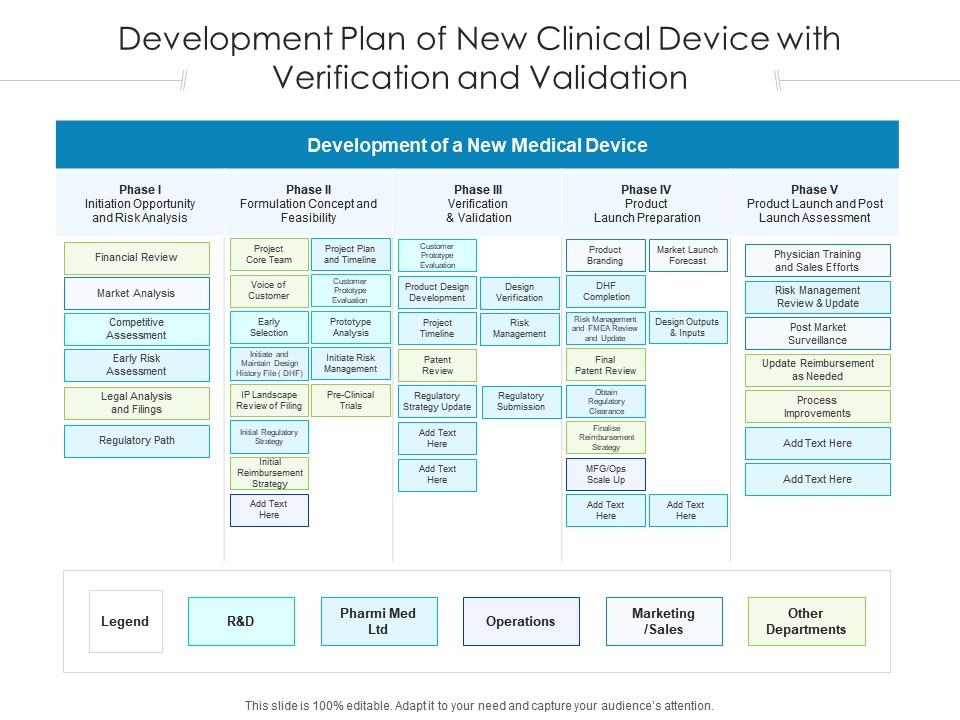
Template 3: Development Plan of New Clinical Device with Verification and Validation
Clinical device development rarely follows a straight line, especially when verification and validation sit at the center. This PPT preset gives practitioners a structured view from initiation through opportunity and risk analysis to formulation, concept, feasibility, and final V&V. Program managers and R&D leads reach for this slide when walking a cross-functional team through a medical device verification and validation plan. It works equally well for internal milestone reviews and regulatory submission planning. The template is 100% editable and customizable.
Download this PowerPoint Template
Template 4: Verification Software Matching Output to Input Specifications PPT
Precision in software verification starts with matching every output exactly to its input specification. This deck delivers a clear, structured framework for presenting that critical alignment. It captures the verification logic that underpins FDA software validation guidelines and ISO 13485 software requirements. Every layout drives confidence—showing reviewers that your software requirements are fully traced and tested. Flexible design lets you adapt the structure to your organization's specific verification protocol. Use it for design review sessions, regulatory submissions, or internal QA sign-off meetings. You can also explore additional medical device software validation templates to complement your documentation set. Transform your software verification presentations today. Download this template now and unlock the clarity your compliance reviews demand.
[product_image id=1766205]
Template 5: Medical Billing Audit Key Points to Verify Patient Records PPT Slides
Medical billing audits depend on getting patient record verification right the first time. This PPT preset gives compliance teams and audit leads a clean, structured way to present key verification checkpoints. It suits scenarios where accuracy, traceability, and documentation rigor need to be communicated to senior reviewers. For teams exploring broader validation of medical devices PPT templates, this deck pairs well with process and software validation slides. The template is 100% editable and customizable.
[product_image id=1574463]
Elevate Your Medical Device Software Validation with SlideTeam
SlideTeam's PowerPoint templates are the best in the industry for medical device software validation. Their content-ready structures help you present software verification and validation activities, traceability matrices, and regulatory compliance evidence with professional clarity. Use these ready-made slides to turn months of validation work into presentations that hold up under FDA or EU MDR scrutiny. Deploy these templates to communicate compliance confidently and move your submissions forward faster.
FAQs on Medical Device Software Validation
What distinguishes software validation from software verification in the context of medical devices?
Verification asks: did we build the software correctly? Validation asks: did we build the right software? Verification checks that outputs match specifications at each development stage. Validation confirms the final software meets real user needs and its intended use. Both are required under FDA software validation guidelines and IEC 62304, but they happen at different points in the software lifecycle and produce different evidence.
How does IEC 62304 define software safety classifications, and what validation activities are required for each class?
IEC 62304 assigns three classes: Class A (no injury risk), Class B (non-serious injury risk), and Class C (serious injury or death risk). Class A requires basic documentation. Class B adds software unit testing and integration testing. Class C requires full traceability, rigorous V&V testing, and detailed risk management records. Most medical device software qualifies as Class B or C, which drives the bulk of validation work.
What are the key differences between validation requirements for standalone medical device software versus embedded software?
Standalone software—called SaMD—is validated as a product in its own right, with user needs and intended use defined independently. Embedded software validation must also account for hardware interaction, real-time constraints, and the physical device's risk profile. Embedded software often requires additional integration testing with the hardware. SaMD validation requirements focus more on software-only failure modes, cybersecurity, and clinical performance evidence.
How should organizations document the traceability matrix between user needs, software requirements, and validation test cases?
A software traceability matrix should link each user need to at least one software requirement, and each requirement to at least one validation test case. Track it in a table with unique IDs for each element. Update it whenever requirements or test cases change. Regulators expect bidirectional traceability—meaning you can move from any test result back to the user need it satisfies. Gaps in traceability are a common FDA audit finding.
What role does risk management under ISO 14971 play in determining the scope and rigor of software validation activities?
ISO 14971 risk management determines how thorough your validation needs to be. Higher-risk software functions require more test cases, tighter acceptance criteria, and more formal documentation. Risk analysis identifies which software failure modes could harm patients—those items get the most rigorous validation attention. Residual risk decisions must be documented and approved before validation is closed. Risk management output directly shapes the scope of your validation protocol.
How do regulatory bodies like FDA and EU MDR differ in their expectations for medical device software validation documentation?
The FDA focuses on predicate-based substantial equivalence for 510(k) submissions and expects validation documentation aligned with 21 CFR Part 11 and its software guidance documents. The EU MDR requires a full technical file demonstrating compliance with Annex I safety and performance requirements, with stronger post-market surveillance obligations. The EU MDR also demands explicit clinical evidence linkage. Both require traceability and risk management records, but the EU framework is broader in scope.
What constitutes adequate evidence of software validation for an AI/ML-based medical device algorithm?
Regulators expect evidence that the AI/ML algorithm performs as intended across the full intended patient population and use conditions. This includes training and test dataset documentation, performance metrics with statistical confidence, bias analysis across subgroups, and a defined acceptable performance threshold. The FDA's AI medical device regulation framework also expects a predetermined change control plan for algorithms that update post-market. Static, locked algorithms follow standard V&V; adaptive ones require additional ongoing monitoring evidence.
How should change control processes be structured to determine when revalidation is triggered after a software update?
Change control should include a documented impact assessment for every software update. The assessment asks: does this change affect a validated function, a safety-critical module, or a requirement tied to regulatory submissions? If yes, revalidation is triggered—scoped to the affected area, not necessarily the full system. Minor bug fixes with no functional impact may need only regression testing. The key is a written decision, approved by QA, before the change is deployed.