




 0 Comment
 Customer Reviews

The audit's in six weeks. Someone just asked who's handling the GMP presentation.
Not the compliance part—that's documented, filed, probably current. But explaining it. Walking auditors through protocols without sounding defensive. Showing inspectors you actually follow what you've written down.
There's this moment during every facility review when the auditor stops taking notes and starts asking questions. Real ones. About deviations nobody reported. About the gap between your standard operating procedures (SOPs) and what actually happens on Tuesday afternoons. About why your documentation and record-keeping looks so clean.
Good manufacturing practices aren't the problem. Most operations teams know their processes, understand contamination risks, follow the right steps. The problem is proving it. Taking months of daily manufacturing compliance and condensing it into slides that don't scream "we're worried you'll find something."
One poorly explained batch record can derail everything. A missing flowchart makes solid processes look chaotic. The wrong visual turns routine quality control process into something that needs defending.
Manufacturing teams don't panic about the work—they panic about the presentation. How to make systematic compliance look systematic. How to show traceability without drowning people in paperwork. How to prove you're not just checking boxes against regulatory requirements.
Because that's what GMP really is. Not just following procedures, but showing you understand why they exist. That quality assurance standards aren't an afterthought.
So these templates exist. Not because manufacturing's hard to explain—though it is. They exist because regulatory presentations have no margin for error. Because "we do this right" isn't enough if you can't demonstrate it clearly.
SlideTeam's GMP templates tackle this exact gap—ready-made frameworks for when compliance needs to look as thorough as it actually is. Pre-designed slides that handle the structure so you can focus on the substance.
What follows are the templates that work when your processes are solid but your presentation game needs backup.
Template 1: Operational Plan for Improving Good Manufacturing Practices for a Beverage Company
This SlideTeam PPT complete deck is a compendium of GMP improvement tools, not another compliance checklist that collects dust. This slide delivers workforce gap analysis, supplier audit frameworks, equipment upgrade tracking, and calibration validation protocols as well. Manufacturing teams and quality managers get customizable templates for benchmarking through a robust quality management system (QMS). Use these pre-designed slides for strategic planning sessions, manufacturing compliance reporting, and operational reviews. Download now.
[product_image id=1328647]
Template 2: Improving Good Manufacturing Practices in Beverage Industry PPT
You need this GMP improvement PPT template for beverage quality compliance. Pre-designed slides cover gap analysis, risk management, and cost benchmarking. Quality managers and compliance teams get actionable frameworks that work for strategic planning and audit preparation with quality assurance standards. Download now.
[product_image id=1388231]
Template 3: Optimizing Good Manufacturing Operational Practices in Beverage Business PPT
These actionable GMP optimization tools, in a PPT complete deck, actually work in beverage operations. This pre-built PowerPoint template delivers essential compliance dashboards, risk matrices, Gantt charts, process flowcharts, and supplier management tables. Quality managers, operations teams, and compliance officers welcome this useful tool. It helps them manage regulatory requirements, quality assurance standards, and manufacturing compliance. Download now.
[product_image id=1388243]
Template 4: Good Manufacturing Practices Overview PPT Graphics
This GMP Overview PowerPoint slide works well for pharmaceutical compliance training and regulatory presentations. The customizable templates deliver actionable quality assurance standards and standard operating procedures (SOPs) for manufacturing through numbered steps and professional layout. Compliance managers and pharmaceutical teams can leverage this slide for training sessions where clarity matters. This actionable PPT preset transforms complex regulatory requirements into easily-understandable content for your next compliance review. Download now.

Template 5: Good Practices for Pharmaceutical Drug Safety Manufacturing
Pharmaceutical manufacturing compliance has to work well, or the business risks doom. This pre-built PowerPoint slide delivers nine actionable drug safety practices. These include personnel hygiene, clean premises, equipment standards and waste disposal. Standard Operating Procedures (SOPs) on the slide provides a practical checklist for quality managers and regulatory teams conducting Pharmaceutical GMP compliance audits or training sessions. Download this PPT now.

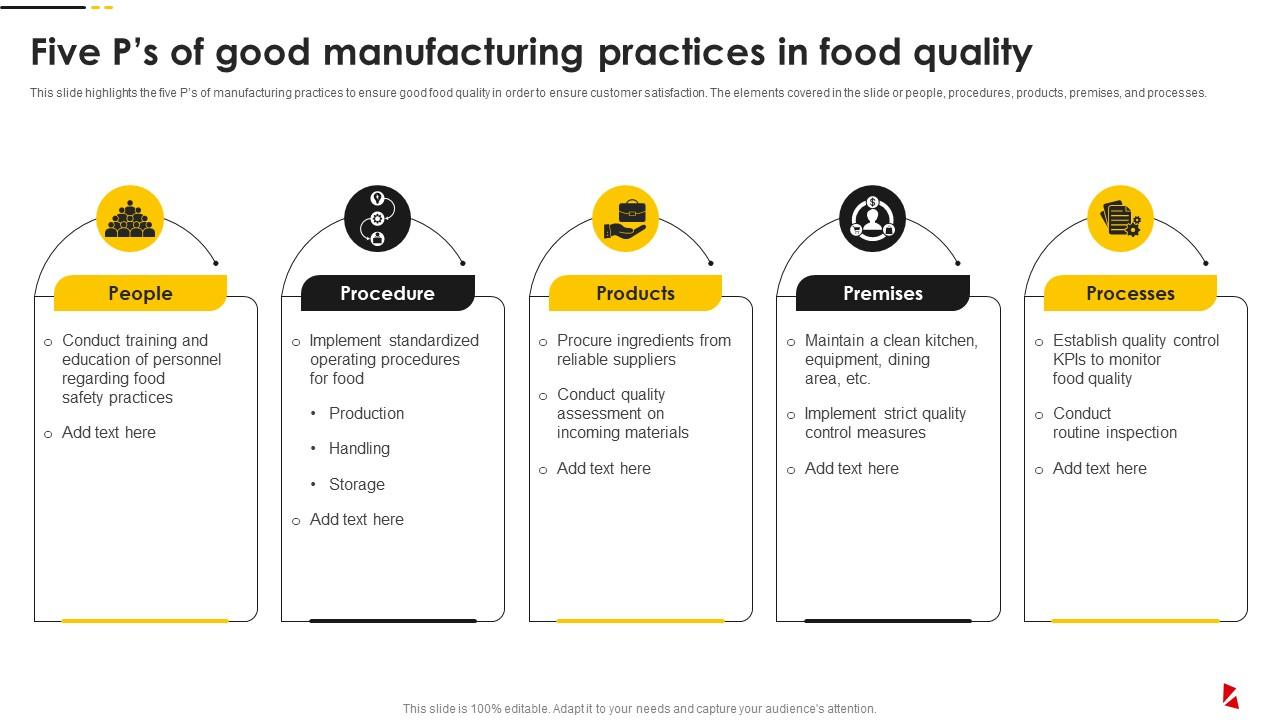
Template 6: Five Ps of GMPs in Food Quality and Safety Management Guide
You need practical GMP oversight in business and this SlideTeam PPT delivers it for you. This presentation framework showcases the Five Ps framework. These are people, procedure, products, premises and processes for manufacturing compliance and customer satisfaction. Quality managers and operations teams can customize this actionable PPT template for training sessions. These are also good to be used for audit preparations, regulatory requirements, and quality assurance standards presentations. Download now.
Template 7: Good Practices for Food Manufacturing Process
Food manufacturing managers need this pre-designed PPT template covering equipment protocols to make lives easier and deliver on their mandate. It includes personnel training, sourcing standards, and hygiene and sanitation procedures. This actionable PowerPoint slide delivers Food GMP-focused content for operational training and audit presentations. Download now.

Good Manufacturing Practices Non-Negotiable
SlideTeam's PowerPoint templates are the industry's best solution for presenting good manufacturing practices and quality management system (QMS) effectively. These content-ready slides provide structured frameworks that ensure regulatory compliance while maintaining professional clarity for audit presentations and training sessions. Our custom-made templates streamline complex GMP documentation and corrective and preventive actions (CAPA) into visually compelling formats. Deploy these PowerPoint slides to enhance stakeholder communication and ensure manufacturing excellence across your organization.
FAQs on good manufacturing practices
What are Good Manufacturing Practices (GMP), and why are they critical in production industries?
GMPs are quality assurance standards that ensure products are made safely and consistently. They cover three core areas: clean facilities, trained workers, and documented processes. Companies must maintain sterile environments, qualify staff properly, and record every production step. These manufacturing compliance practices prevent contamination, reduce defects, and meet regulatory requirements. Without GMP, businesses face product recalls, legal penalties, and lost customer trust.
How can facility design and equipment maintenance support GMP compliance?
Design facilities with smooth, cleanable surfaces and proper drainage systems, according to facility design standards. Install HVAC systems that control air-flow and prevent contamination between production areas that follow Pharmaceutical GMP requirements. Maintain equipment through scheduled inspections and calibration programs. Keep detailed records of maintenance activities and equipment performance to demonstrate compliance with quality assurance standards during audits.
What are the most common challenges in achieving GMP compliance?
Documentation errors create most compliance failures with regulatory requirements. Staff often lack proper training on procedures and record-keeping. Equipment maintenance gets delayed, causing contamination risks. Cross-contamination occurs when facilities mix different products without adequate cleaning. Audits reveal these four issues repeatedly. Fix them by implementing daily record checks, monthly staff refreshers, preventive maintenance schedules, and dedicated production lines for different products to maintain quality assurance standards.