

 0 Comment
 Customer Reviews

The deck's been shared. Three stakeholders have looked at it. Nobody's responded.
That's the specific silence that follows a service sector project presentation — the kind where you've done real work, coordinated real teams, managed real client expectations, and still can't quite show it on a slide. Not because the project failed. Because service work doesn't compress neatly.
There's no widget. No unit count. What you're presenting is a sequence of decisions, relationships, and delivery moments that somehow added up to value — and you need a room of people to agree that they did. That's a harder ask than it sounds.
Service operations project management sits in uncomfortable territory. The scope is fuzzy by nature. Clients redefine what they want mid-project. Success is partly subjective. And the person running the project often spends more time managing emotions than managing timelines. You can't show a prototype. You can't point to a physical output. You describe a process, a result, a relationship — and hope it lands.
What makes it worse is that the wrong presentation structure makes service work look vague. Like you didn't have a plan. Like the project happened to you rather than because of you. One awkward roadmap slide can undo weeks of credibility-building with a client or leadership team.
Templates for project management in service sector contexts exist because this problem is genuinely common. Every service organization — consulting, IT services, healthcare delivery, facilities management — eventually needs to show its work. And "showing your work" when the work is relational and process-driven requires a specific kind of structure that most people don't build from scratch.
That's where SlideTeam's pre-designed templates come in. Built specifically for service delivery management scenarios, they give you the scaffolding for roadmaps, challenge frameworks, manager development matrices, and operations timelines. Content-ready and structured around how service projects actually run — not how product launches do.
SlideTeam put these together knowing that service professionals rarely have blank-canvas time. Here's what's in the collection.
Template 1: Project Management in Service Sector PPT
Clear project communication is hard in service work — the outputs are often invisible until delivery. This PPT preset gives service sector leaders a structured starting point for presenting project plans. It covers the full arc of service project management, from initiation through stakeholder alignment. Practitioners in IT service delivery, consulting, and operations reach for this deck when a client-facing presentation needs to look credible fast. It fits knowledge transfer reviews and service sector project planning sessions alike. The template is 100% editable and customizable.
[product_image id=1486915]
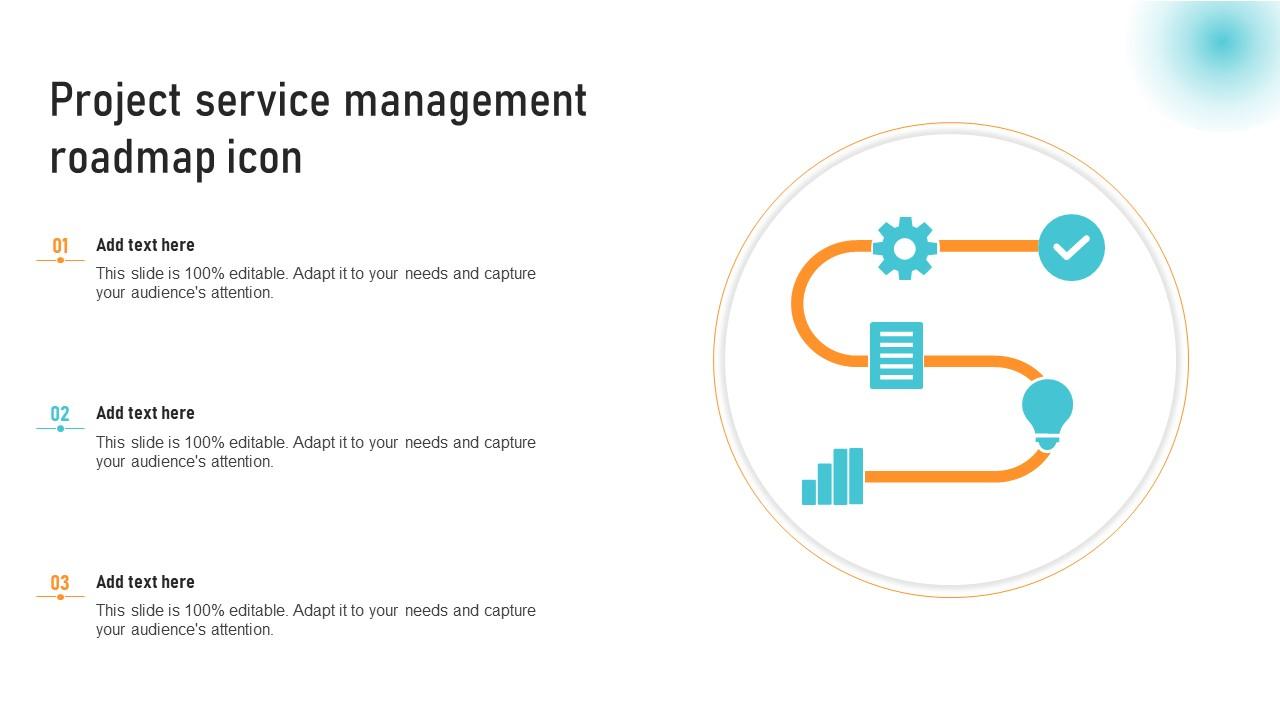
Template 2: Project Service Management Roadmap Icon
Roadmaps in service projects do one specific job: they show a client or leadership team where you are and where you're going. This PowerPoint slide is built for project leads who need to communicate service delivery milestones across three clear stages. It works well in client project management reviews where progress needs to be visible at a glance. For context, a well-structured roadmap also keeps internal teams anchored during longer engagements. The template is 100% editable and customizable.
Download this PowerPoint Template
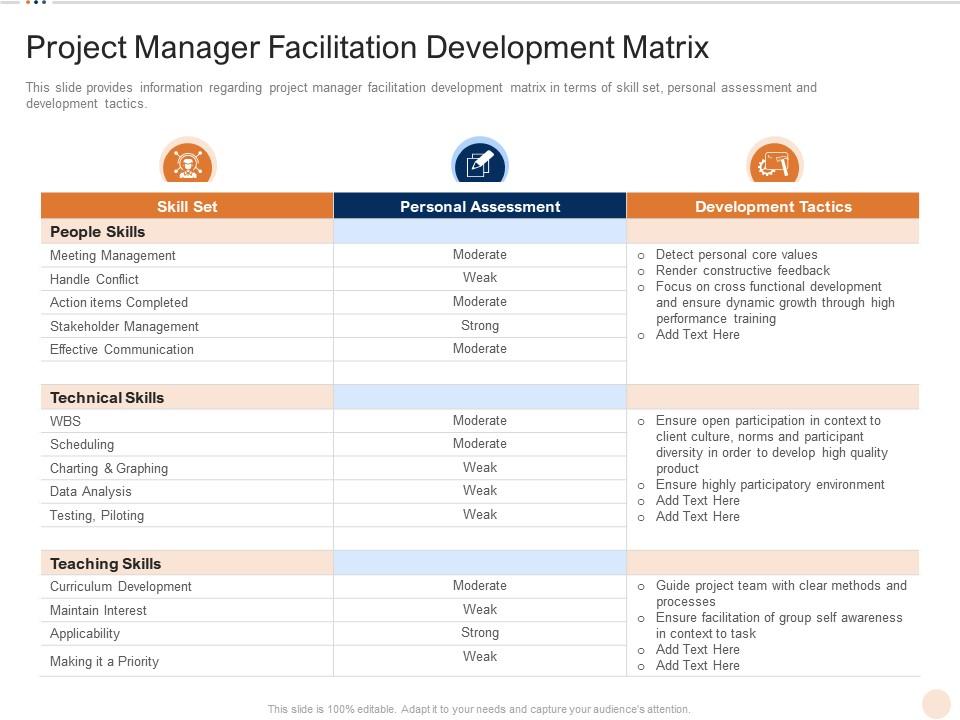
Template 3: Project Manager Facilitation Development Matrix PMP Elements IT Projects
Good project managers in service environments are assessed on skills that rarely show up in job descriptions — meeting facilitation, stakeholder management, effective communication. This PPT template maps those competencies against personal assessment and development tactics in a single matrix view. HR leads and project directors use this slide to structure manager development conversations or run team capability reviews. It's a practical tool for any organization building project management best practices into its service operations. The template is 100% editable and customizable.
Download this PowerPoint Template
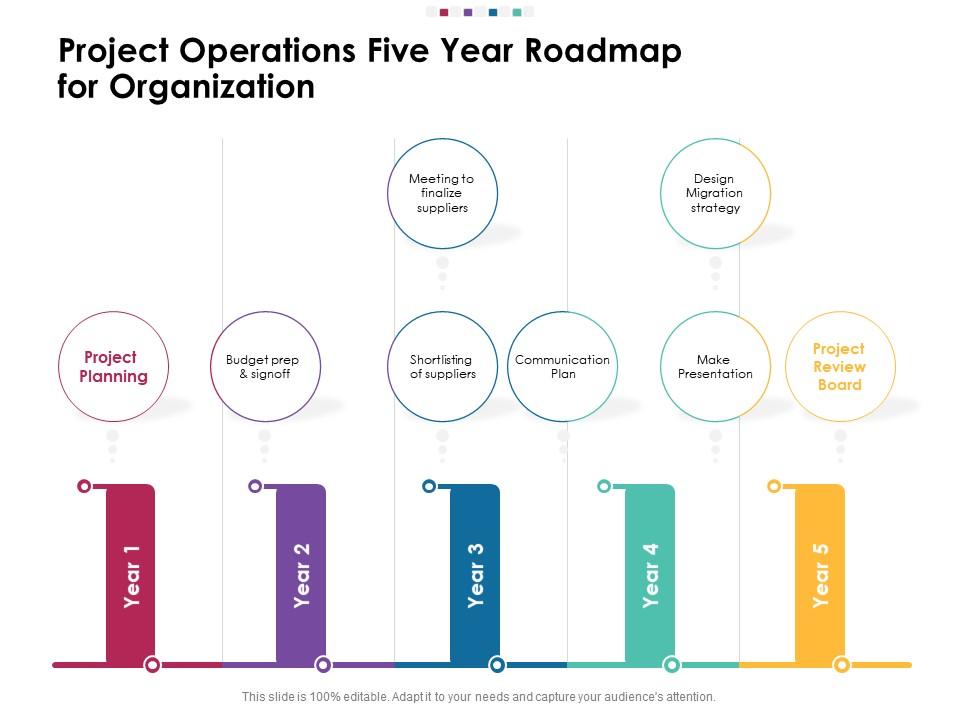
Template 4: Project Operations Five-Year Roadmap for Organization
Five-year planning in service organizations requires showing operational continuity alongside growth ambition. This PowerPoint slide gives operations leaders a structured view across long-horizon project milestones. Program directors and COOs use this PPT to align board-level conversations around service operations management over multi-year cycles. It keeps the narrative clean when the actual underlying complexity is significant. The template is 100% editable and customizable.
Download this PowerPoint Template
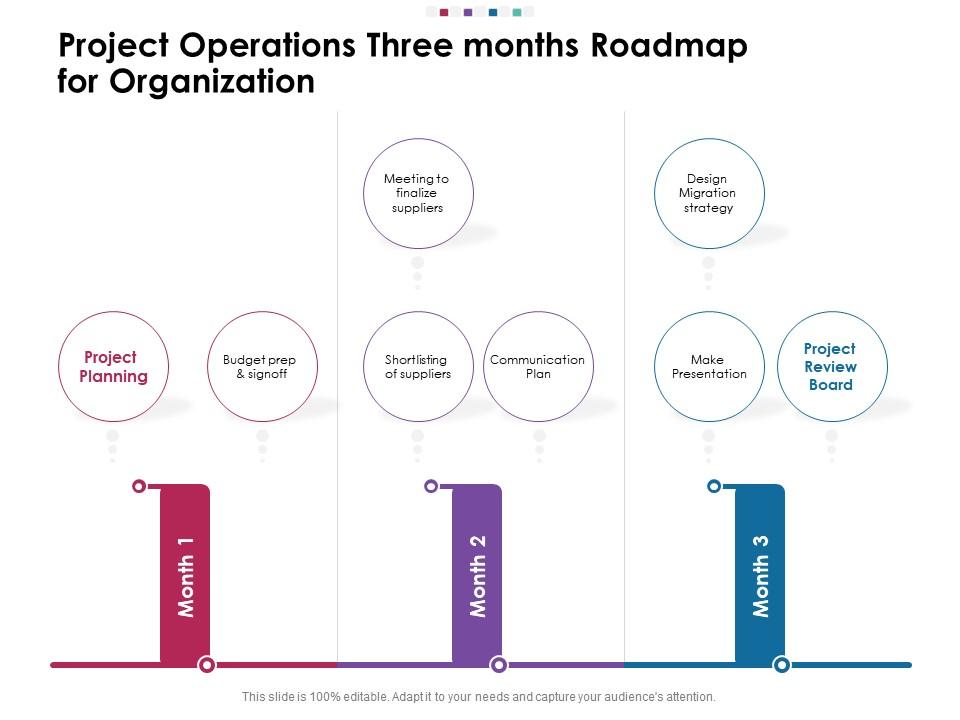
Template 5: Project Operations Three-Month Roadmap for Organization
Short-cycle planning is where most service teams actually live — and three months is often the real unit of work. This PPT preset is built for project managers who need to communicate a near-term operational roadmap without burying the audience in detail. It works well in sprint reviews, client check-ins, and quarterly service project scheduling conversations. So yeah, when the long-term plan exists but the room needs to see what happens next, this slide does the job. The template is 100% editable and customizable.
Download this PowerPoint Template
Template 6: Challenges to Service Operations Project Management
Service operations rarely fail quietly — the problems show up as poor customer satisfaction, resource bottlenecks, or quality gaps that compound over time. This slide names those challenges directly and pairs each with a concrete response. Operations managers and service delivery leads use this PPT when they need to present a structured problem-solution view to senior stakeholders. It's particularly useful in post-project reviews or turnaround planning sessions where accountability and clarity both matter. The template is 100% editable and customizable.
[product_image id=1127564]
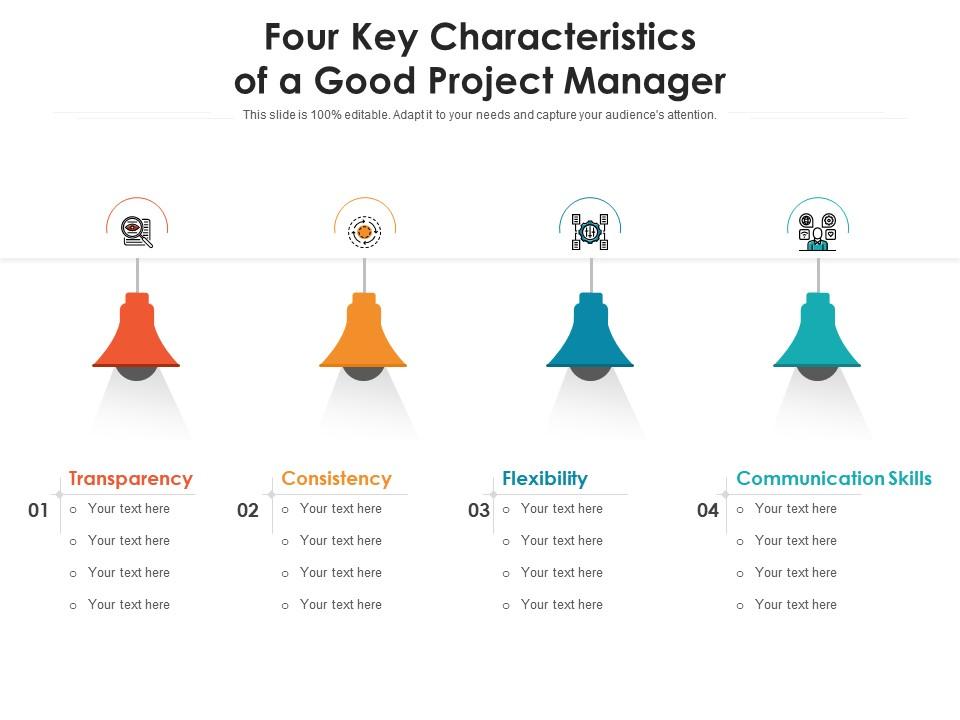
Template 7: Four Key Characteristics of a Good Project Manager
In high-touch service environments, the project manager's personal attributes shape outcomes as much as any methodology does. This PowerPoint slide presents four defining characteristics — transparency, consistency, flexibility, and communication skills — in a format that supports team discussions and capability planning. HR directors and project leads use this deck in leadership development workshops or team onboarding sessions. It anchors abstract leadership qualities to something a room can actually talk about. The template is 100% editable and customizable.
Download this PowerPoint Template
Deliver Winning Service Projects with SlideTeam
SlideTeam's PowerPoint templates are the best in the industry for project management in service sector presentations. These content-ready slides give you professional structure for roadmaps, challenge frameworks, and KPI tracking — without starting from a blank canvas. Use these ready-made PowerPoint slides to present service delivery plans with clarity and confidence. Deploy these pre-designed templates to drive client trust and project success every time.
FAQs on Project Management in Service Sector
How does the intangible nature of service deliverables complicate project scope definition compared to product-based industries?
In product industries, scope is defined by a physical output — specifications are measurable. In service projects, the deliverable is an experience or outcome, which clients interpret differently over time. This makes agreement on "done" genuinely difficult. The fix is to define scope in observable behaviors or measurable milestones — response times, completion rates, satisfaction scores — rather than describing the service itself. Get client sign-off on those markers before work begins.
What methodologies are most effective for managing client expectations in service sector projects where outcomes are subjective?
Two methodologies work well here: Agile and structured check-in frameworks. Agile breaks delivery into short cycles, giving clients regular review points before expectations drift too far from reality. Structured check-ins — weekly or bi-weekly client reviews with documented notes — create a paper trail of agreed outcomes. Both approaches replace subjective end-of-project disappointment with continuous, small moments of alignment. The goal is fewer surprises, not perfect prediction.
How can project managers measure the ROI of service projects when success metrics are often qualitative rather than quantitative?
Start by converting qualitative outcomes into proxy metrics. Client retention rate, Net Promoter Score, repeat engagement volume, and support ticket reduction all translate service quality into numbers. Then compare those numbers against project cost and time investment. ROI doesn't require a perfect formula — it requires agreed-upon KPIs set before the project starts, not after. Define what "better" looks like at kickoff, then measure against it at close.
What role does emotional intelligence play in leading project teams within high-touch service environments?
Service environments involve high client contact, ambiguous outcomes, and teams under real pressure — all of which create friction that process alone can't fix. A project manager who reads a room, de-escalates tension, and keeps team morale stable through uncertainty directly affects delivery quality. Emotional intelligence isn't a soft skill here; it's a core operational capability. Teams in high-touch service work perform better under leaders who respond to people, not just plans.
How should project managers handle scope creep when clients continuously redefine service requirements mid-project?
First, document every change request formally — no verbal approvals. Second, link each new requirement to a visible cost: time, budget, or resource impact. Third, present the client with a clear choice: add scope, or maintain the original timeline and price. Most scope creep continues because clients don't see the trade-off. Make it visible and make it a decision, not a default. A simple change log shared at every status meeting usually slows the pattern.
What are the key differences between applying Agile versus Waterfall methodologies in service sector project management?
Waterfall works when service requirements are fixed and clients can define the full scope upfront — government contracts or compliance-driven projects, for example. Agile project management for services works when client needs evolve, feedback loops matter, and quick adjustments improve outcomes. Most service sector projects sit closer to Agile territory because client expectations shift. The practical difference: Waterfall plans the whole journey first; Agile plans one leg at a time and corrects mid-route.
How can service organizations build repeatable project frameworks without sacrificing the customization clients demand?
Build templates for the repeatable parts — onboarding, discovery, reporting, close-out — and leave defined flex zones for client-specific content. The mistake most service organizations make is trying to template the customization itself, which kills both consistency and quality. Instead, standardize the process and leave the content open. A well-designed project framework tells the team what to do in what order; it doesn't dictate what they say to each specific client.
What techniques help project managers effectively allocate human resources in service projects with fluctuating demand cycles?
Three techniques work reliably. First, maintain a skills inventory so you know exactly who can do what before demand spikes. Second, use rolling 4-6 week capacity forecasts tied to the project pipeline, not just current bookings. Third, cross-train team members across two or three service functions so reallocation is fast when demand shifts. Resource management in services is fundamentally a forecasting problem — the teams that handle fluctuation best are the ones who see it coming two weeks early.