

 0 Comment
 Customer Reviews

The device is already on your wrist. Has been all day.
It counted your steps, tracked your heart rate, maybe flagged an irregular rhythm around 2pm. You barely noticed. That's sort of the point—wearable computing is most effective when it disappears into the background, doing its job while you do yours.
But here's the part that doesn't disappear: explaining it. Whether you're pitching a health monitoring wearables product to investors, briefing a hospital board on bio-sensor integration, or walking a retail team through wearable payment technology rollout plans—someone has to stand at the front of a room and make it make sense. And that's harder than it sounds.
The technology itself is genuinely complex. Fitness tracker devices pull from accelerometers, gyroscopes, optical sensors. AR headsets balance display optics with real-time spatial mapping. IoT wearables communicate with cloud backends, edge nodes, and body sensor networks all at once. You know how it works. Getting a non-technical audience to follow along—without glazing over—is the actual challenge.
There's also the framing problem. Wearable computing sits at the intersection of health, consumer electronics, enterprise IT, and AI. Depending on who's in the room, the same product means completely different things. A CFO sees cost and liability. A CMO sees brand and differentiation. A CTO sees architecture and integration. One deck can't do all of that unless it's built deliberately.
So the templates exist. Not because the technology is new—it's been evolving since the first digital watch—but because the presentations are genuinely hard to structure from scratch. Every time. SlideTeam's wearable computing templates handle the part that eats up the most time: laying out a logical, professional visual framework so you can focus on what you actually know.
These are pre-designed, content-ready slides built for the people who present this stuff regularly. Product teams, health tech consultants, enterprise solution architects, innovation leads. What follows are seven templates worth knowing about.
Template 1: Wearable Tech and Wellness Fog Computing in Health Devices PPT Presentation
Wearable health technology presentations demand both clarity and credibility. This deck delivers a polished visual framework that merges wellness insights with fog computing concepts effectively. The balance of simplicity and innovation captures audience attention from the very first slide. Color-coded layouts create instant visual distinction between technical and clinical content. You can adapt the structure to showcase health monitoring wearables across multiple product categories. Embedded sensor data flows and device architecture slides anchor complex ideas in real context. Each section builds logically, giving your audience a clear path through dense material. Transform your wearable tech health presentations into compelling, boardroom-ready experiences. Download this dynamic deck now and elevate every health device pitch you deliver.
[product_image id=1420140]
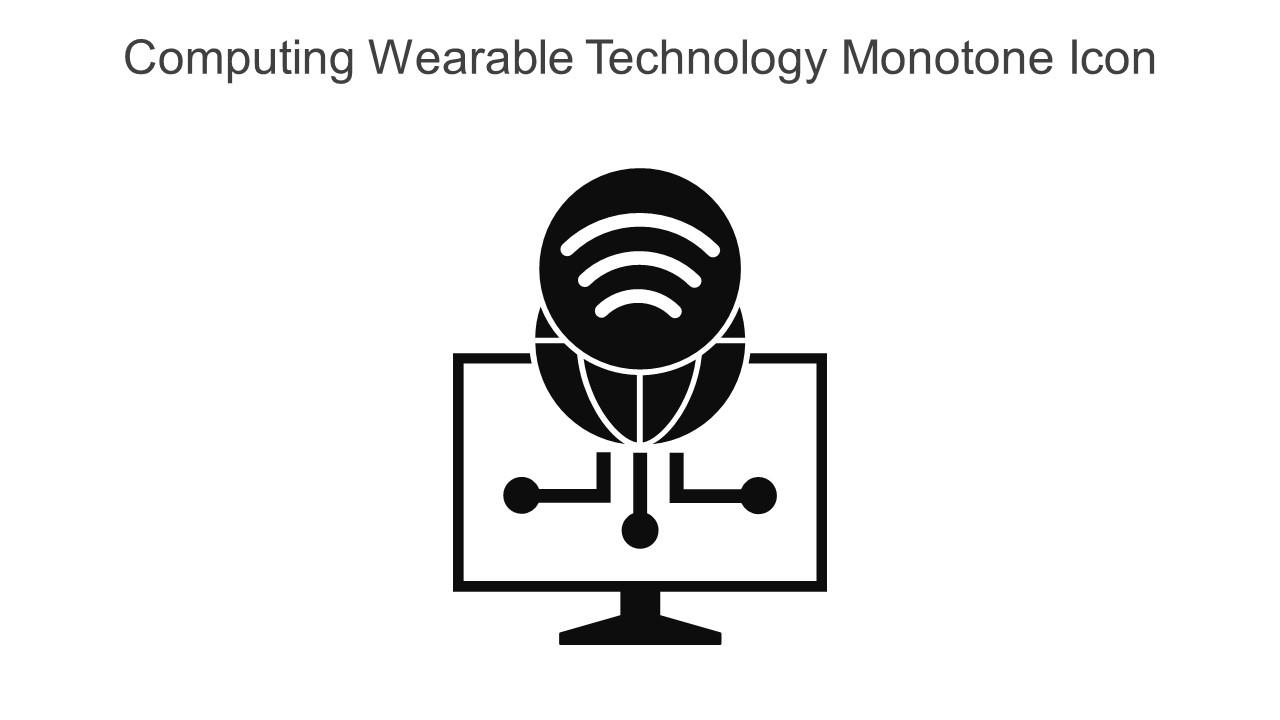
Template 2: Computing Wearable Technology Monotone Icon in PowerPoint
Visual consistency matters when presenting wearable computing concepts to mixed audiences. This PPT preset gives practitioners a clean monotone icon set purpose-built for technology decks. Designers and product leads use it to communicate device categories — smartwatch technology, fitness tracker devices, embedded wearable sensors — without cluttered visuals. The icons translate hardware concepts into instantly readable symbols. It fits naturally into broader wearable computing presentation frameworks where visual shorthand saves time. The template is 100% editable and customizable.
Download this PowerPoint Template
Template 3: Cloud Based Quantum Computing Access and Benefits PPT
Cloud architecture decisions in wearable computing are rarely straightforward. This PPT template is built for analysts and solution architects who need to present quantum computing access models and their business benefits concisely. Whether you're reviewing latency trade-offs for IoT wearables or showing how cloud backends support real-time biometric monitoring devices, this deck provides a clear visual structure. For teams covering wearable technology infrastructure, it fits naturally into a broader presentation. The template is 100% editable and customizable.
[product_image id=1596435]
Template 4: VMware Cloud Computing Solutions Presentation Deck PPT Summary
VMware cloud infrastructure presentations require precision—vague slides cost credibility fast. This deck delivers a structured, enterprise-grade visual framework for cloud computing solution briefings. Every section guides your audience from architecture overview to deployment benefit with logical clarity. The professional layout commands attention in executive reviews and technical deep-dives alike. Each layout reinforces your authority as the subject matter expert in the room. Transform your VMware solution presentations into confident, client-ready deliverables. Download this deck now and drive your cloud strategy conversations forward.
[product_image id=1575215]
Template 5: Cloud Computing Supporting Wearable Technology Data Analysis PPT Sample
Data analysis for wearable computing rarely lands well without the right visual structure. This PPT is built for teams presenting how cloud infrastructure supports activity tracking devices, wearable ECG monitors, or body sensor networks. Health tech product managers and enterprise architects reach for it when the audience needs to follow data flows, not just conclusions. It handles the heavy lifting of visualizing cloud-to-device pipelines clearly. The template is 100% editable and customizable.
[product_image id=1596436]
Template 6: Bio-Wearables a New Era in Health Monitoring PPT Presentation
Bio-wearables present a genuinely new communication challenge—clinical depth meets consumer relevance. This deck bridges that gap with a visually striking design built for health monitoring wearable presentations. Bold layouts translate complex biosensor data into narratives that clinical, investor, and product audiences can all follow. The structure moves logically from device capability through real-world health application. You can anchor discussions around wearable AI applications, wearable HR monitors, or next-generation biometric monitoring devices with equal confidence. Each slide section is designed to hold audience attention through technically dense material. The content-ready framework means you spend time on your argument, not your formatting. Transform your bio-wearables presentations into authoritative, compelling briefings today. Download this deck now and make every health technology pitch land with clarity.
[product_image id=1220179]
Template 7: Wearable and Ubiquitous Computing in PowerPoint
Ubiquitous computing is a broad concept, and most audiences need a concrete entry point. This slide is built for researchers, product designers, and technology leads presenting wearable UI design principles or smart environment integration scenarios. It captures the three-stage model that practitioners use to explain how wearable and ambient devices coexist in the same ecosystem. It works equally well for AR headset briefings and IoT wearables architecture reviews. The template is 100% editable and customizable.
[product_image id=1207288]
Elevate Every Wearable Computing Presentation with SlideTeam
SlideTeam's PowerPoint templates are the best in the industry for wearable computing presentations. These content-ready slides save hours of design time while delivering the professional structure your technical and business audiences expect. Whether you're presenting health monitoring wearables, IoT wearables architecture, or AR headset product roadmaps, these ready-made frameworks keep your message sharp. Grab these templates today and turn every wearable technology briefing into a confident, compelling presentation.
FAQs on Wearable Computing
How do wearable devices balance the trade-off between battery life and computational power?
Wearable devices manage this trade-off through three main approaches. Low-power processors handle routine tasks like step counting, while offloading heavy computation to paired smartphones or cloud servers. Duty cycling — running sensors in short bursts rather than continuously — cuts energy draw significantly. Some devices use dedicated AI chips designed for ultra-low-power inference. The result: most modern wearables prioritize efficient task distribution over raw on-device processing power.
What role does edge computing play in enhancing the performance of wearable devices?
Edge computing moves data processing closer to the wearable device — either on the device itself or on a nearby gateway. This reduces the latency that comes from sending raw sensor data to a distant cloud server. For health monitoring wearables, faster local processing means quicker alerts and more responsive feedback. It also reduces bandwidth use and keeps sensitive biometric data off public networks longer, improving both performance and privacy.
How are flexible electronics transforming the design possibilities for next-generation wearables?
Flexible electronics allow circuits and sensors to bend, stretch, and conform to body surfaces. This removes the rigid form factor constraint that limited earlier wearables to wrists and heads. Designers can now embed sensors into smart clothing, adhesive patches, and even temporary skin-worn monitors. The practical result is more accurate sensor contact, greater comfort for long-term wear, and entirely new device categories — from flexible wearable ECG monitors to conformable neural interfaces.
What are the primary challenges in ensuring data privacy for continuous health monitoring wearables?
Continuous health monitoring generates dense, sensitive personal data — and the risks are specific. Data can be intercepted in transit if encryption is weak. It can be misused by third-party apps accessing device APIs. Storage breaches expose long-term biometric histories. Regulatory compliance — particularly under GDPR or HIPAA — adds another layer of obligation. The core challenge is that users rarely understand what is collected, where it goes, or who can access it.
How does sensor fusion improve the accuracy of biometric data collected by wearables?
Sensor fusion combines data from multiple sensors — accelerometer, gyroscope, optical heart rate, skin temperature — and cross-references them in real time. No single sensor is fully accurate on its own; each has noise and blind spots. Combining their outputs filters out errors that would skew individual readings. For biometric monitoring devices, this means heart rate estimates, activity classification, and sleep staging all become meaningfully more reliable than any one sensor could deliver alone.
What distinguishes augmented reality wearables from virtual reality wearables in terms of hardware requirements?
AR wearables, like smart glasses, overlay digital content onto the physical world — so their displays must be transparent and the processing lightweight enough for real-time environment mapping. VR headsets block out the real world entirely, requiring high-resolution opaque displays, faster refresh rates, and stronger onboard processing to prevent motion sickness. AR hardware prioritizes spatial awareness and low latency. VR hardware prioritizes immersive display fidelity and full scene rendering.
How do wearables integrate with IoT ecosystems to enable smarter environments?
Wearables connect to IoT ecosystems primarily through Bluetooth, Wi-Fi, or NFC. Once connected, they share sensor data — location, biometrics, activity — with smart home systems, building management platforms, or enterprise networks. A fitness tracker can trigger smart lighting based on sleep state. A worker safety wearable can alert facility systems to a fall. The wearable acts as a personal data node inside a broader network of connected environments.
What are the ethical implications of employer-mandated wearable usage in the workplace?
Employer-mandated wearables raise clear issues around consent and power imbalance — employees may feel unable to refuse. Continuous location or biometric tracking can cross from safety monitoring into surveillance. Data collected at work can reveal health conditions, stress levels, or personal habits that employees haven't chosen to disclose. Organizations must be transparent about what is collected, set strict data retention limits, and separate health data from performance evaluation entirely.