


Chatgpt Vs Bing Chat Key Differences Ultimate Showdown Of Ai Powered Chatgpt Vs Bard Chatgpt SS




Try Before you Buy Download Free Sample Product
 Impress Your
 Audience
 100%
100% Editable
 Save Hours
 of Time


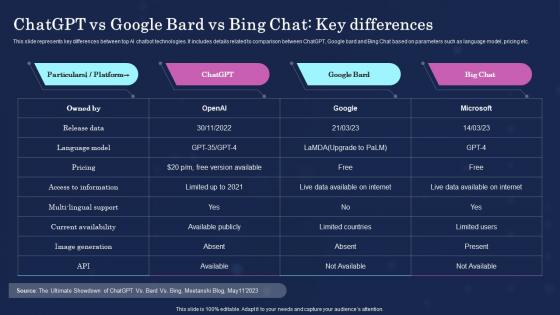
This slide represents key differences between top AI chatbot technologies. It includes details related to comparison between ChatGPT, Google bard and Bing Chat based on parameters such as language model, pricing etc.
People who downloaded this PowerPoint presentation also viewed the following :
Chatgpt Vs Bing Chat Key Differences Ultimate Showdown Of Ai Powered Chatgpt Vs Bard Chatgpt SS with all 9 slides:
Use our Chatgpt Vs Bing Chat Key Differences Ultimate Showdown Of Ai Powered Chatgpt Vs Bard Chatgpt SS to effectively help you save your valuable time. They are readymade to fit into any presentation structure.








FAQs for Chatgpt Vs Bing Chat Key Differences Ultimate Showdown Of Ai Powered Chatgpt Vs
ChatGPT utilizes OpenAI's GPT architecture with reinforcement learning from human feedback, while Bing Chat integrates GPT-4 with Microsoft's Prometheus model, real-time web search capabilities, and citation systems. These technological approaches deliver different user experiences, with ChatGPT focusing on conversational depth and Bing Chat emphasizing current information retrieval, ultimately enabling organizations to choose solutions based on their specific operational needs and information requirements.
ChatGPT and Bing Chat handle user input through natural language processing with context retention varying by conversation length, with ChatGPT maintaining longer conversational memory while Bing Chat focuses on search-integrated responses. Both platforms enable businesses to streamline customer interactions, automate support functions, and enhance user experiences, with many organizations finding that strategic implementation delivers improved response times and operational efficiency.
ChatGPT prioritizes accuracy through extensive training data, continuous model refinement, and built-in safety filters, while Bing Chat enhances reliability by integrating real-time web search results and citing sources. These approaches enable organizations to leverage AI for customer service, content creation, and research tasks, with many businesses finding that combining both platforms delivers comprehensive solutions while maintaining credibility and trust.
ChatGPT and Bing Chat address privacy through different approaches, with ChatGPT offering conversation deletion options and opt-out controls, while Bing Chat integrates Microsoft's enterprise-grade security protocols and Azure compliance frameworks. Both platforms enable organizations to maintain data governance standards, though many financial services and healthcare institutions find that Microsoft's established enterprise infrastructure delivers enhanced regulatory compliance and seamless integration with existing security systems.
ChatGPT excels in creative storytelling, nuanced dialogue, and imaginative content generation, while Bing Chat leverages real-time web access for current references and factual grounding in creative works. ChatGPT offers more consistent creative voice and narrative flow, though Bing Chat provides fresher context and citations, with content creators increasingly finding that ChatGPT delivers superior pure creativity while Bing Chat enhances research-backed creative projects.
ChatGPT features a minimalist, conversation-focused interface with clean text input and streamlined chat history, while Bing Chat integrates search functionality with chat responses, offering web citations and suggested follow-up questions. ChatGPT's simplicity enhances accessibility for users seeking straightforward interactions, whereas Bing Chat's search integration delivers comprehensive research capabilities, with many organizations finding that each interface serves distinct workflow needs.
ChatGPT excels in creative industries, content marketing, education, and software development through its advanced reasoning and conversational abilities, while Bing Chat benefits research-heavy sectors, journalism, financial services, and consulting with its real-time web integration. Many organizations find that combining both platforms strategically enhances operational efficiency, with creative teams leveraging ChatGPT's ideation capabilities and analytical departments utilizing Bing Chat's current information access.
ChatGPT and Bing Chat manage conversational flow through advanced natural language processing, context retention algorithms, response prioritization systems, and turn-based interaction protocols. These AI platforms streamline dialogue management by maintaining conversation history, recognizing user intent shifts, and delivering contextually relevant responses, with many organizations finding that strategic implementation enhances customer interactions and operational efficiency.
ChatGPT's training on diverse text sources excels in creative writing, detailed explanations, and conversational tasks, while Bing Chat's integration with current web data delivers superior performance in real-time information retrieval and recent events. These different approaches enable organizations to leverage ChatGPT for content creation and strategic planning, with Bing Chat proving invaluable for market research and competitive intelligence requiring up-to-date insights.
ChatGPT and Bing Chat enhance user experiences through strategic integrations, with ChatGPT connecting to third-party applications via plugins and APIs, while Bing Chat seamlessly integrates with Microsoft's ecosystem including Office 365, Teams, and Edge browser. These integrations streamline workflows by enabling real-time web searches, document analysis, and collaborative features, ultimately delivering enhanced productivity and comprehensive information access.
Continuous learning enables ChatGPT and Bing Chat to enhance accuracy, expand knowledge bases, refine conversational abilities, and adapt to evolving user needs through ongoing data analysis and model refinement. This iterative improvement process helps organizations leverage increasingly sophisticated AI capabilities for customer service, content creation, and decision support, ultimately delivering more reliable automated interactions and competitive advantages in an increasingly AI-driven business landscape.
ChatGPT uses thumbs-up/down ratings and detailed feedback forms to capture user satisfaction, while Bing Chat incorporates feedback buttons and search result relevance ratings within its integrated search environment. These mechanisms enable both platforms to refine their algorithms through user interaction data, with ChatGPT focusing on conversational quality and Bing Chat optimizing search-integrated responses, ultimately delivering more personalized and accurate user experiences.
AI chatbots like ChatGPT and Bing Chat revolutionize customer service by delivering 24/7 availability, instant responses, multilingual support, and consistent service quality across all interactions. These technologies streamline operations by reducing wait times, minimizing staffing costs, and handling routine inquiries efficiently, with many organizations finding that strategic implementation enhances customer satisfaction while enabling human agents to focus on complex, high-value interactions.
ChatGPT supports over 95 languages with strong conversational abilities across major global languages, while Bing Chat leverages Microsoft Translator's infrastructure for real-time translation and multilingual search integration. Both platforms enable seamless cross-language communication, with many international businesses finding that these capabilities streamline global customer interactions, enhance market accessibility, and deliver competitive advantages in increasingly diverse markets.
Key ethical considerations include data privacy protection, algorithmic bias mitigation, transparency in AI-generated responses, content accuracy verification, and user consent protocols. These chatbots present both opportunities for enhanced accessibility and challenges around misinformation risks, with many organizations finding that implementing robust oversight frameworks, regular bias audits, and clear AI disclosure policies ultimately delivers more trustworthy user experiences.
-
Definitely a time saver! Predesigned and easy-to-use templates just helped me put together an amazing presentation.
-
Use of different colors is good. It's simple and attractive.