

Creating An Effective Leadership Training Program Powerpoint Presentation Slides





Try Before you Buy Download Free Sample Product
 Impress Your
Audience
 100%
Editable
 Save Hours
of Time


Explore our meticulously crafted Creating an Effective Leadership Training Program PowerPoint Presentation. Encompassing training at all management levels, our Skill Development Program presentation provides a comprehensive training blueprint cultivating competencies essential for personal, team, and organizational leadership. It includes a skill gap assessment to pinpoint training needs and enhance performance in present leadership roles. Moreover, our Leadership Management PPT outlines competencies to address skill gaps with tailored training programs for the novice, mid level, and senior managers. It delves into leadership skill development, fostering an understanding of personal leadership styles. Additionally, the Executive Development module focuses on Team Management Training, equipping leaders to achieve objectives while navigating diverse cultural attributes. Lastly, with a budget planning template to assess training costs and various assessment tools such as the 360 degree feedback model, DISC model Dominance, Influence, Steadiness, Conscientiousness, and ESCI model Emotional and Social Competency Inventory, this template ensures comprehensive training evaluation. Access our 100 percent editable Leadership Powerpoint Presentation Slides based on needs.
People who downloaded this PowerPoint presentation also viewed the following :
Content of this Powerpoint Presentation
Slide 1: This slide introduces Creating an Effective Leadership Training Program. Commence by stating Your Company Name.
Slide 2: This slide depicts the Agenda of the presentation.
Slide 3: This slide incorporates the Table of contents.
Slide 4: This slide highlights the Title for the Topics to be covered further.
Slide 5: This slide showcases Company survey result on essential elements required for effective leadership.
Slide 6: This slide portrays the Current leadership skill gap analysis to assess training needs.
Slide 7: This slide shows the Training and development requirement for leaders and managers.
Slide 8: This slide portrays the Heading for the Contents to be discussed next.
Slide 9: This slide reveals the Three month training timeline for leadership development program.
Slide 10: This slide presents the Target audience for leadership development program.
Slide 11: This slide indicates the Title for the Ideas to be covered in the upcoming template.
Slide 12: This slide depicts the Four E’s of leadership development plan.
Slide 13: This slide showcases the 70-20-10 rule of leadership skill development.
Slide 14: This slide reveals the Heading for the Ideas to be discussed next.
Slide 15: This slide exhibits the Four key elements of self-awareness.
Slide 16: This slide portrays the SWOT analysis for personal leadership development.
Slide 17: This slide showcases the weekly exercise of recognizing personal emotions and impact of each emotions on work performance.
Slide 18: This slide reveals the classroom training program for developing emotional intelligence at workplace.
Slide 19: This slide indicates the Title for the Contents to be covered further.
Slide 20: This slide states the self evaluation exercise to identify personal level of competency in self-management.
Slide 21: This slide displays the Outdoor trainings for developing self-management skills.
Slide 22: This slide reveals the Self-assessment exercise based on Blake and Mouton leadership model.
Slide 23: This slide exhibits the Heading for the Ideas to be discussed next.
Slide 24: This slide showcases training plan for improving communication skills of employees for building professional relationships.
Slide 25: The slide presents the training plan for improving teamwork skills for achieving better results.
Slide 26: This slide talks about the Active listening skill training for leaders and managers.
Slide 27: This slide portrays training plan for improving teamwork skills for achieving better results.
Slide 28: This slide depicts the Title for the Contents to be covered in the upcoming template.
Slide 29: The following slide showcases the training programs aiming to minimize effects of conflicts at all levels.
Slide 30: This slide mentions the Training program to develop strategic thinking.
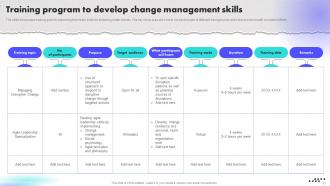
Slide 31: This slide displays the Training program to develop change management skills.
Slide 32: This slide reveals the Heading for the Topics to be discussed next.
Slide 33: The following slide showcases transformative executive leadership courses to develop leaders at the top of the organization.
Slide 34: This slide presents the Transformative leadership training program for mid-level managers.
Slide 35: This slide focuses on Maximizing leadership potential with first-time manager training program.
Slide 36: This slide includes the Title for the Topics to be covered in the forthcoming template.
Slide 37: This slide exhibits the Resource planning to check requirements for training programs.
Slide 38: The slide showcases the budget analysis of leadership training program.
Slide 39: This slide reveals the Average expenditure on leadership development per person.
Slide 40: This slide contains the Heading for the Contents to be discussed next.
Slide 41: The following slide showcases the 360 degree tool for leadership assessment.
Slide 42: This slide presents the ESCI model to assess leadership skills of all level managers.
Slide 43: This slide displyas the ESCI model for assessing leadership skills at functional level.
Slide 44: This slide exhibits the assessment level of company managers on the parameters of DISC model.
Slide 45: This slide represents the Dashboard to track leader’s competency level on monthly basis.
Slide 46: This is the Icons slide containing all the Icons used in the plan.
Slide 47: This slide is used for depicting some Additional information.
Slide 48: This is the About us slide. State your company-related information here.
Slide 49: This is our mission slide containing the organization's mission, vision, and values.
Slide 50: This is the Idea generation slide for encouraging fresh ideas.
Slide 51: This is the 30 60 90 days plan slide for effective planning.
Slide 52: This slide exhibits the firm's Timeline.
Slide 53: This is the Puzzle slide with related imagery.
Slide 54: This slide contains the Post it notes for reminders and deadlines.
Slide 55: This slide elucidates information related to the Financial topic.
Slide 56: This is the Thank You slide for acknowledgement.
Creating An Effective Leadership Training Program Powerpoint Presentation Slides with all 61 slides:
Use our Creating An Effective Leadership Training Program Powerpoint Presentation Slides to effectively help you save your valuable time. They are readymade to fit into any presentation structure.









FAQs for Creating An Effective Leadership Training Program
Honestly, emotional intelligence is probably the biggest one - you've gotta read people and situations quickly. Communication skills are massive too, especially explaining your vision to different groups. Everything changes so fast now, so adaptability is clutch. Oh, and strategic thinking - seeing the big picture while handling daily chaos is tough but necessary. Data-driven stuff matters since we're all obsessed with metrics these days (sometimes annoyingly so). Digital literacy too, obviously. I'd pick whichever area feels like your weakest spot and find a mentor or course. Don't try tackling everything at once though.
Each industry really needs its own approach, you know? Healthcare folks deal with patient safety and all that regulatory stuff daily. Tech companies? They're juggling remote teams and constant innovation cycles. Manufacturing is more about operational efficiency and keeping people safe on the floor - honestly way different than what a hospital administrator faces. I'd start by actually asking your target audience what frustrates them most as leaders day-to-day. Then build training around real scenarios they'll recognize. Case studies help tons. The terminology matters too - speak their language, not generic business-speak that doesn't land.
Dude, EQ is everything in leadership. You gotta read people's vibes and handle your own emotions instead of just shouting commands at everyone. Practice really listening to your team - like actually hearing them, not just waiting for your turn to talk. Get feedback on how you come across because we're all terrible at seeing our own issues, honestly. Oh, and try role-playing tough conversations with someone you trust. It sounds cheesy but it works. Start by asking your people how they feel about your communication style. That feedback alone will probably blow your mind and give you tons to improve on.
Honestly, mix it up - don't just pick one thing. Workshops are solid for building basics and learning from other people's mistakes. Then add some one-on-one coaching for the stuff you're really struggling with. Online courses? Meh, they're useful for background knowledge but kinda boring without real interaction. The projects where you actually practice new skills in real situations - those stick way better than just reading about leadership theory. Oh, and don't sleep on peer mentoring. Other leaders' horror stories and wins are gold. Start with a workshop, then layer in coaching sessions for the hard parts.
You gotta measure both the obvious stuff and the harder-to-pin-down things. 360 feedback scores are solid, plus employee surveys and whether people actually stick around under trained managers. Performance data helps too - like how their teams hit goals or get promoted. Honestly, separating training impact from everything else is kinda impossible, but whatever. Do your baseline before training starts, then check back at 3, 6, and 12 months. Oh, and set up some basic dashboard so you're not scrambling to find numbers later. Makes the whole thing way less painful.
Honestly, the trickiest part is getting leadership to actually care instead of just checking a box. Budget's always tight too. Half the time managers bail on sessions because they're "too busy" - super frustrating. People also think leadership training is just touchy-feely nonsense that won't help them hit their numbers. And don't even get me started on trying to prove it actually works beyond those useless happy sheets. My take? Find a few people who are actually interested first. Connect everything to real business stuff they care about. But here's the game-changer - if your executives show up and participate, suddenly everyone else takes it seriously.
Honestly, just pair each trainee with someone experienced right from the start. Have the mentors actually sit in on training sessions with their people, then do regular check-ins after to talk through how to use this stuff for real. Way more effective than just doing workshops and hoping it sticks. Monthly conversations work well - give the mentors some basic talking points so they're not winging it completely. The mentor thing is clutch because they help connect the dots between what you learn in theory and the actual chaos of leading people day-to-day.
So the big thing now is AI that creates personalized learning paths for each person. VR simulations are huge too - you can practice leadership scenarios without screwing up in real life, which is pretty cool. Micro-learning is everywhere, like 5-10 minute modules you can knock out between meetings. Oh, and emotional intelligence training is finally getting the attention it deserves. Companies want inclusive leaders, not those old-school command types. The leaders coming out of these programs are way better at managing remote teams and working across cultures. If you're thinking about upskilling, definitely look for programs with VR practice or AI feedback. Game changers.
You've gotta model curiosity yourself first - that's huge. After any project (good or bad), ask "what'd we learn here?" and actually listen. I can't tell you how many managers claim they want innovation but then freak out over every mistake. It's so counterproductive. Budget time for learning, even if it's just weekly 30-minute skill shares. Celebrate when people try stuff, even messy attempts. Here's the thing though - start by sharing what YOU'RE struggling to learn right now. Being vulnerable as a leader? That creates the psychological safety everyone needs to actually take risks.
So diversity training actually makes you way better at leading teams - you'll connect with people more and spot those blind spots we all have. The emotional intelligence piece is huge. Plus you learn how to make everyone feel safe speaking up, which honestly leads to some pretty brilliant ideas you wouldn't get otherwise. I had a few "oh shit" moments when I did mine - really opened my eyes. Look for programs that give you real scenarios to practice with, not just lectures. You want stuff you can use Monday morning, you know?
Dude, experiential learning is a total game-changer for leadership training. People retain like 90% of what they actually do versus only 10% from boring lectures - crazy difference, right? Get your participants doing real simulations and role-playing those awkward conversations nobody wants to have. Work through actual case studies from your company too. It's honestly like learning to ride a bike - you can't just read about it and expect to not fall flat on your face. Even something small works, like a 15-minute partner exercise each session. The hands-on stuff just sticks way better than passive listening ever will.
Honestly, most workshops die after like two weeks because nobody follows up. You need peer coaching sessions where people tackle real work problems together - not just theory stuff. Managers should check in monthly about what's actually being used (and what's total garbage). Give participants tiny actions they can try right away instead of dumping a million concepts on them. The accountability piece is huge. I'd start with monthly reviews, then spread them out once people get into the groove. Oh, and create spaces where they can admit when something isn't working without getting side-eyed.
Yeah so remote work totally flips the script - you can't just walk over and check on people anymore. Trust becomes huge, and you're focusing way more on actual results than just seeing butts in seats. Communication skills matter SO much more now since everything's virtual meetings and Slack messages. Training programs worth checking out usually cover stuff like not-boring video calls, giving feedback through a screen (harder than it sounds), and somehow building team vibes when everyone's working from their kitchen table. Oh and learning to lead through influence instead of just being physically around. Honestly the whole thing's made me rethink what good leadership even looks like.
Dude, cross-functional training is honestly a game changer for developing leaders. Your people get to see how the whole company actually fits together instead of just staying stuck in their own bubble. They'll learn different problem-solving styles and figure out how to talk to teams that think totally differently than theirs. Way more interesting than boring traditional leadership stuff too. Short rotations work great - or just throw them on cross-department projects first. The networking alone is worth it, plus they start thinking bigger picture. That's what separates the decent managers from the ones who actually get it.
Honestly, feedback makes or breaks these programs. I'd hit people up right after sessions while they remember stuff, then again a few weeks later once they've actually tried things out. The real test? Check back months later to see what stuck around. Quick surveys work great, but face-to-face convos usually get you better intel. Peer circles are solid too - sometimes people are more honest with each other than with trainers. Oh, and if you can watch leaders doing their thing in real situations, that's gold. Just make it super easy for people to give you straight answers, not sugar-coated nonsense.
-
Good research work and creative work done on every template.
-
Awesome use of colors and designs in product templates.