


Leadership Powerpoint Presentation Slides





Try Before you Buy Download Free Sample Product
 Impress Your
 Audience
 100%
100% Editable
 Save Hours
 of Time


Wish to implement leadership strategies that influence, engage and encourage excellence performance in the organization? SlideTeam has come up with content ready leadership PowerPoint presentation slides to portray the management abilities of the workforce. These team management PPT templates include slides like leadership introduction, leadership vs. management, control styles and theories, participating captaincy process, strategic management, business theory, adaptive performance, group cohesion, communication patterns and many more. Apart from this, if you want customized designs for your presentation, our design team is at your service. Our predesigned leader-member exchange theory presentation can be used for the topics like leadership skills and training, qualities of leadership, leadership in management, leadership strategies & practices, productive guidance etc. Click and download our leadership PowerPoint presentation templates and make your team efficient. Folks are enthralled by the explosion of colors in our Leadership Powerpoint Presentation Slides. It's iridescence increases interest.
People who downloaded this PowerPoint presentation also viewed the following :
Content of this Powerpoint Presentation
Slide 1: This slide introduces Leadership. State company name here and get started.
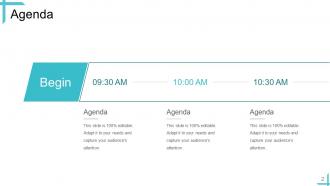
Slide 2: This is an Agenda slide. State your Starting agendas here.
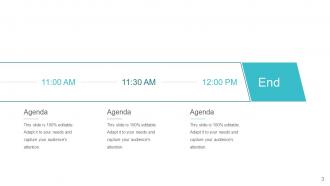
Slide 3: This is also an Agenda slide. State your Ending Agendas here.
Slide 4: This slide defines What is Leadership with imagery.
Slide 5: This slide presents the Definition of Leadership
Slide 6: This slide states what Leadership Is.
Slide 7: This slide states Who is a Leader? with introduction, definition etc.
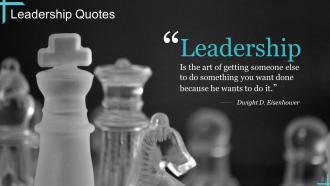
Slide 8: This slide presents Leadership Quotes for inspiration, motivation etc. You may change the slide content as per need.
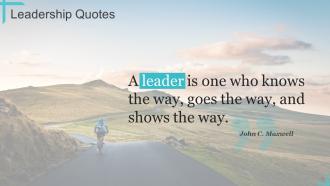
Slide 9: This too is a Leadership Quotes slide with background imagery.
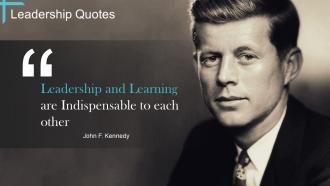
Slide 10: This slide shows another variation of Leadership Quotes.
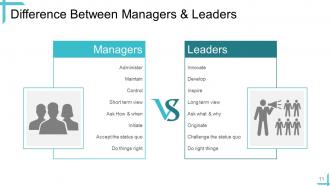
Slide 11: This slide states the Difference Between Managers & Leaders. Showcase it here in points.
Slide 12: This is a Leadership vs Management slide with respect to the following factors- Role, Focus, Approach, Methodology, Style/tone, Outcome.
Slide 13: This slide states the Qualities of a Good Leader such as- Shared Vision, Lead Change, Set Example, Inspire People, Empower People, Honest, Competent, Forward Looking.
Slide 14: This slide states Formal and Informal Leadership in points.
Slide 15: This slide is titled Styles of Leadership.
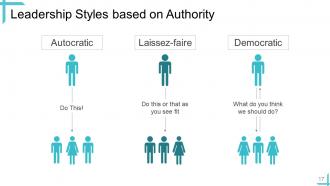
Slide 16: This slide presents Leadership Styles based on Authority in a flow chart form.
Slide 17: This is another slide showing Leadership Styles Based On Authority divided into three categories- Autocratic, Laissez-faire, Democratic.
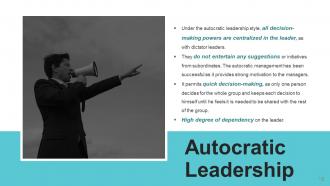
Slide 18: This slide presents the definition of Autocratic Leadership with imagery. You can alter it as per need.
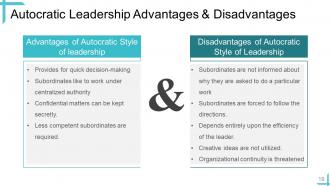
Slide 19: This slide showcases Autocratic Leadership Advantages & Disadvantages. You can add your own as per your need and use it.
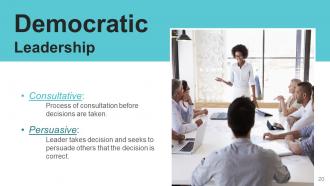
Slide 20: This slide showcases Democratic Leadership with imagery divided into- Consultative, Persuasive.
Slide 21: This slide presents a list of Democratic Leadership Advantages & Disadvantages.
Slide 22: This slide shows Laissez Faire Leadership.
Slide 23: This slide states Laissez-faire Leadership Advantages & Disadvantages in points. You can refine them on the basis of your requirements.
Slide 24: This is a Based on Task vs People Emphasis matrix slide ranging from High to Low and vice versa.
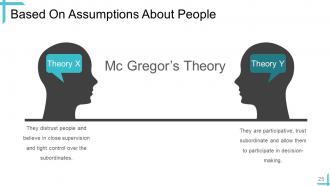
Slide 25: This is Based On Assumptions About People slide showing Mc Gregor’s Theory with human head imagery.
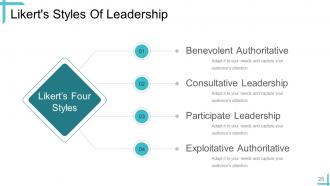
Slide 26: This slide showcases Likert's Styles of Leadership which include the following 4 points- Benevolent Authoritative, Consultative Leadership, Participate Leadership, Exploitative Authoritative.
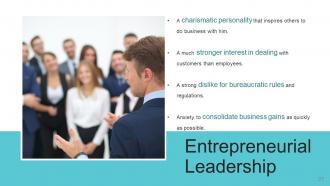
Slide 27: This slide states Entrepreneurial Leadership facts and information to be displayed.
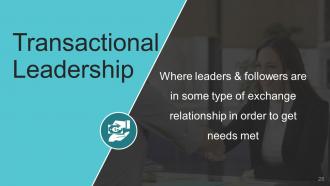
Slide 28: This slide showcases Transactional Leadership.
Slide 29: This is a Transformational Leadership slide showcasing its 4 important components- Inspirational Motivation, Individual Consideration, Idealized Influence, Intellectual Stimulation.
Slide 30: This is Transactional vs Transformational Leadership slide to state.
Slide 31: This slide is titled Theories of Leadership.
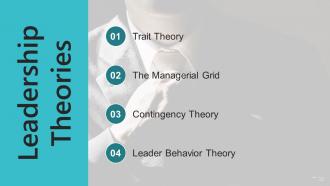
Slide 32: This slide showcases four Leadership Theories. These are- Trait Theory, The Managerial Grid, Contingency Theory, Leader Behavior Theory.
Slide 33: This is Trait Theory of Leadership slide showing Personality Traits further divided into three components- Abilities Personal Traits Motivators
Slide 34: This slide states What Makes a Leader with the following points- A Born Leader, Honesty and Integrity, Maturity and Charisma, Analytical Ability, Self Confidence, A Desire to Lead, Development, Contextualize Decisions, A Drive to Achieve.
Slide 35: This slide showcases various Traits and Skills (Leaders vs Non-Leaders). Monitor them and change as per requirement.
Slide 36: This is Behavioral Theory of Leadership differentiating between Behavioral Theory and Trait Theory.
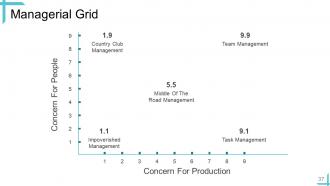
Slide 37: This slide shows Managerial Grid matrix with two parameters- Concern For People, Concern For Production.
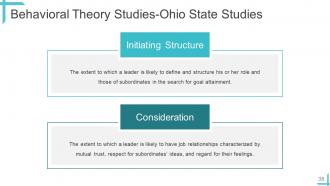
Slide 38: This slide showcases Behavioral Theory Studies-Ohio State Studies with- Consideration, Initiating Structure.
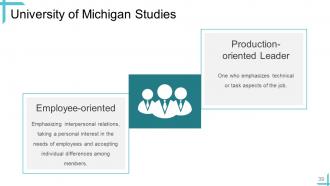
Slide 39: This slide states University of Michigan Studies with the following points- Employee-oriented, Production-oriented Leader.
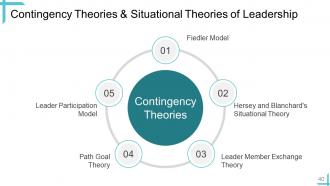
Slide 40: This slide shows 4 Contingency Theories & Situational Theories of Leadership. These are- Fiedler Model, Hersey and Blanchard's Situational Theory, Leader Member Exchange Theory, Path Goal Theory, Leader Participation Model.
Slide 41: This is a Coffee Break image slide to halt. Alter as per need.
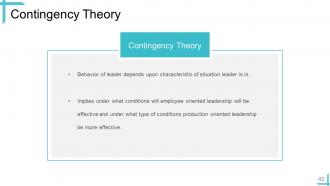
Slide 42: This slide states Contingency Theory with description, introduction etc.
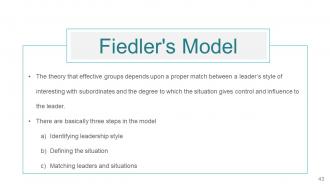
Slide 43: This slide shows Fiedler's Model.
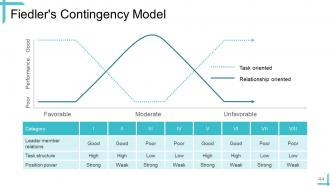
Slide 44: This slide presents Fiedler's Contingency Model in a graphical form with the following parameters- Favorable Moderate Unfavorable
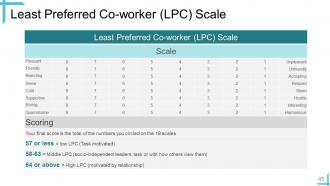
Slide 45: This slide showcases Least Preferred Co-worker (LPC) Scale with Scroring.
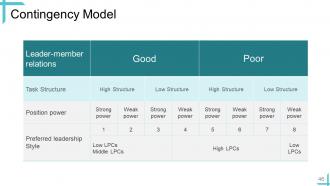
Slide 46: This slide shows Contingency Model.
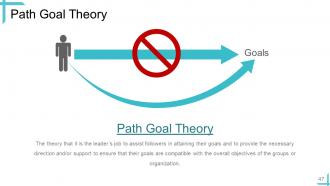
Slide 47: This slide shows Path Goal Theory.
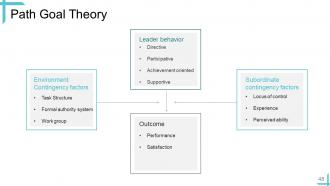
Slide 48: This slide also shows Path Goal Theory further divided into 4 components- Leader behavior, Environment Contingency factors, Subordinate contingency factors, Outcome.
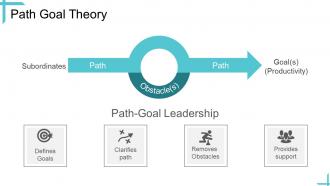
Slide 49: This too is a Path Goal Theory slide showing Path-Goal Leadership with the following functions to perform- Defines Goals, Clarifies path, Removes Obstacles, Provides support.
Slide 50: This slide shows How Path Goal Theory Works with- Subordinate Behavior, Task Characteristics, Leadership Behavior.
Slide 51: This slide shows Hersey & Blanchard's Situational Leadership (SLT) matrix. You can add or modify text as per need.
Slide 52: This slide states Four Leadership Styles (Hersey & Blanchard)- Telling, Selling, Participating, Delegating.
Slide 53: This slide presents Leader-Member Exchange Theory in a flow chart form. You can add or modify text as per need.
Slide 54: This slide showcases the Normative Decision Model (Vroom & Yetton ).
Slide 55: This is Participative Leadership slide showing Continuum Of Decision Procedures.
Slide 56: This slide showcases Participative Leadership Process with the following 6 steps- Facilitate the conversation, Openly share information and knowledge, Encourage people to share their ideas, Synthesize all the available information, Take the best possible decision, Communicate their decision back to the group.
Slide 57: This slide states Four Types of Participative Decision Making. These are- Democratic, Consensus, Collective, Autocratic.
Slide 58: This slide showcases Icons For Leadership. Use icons as per requirement.
Slide 59: This slide is titled Additional Slides to proceed further. You may alter the slide content as required.
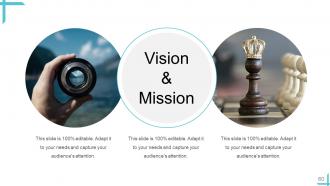
Slide 60: This is Vision & Mission slide. State your mission, vision etc. here.
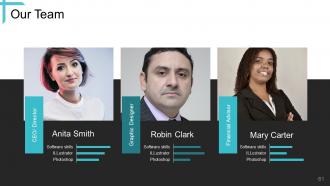
Slide 61: This is Our team slide with names and designation to fill.
Slide 62: This is an About us slide to state company specifications etc.
Slide 63: This slide shows Our Main Goals such as Satisfaction, Communication, Values etc.
Slide 64: This slide shows Comparison between two enties etc.
Slide 65: This is a Dashboard slide to state metrics, kpis etc.
Slide 66: This is a Location slide on a world map image to show global presence, growth etc.
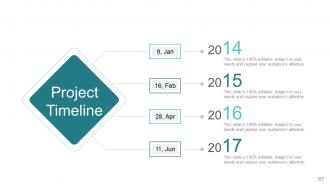
Slide 67: This is a Project Timeline slide to show evolution, growth, milestones etc.
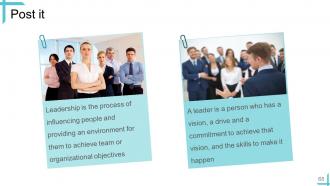
Slide 68: This is a Post It slide to mark events, important information etc.
Slide 69: This is a Puzzle pieces slide to show information, specifications etc.
Slide 70: This is a Target image slide. State targets, etc. here.
Slide 71: This is a Venn diagram image slide to show information, specifications etc.
Slide 72: This slide shows a Mind map for representing entities.
Slide 73: This is a LEGO slide with text boxes to show information.
Slide 74: This is a Silhouettes slide to show people specific information etc.
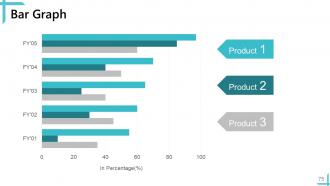
Slide 75: This slide presents a Bar Graph for showcasing product/ company growth, comparison etc.
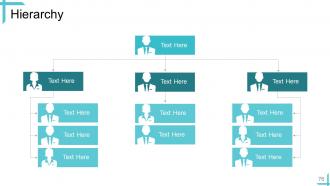
Slide 76: This is a Hierarchy slide to show information, organization structural specifications etc.
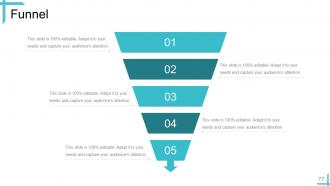
Slide 77: This slide displays a Funnel image. State information, funneling aspects etc. here.
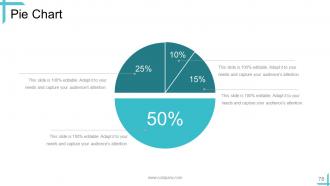
Slide 78: This is a Pie Chart slide to show product comparison etc.
Slide 79: This is a Contact Us slide with Email, Address# street number, city, state, Contact Numbers.
Slide 80: This is a Thank You slide for acknowledgement or to end the presentation.
Leadership Powerpoint Presentation Slides with all 80 slides:
Explore fresh areas with our Leadership Powerpoint Presentation Slides. Expand your business at your convenience.
-
Leadership
-
Agenda
-
Agenda Slide
-
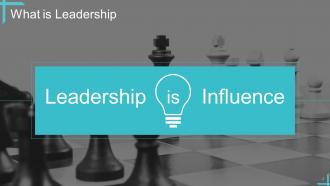
What is Leadership
-
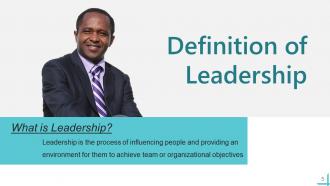
Definition of Leadership
-
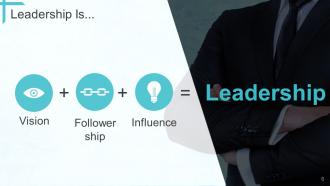
Leadership Is
-
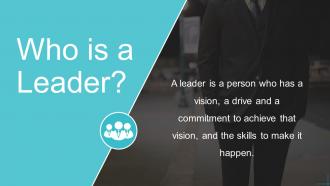
Who is a Leader
-
Leadership Quotes
-
Leadership Quotes
-
Leadership Quotes
-
Difference Between Managers Leaders
-
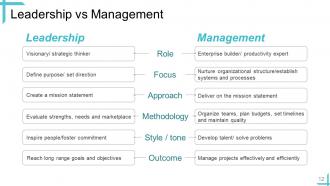
Leadership vs Management
-
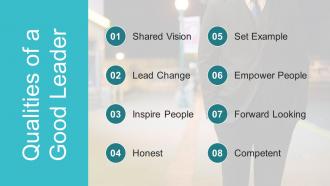
Qualities of a Good Leader
-

Formal and Informal Leadership
-
Styles of Leadership
-
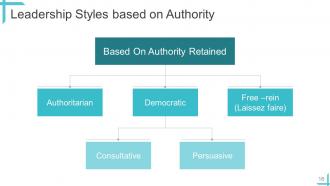
Leadership Styles based on Authority
-
Leadership Styles based on Authority
-
Autocratic Leadership
-
Autocratic Leadership Advantages Disadvantages
-
Democratic Leadership
-
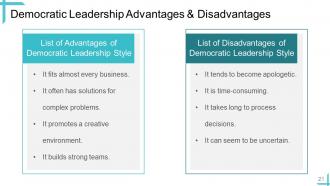
Democratic Leadership Advantages Disadvantages
-
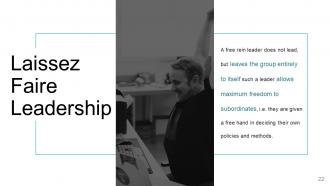
Laissez Faire Leadership
-
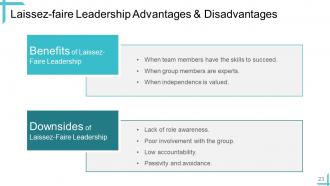
Laissez faire Leadership Advantages Disadvantages
-
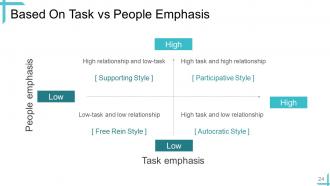
Based On Task vs People Emphasis
-
Based On Assumptions About People
-
Likert s Styles Of Leadership
-
Entrepreneurial Leadership
-
Transactional Leadership
-
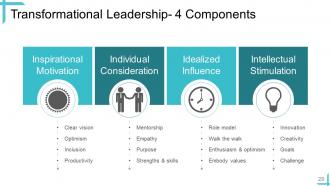
Transformational Leadership 4 Components
-
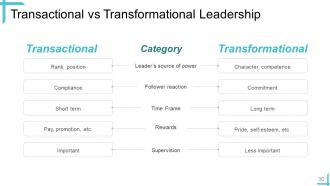
Transactional vs Transformational Leadership
-
Theories of Leadership
-
Leadership Theories
-
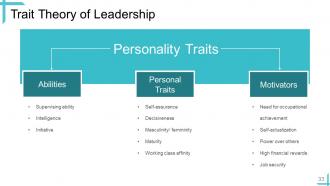
Trait Theory of Leadership
-
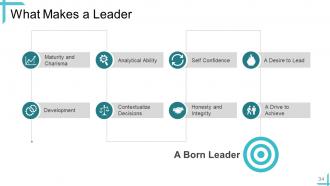
What Makes a Leader
-
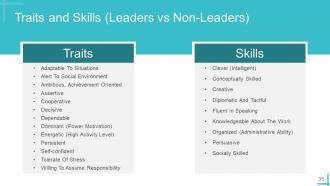
Traits and Skills Leaders vs Non Leaders
-
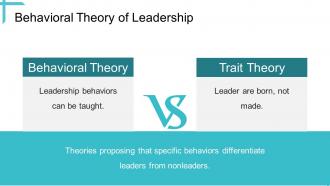
Behavioral Theory of Leadership
-
Managerial Grid
-
Behavioral Theory Studies Ohio State Studies
-
University of Michigan Studies
-
Contingency Theories Situational Theories of Leadership
-

Leadership
-
Contingency Theory
-
Fiedler s Model
-
Fiedler s Contingency Model
-
Least Preferred Co worker LPC Scale
-
Contingency Model
-
Path Goal Theory
-
Path Goal Theory
-
Path Goal Theory
-
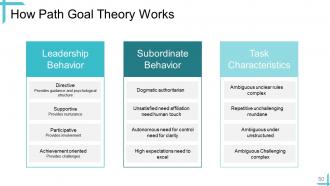
How Path Goal Theory Works
-
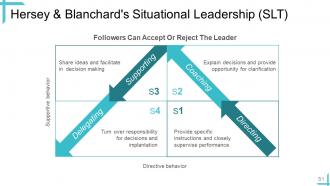
Hersey Blanchard s Situational Leadership SLT
-
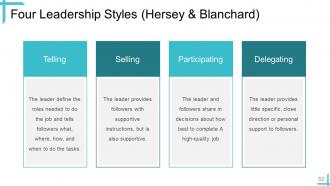
Four Leadership Styles Hersey Blanchard
-
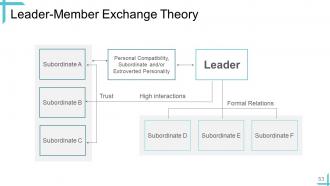
Leader Member Exchange Theory
-
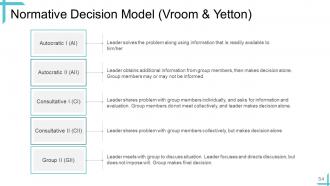
Normative Decision Model Vroom Yetton
-
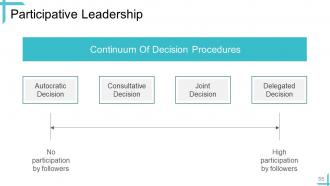
Participative Leadership
-
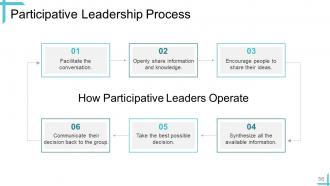
Participative Leadership Process
-
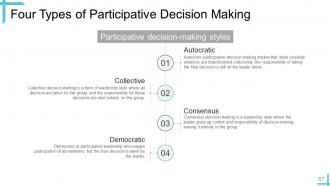
Four Types of Participative Decision Making
-
Icons for Leadership
-
Additional Slides
-
Vision Mission
-
Our Team
-

About Us
-
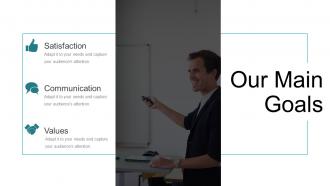
Our Main Goals
-
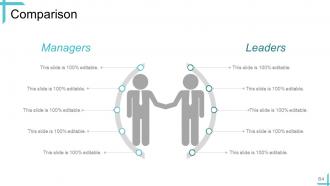
Comparison
-
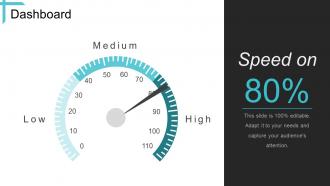
Dashboard
-
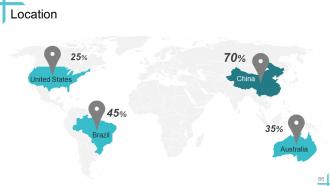
Location
-
Project Timeline
-
Post it
-
Puzzle Pieces
-
Target
-
Venn
-
Mind Map
-
Lego
-
Silhouettes
-
Bar Graph
-
Hierarchy
-
Funnel
-
Pie Chart
-

Contact US
-
Leadership
FAQs for Leadership
Honestly? The best leaders I've seen are just emotionally smart and flexible. They can read a room, pivot when shit changes (which is constantly), and they're not afraid to say "I don't know" sometimes. Communication is everything - actually listening instead of just waiting to jump in. Remote work made empathy way more critical too, since everyone feels so disconnected now. Oh, and here's something most people skip: just ask your team what they need from you as a leader. Their answers will probably surprise you. Transparency beats having all the answers every time.
Honestly, your leadership style pretty much dictates everything about team dynamics. Autocratic gets stuff done fast but crushes creativity - and who wants to be micromanaged constantly? With democratic leadership, people actually feel heard so you'll see way more engagement and fresh ideas. Takes forever to make decisions though. Laissez-faire? Perfect for seasoned teams who know their stuff, but total disaster if you've got newbies who need hand-holding. I've seen that go sideways so many times. Really comes down to reading your team's experience and what situation you're dealing with. Watch how people react to your current approach and tweak from there.
Honestly, you can't lead people well if you can't read emotions - yours or theirs. Self-awareness is huge. Like, notice when you're stressed and snapping at everyone? That kills team morale fast. Empathy matters too - understanding what actually motivates each person on your team. I've seen so many managers miss obvious signs that someone's struggling or frustrated. Social skills are the third piece. Really listen when people talk (not just waiting for your turn). Watch body language during meetings. Nobody follows leaders who seem emotionally clueless or unpredictable. Start small - just pay attention to how your mood ripples out to others.
Look, people won't take risks if they think you'll shut them down. So when someone throws out a crazy idea, don't immediately poke holes in it. Actually celebrate when experiments fail - that's how you learn stuff. Give your team real time to mess around with new ideas (Google does that 20% thing for a reason). Cut through the red tape that kills creativity before it even gets started. Oh, and here's the thing most managers miss - admit when you're clueless about something. Ask your team what one stupid process they'd eliminate tomorrow. You'll be surprised what they say.
Remote teams are tricky - you really gotta be more deliberate about staying connected. I do regular one-on-ones that aren't just work stuff, like actually checking in on how people are feeling. Those virtual coffee chats might seem silly but honestly they help replace all that random office banter. When someone does great work, call it out specifically in the team chat instead of generic praise. Oh, and this is huge - give people space to own their projects. Set your expectations upfront, then resist the urge to micromanage. Trust goes both ways and it's way more important when you can't just pop by someone's desk.
Don't let this stuff sit and fester - trust me, it gets so much worse. I made the mistake once of picking sides right away and it blew up in my face. Get everyone talking in a space where they feel safe being honest. Focus on what you all actually want to achieve instead of who screwed up. Those awkward conversations? Yeah, you can't dodge them forever. Here's what works: separate the actual problem from the personalities involved. People get defensive when they think you're attacking them personally. Once you've worked through it, be super clear about expectations going forward so this doesn't happen again.
Look, when your leadership team all thinks alike, you're missing so much. Different backgrounds bring fresh perspectives that catch opportunities and problems others would totally miss. It's honestly shocking how much better diverse teams are at innovation. Plus your customers want to see themselves reflected in who's running things, right? People definitely want to work somewhere they can actually see a path to leadership. Oh, and diverse teams just make smarter decisions overall - that's been proven over and over. I'd start by checking where you might be accidentally screening out good candidates in your pipeline.
Honestly, just start asking people what they think - your team, boss, whoever. One-on-ones are perfect for this because people actually open up more. Yeah, it's gonna sting sometimes (nobody likes hearing they suck at something), but you'll start seeing patterns. Don't get hung up on one person's comment though. Focus on what multiple people are saying. The trick is making people feel safe enough to be real with you instead of just telling you what sounds nice. Maybe try asking something super specific this week, like "how could I run our meetings better?" It's way less intimidating than some big feedback conversation.
Dude, tech can totally level up your leadership skills. I'd start with communication tools like Slack or Teams - cuts out all those "I never got that message" situations. Data analytics are game-changers too since you're making decisions based on real info instead of just winging it. Project management platforms help you catch problems early before they blow up. Plus automation handles the tedious stuff (honestly, life's too short for manual data entry). My advice? Pick whatever's causing you the biggest headache right now and find a tool for it.
Honestly, the hardest part is just getting people to stop fighting you on everything. Break changes into tiny pieces - nobody can handle massive shifts overnight. Keep explaining WHY you're doing this stuff, even when it feels repetitive. Find those one or two people who actually get excited about new ideas (every team has them) and get them hyped first. They'll do half your convincing for you. Oh, and celebrate the small stuff! Sounds cheesy but it works. Communication is huge too - be crystal clear about what's happening and when.
Okay so think of vision-setting like being the GPS for your team - you're showing everyone the destination so they're not just wandering around doing random stuff. People need to see how their daily work connects to something bigger, you know? Otherwise you're just a task manager instead of actually leading anyone. The trick is making it specific enough that each person can picture their part in getting there. Short sentences work too. When everyone's rowing toward the same goal instead of in circles, that's when things actually start clicking. Honestly, it's one of those leadership basics that sounds obvious but tons of managers still mess up.
Look for your high-potential people early and throw them some stretch assignments that'll make them uncomfortable. Set up mentorship programs, get them working across different departments. The leaders who actually know what they're doing? They usually came up solving real, messy problems - not sitting in meetings all day. Give feedback constantly, not just during those awkward annual reviews. Let them lead small stuff first, maybe a project team or some initiative. Oh, and cross-functional exposure is huge for seeing the big picture. It's really about consistent investment over months and years.
Honestly, stop treating employee well-being like some nice-to-have bonus thing. Your team burns out, productivity goes to hell anyway - trust me on this one. Actually mean it when you talk about work-life balance. Build buffer time into projects so you're not constantly firefighting (this alone will save your sanity). Check in with people about how they're genuinely doing, not just their task updates. Short bursts might feel productive, but sustainable work wins every time. Oh, and try blocking out some no-meeting hours for your team this week. They'll thank you for it.
Honestly, accountability makes or breaks a leader. Your team needs to see you own your mistakes - like actually admit when you screw up, not just give some vague non-apology. I've watched managers completely tank their credibility by blaming everyone else when projects fail. Don't be that person. Follow through on what you promise, hold your team to the same standards you set for yourself. The whole thing falls apart if you're inconsistent about it. Model the behavior first - show them how you handle your own mess-ups and they'll respect you way more for it.
Dude, stories are like magic for getting your point across. People tune out when you hit them with bullet points and spreadsheets. But tell them about that time your project almost crashed and burned? They're hooked. Our brains just eat that stuff up - it's how we've shared knowledge forever, right? Plus you come across as more real when you're sharing actual experiences instead of corporate speak. Complex ideas suddenly make sense. Trust builds because you're not pretending to be perfect. Honestly, I started doing this with my team last year and the difference is wild. Try it next time instead of leading with data.
-
very GooD
-
Best
-
Good
-
Nice
-
Good
-
Exellent
-
Excellent
-
Excellent
-
Excellent!
-
Excellent!
-
Page:
- You're currently reading page 1
- Page 2
-
