

Ecommerce Supply Chain Management And Planning Guide Powerpoint Presentation Slides





Try Before you Buy Download Free Sample Product
 Impress Your
Audience
 100%
Editable
 Save Hours
of Time


Supply planning is the main component of supply chain management that fulfills the changing demand requirements. The main focus is to create a balance between demand and supply. Grab our insightfully designed template on E-commerce Supply Chain Management and Planning Guide. It highlights the problems related to order received, low order value, and late delivery, and it also talks about the company operations and the areas that need improvement. This Module emphasizes the need for accurate supply planning in the organization. Going forward, it covers different supply chain planning models continuous flow model and custom configured model. The PPT mainly focuses on the planning of the supply chain for smooth functioning, including forecast demand planning, global distribution planning with activities, and the role of distribution centers. Shed some light on aggregate planning, S and OP, operations, time planning, return management, and real-time planning for the supply chain by utilizing this professionally-designed PowerPoint template. Moreover, this deck also covers the challenges and mitigation strategies while implementing the plan. The need for performance assessment is important, so we have covered supply planning performance assessment along with revenue and profit estimation. Lastly, it covers a dashboard that highlights the Compliance Stats, Procurement Time, and fleet status in the form of bar graphs and pie charts. Get access to our supply chain management ppt now.
People who downloaded this PowerPoint presentation also viewed the following :
Content of this Powerpoint Presentation
Slide 1: This slide introduces Ecommerce Supply Chain Management and Planning Guide. State your company name and begin.
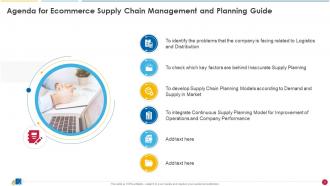
Slide 2: This slide states Agenda of the presentation.
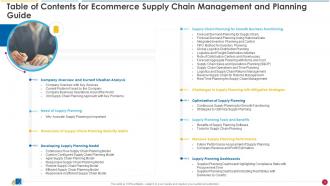
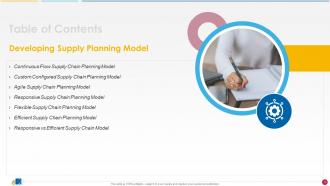
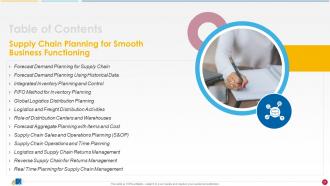
Slide 3: This slide shows Table of Content for the presentation.
Slide 4: This slide highlights title for topics that are to be covered next in the template.
Slide 5: This slide presents Company Overview with Key Services.
Slide 6: This slide displays Current Problem Faced by the Company.
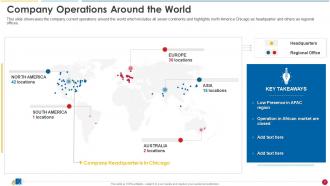
Slide 7: This slide represents Company Operations Around the World.
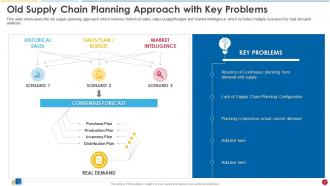
Slide 8: This slide showcases Old Supply Chain Planning Approach with Key Problems.
Slide 9: This slide highlights title for topics that are to be covered next in the template.
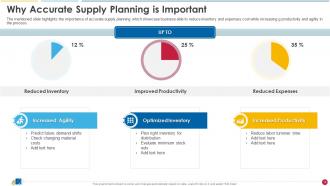
Slide 10: This slide shows Why Accurate Supply Planning is Important.
Slide 11: This slide highlights title for topics that are to be covered next in the template.
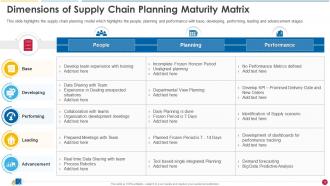
Slide 12: This slide presents Dimensions of Supply Chain Planning Maturity Matrix.
Slide 13: This slide highlights title for topics that are to be covered next in the template.
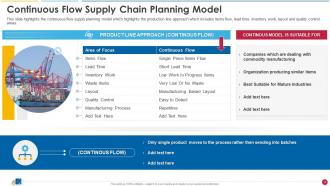
Slide 14: This slide displays Continuous Flow Supply Chain Planning Model.
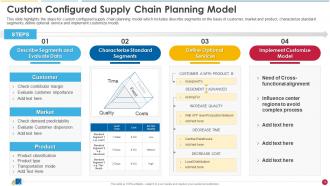
Slide 15: This slide represents Custom Configured Supply Chain Planning Model.
Slide 16: This slide showcases Agile Supply Chain Planning Model.
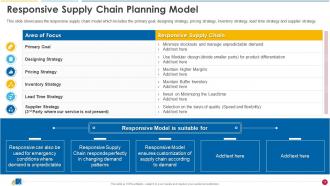
Slide 17: This slide shows Responsive Supply Chain Planning Model.
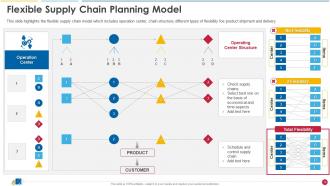
Slide 18: This slide presents Flexible Supply Chain Planning Model.
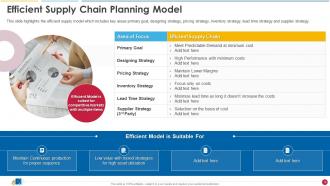
Slide 19: This slide displays Efficient Supply Chain Planning Model.
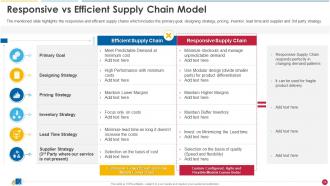
Slide 20: This slide represents Responsive vs Efficient Supply Chain Model.
Slide 21: This slide highlights title for topics that are to be covered next in the template.
Slide 22: This slide showcases Forecast Demand Planning for Supply Chain.
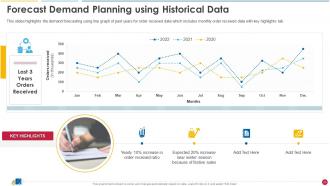
Slide 23: This slide shows Forecast Demand Planning using Historical Data.
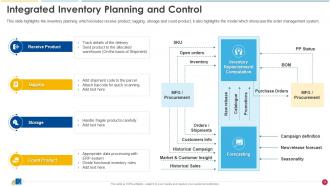
Slide 24: This slide presents Integrated Inventory Planning and Control.
Slide 25: This slide displays FIFO Method for Inventory Planning.
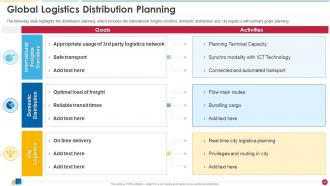
Slide 26: This slide represents Global Logistics Distribution Planning.
Slide 27: This slide showcases Logistics and Freight Distribution Activities.
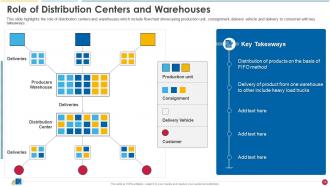
Slide 28: This slide shows Role of Distribution Centers and Warehouses.
Slide 29: This slide presents Forecast Aggregate Planning with Items and Cost.
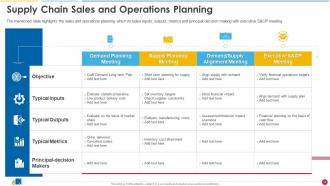
Slide 30: This slide displays Supply Chain Sales and Operations Planning.
Slide 31: This slide represents Supply Chain Operations and Time Planning.
Slide 32: This slide showcases Logistics and Supply Chain Returns Management.
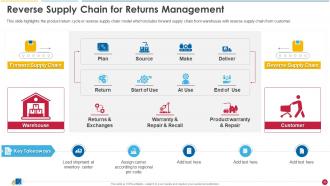
Slide 33: This slide shows Reverse Supply Chain for Returns Management.
Slide 34: This slide presents Real Time Planning for Supply Chain Management.
Slide 35: This slide highlights title for topics that are to be covered next in the template.
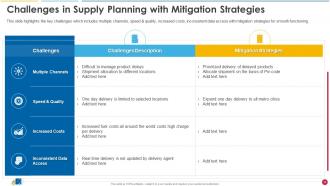
Slide 36: This slide displays Challenges in Supply Planning with Mitigation Strategies.
Slide 37: This slide highlights title for topics that are to be covered next in the template.
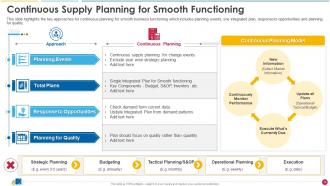
Slide 38: This slide represents Continuous Supply Planning for Smooth Functioning.
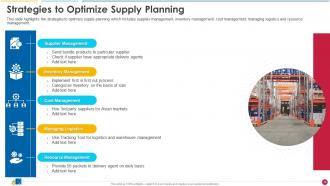
Slide 39: This slide showcases Strategies to Optimize Supply Planning.
Slide 40: This slide highlights title for topics that are to be covered next in the template.
Slide 41: This slide shows Benefits of Supply Planning Software.
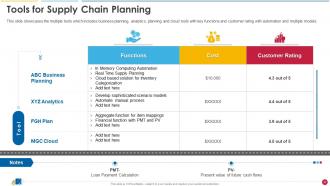
Slide 42: This slide presents Tools for Supply Chain Planning.
Slide 43: This slide highlights title for topics that are to be covered next in the template.
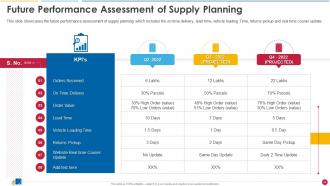
Slide 44: This slide displays Future Performance Assessment of Supply Planning.
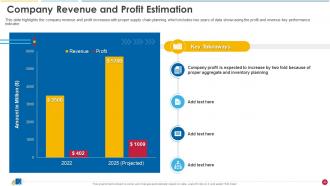
Slide 45: This slide represents Company Revenue and Profit Estimation.
Slide 46: This slide highlights title for topics that are to be covered next in the template.
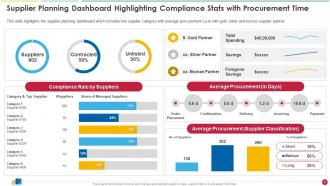
Slide 47: This slide showcases Supplier Planning Dashboard Highlighting Compliance Stats with Procurement Time.
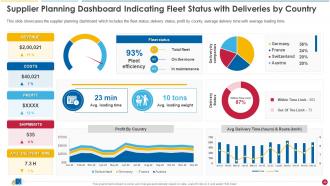
Slide 48: This slide shows Supplier Planning Dashboard Indicating Fleet Status with Deliveries by Country.
Slide 49: This slide is titled as Additional Slides for moving forward.
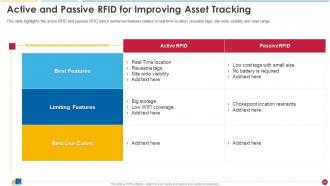
Slide 50: This slide presents Active and Passive RFID for Improving Asset Tracking.
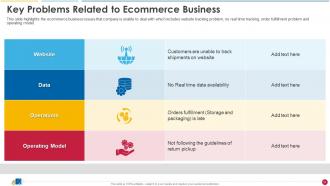
Slide 51: This slide displays Key Problems Related to Ecommerce Business.
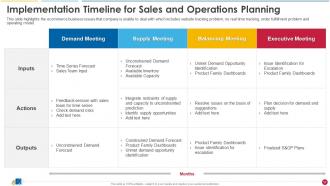
Slide 52: This slide represents Implementation Timeline for Sales and Operations Planning.
Slide 53: This slide contains all the icons used in this presentation.
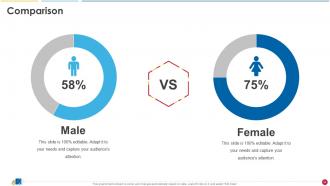
Slide 54: This is a Comparison slide to state comparison between commodities, entities etc.
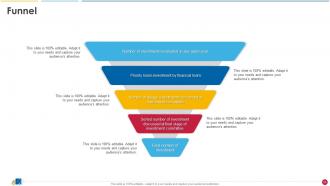
Slide 55: This slide shows Funnel with related imagery.
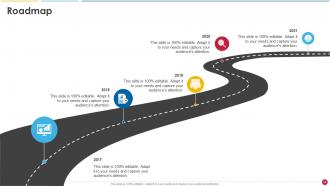
Slide 56: This slide presents Roadmap with additional textboxes.
Slide 57: This slide contains Puzzle with related icons and text.
Slide 58: This slide depicts Venn diagram with text boxes.
Slide 59: This is a Timeline slide. Show data related to time intervals here.
Slide 60: This is Our Mission slide with related imagery and text.
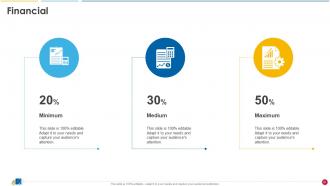
Slide 61: This is a Financial slide. Show your finance related stuff here.
Slide 62: This slide provides 30 60 90 Days Plan with text boxes.
Slide 63: This is Our Team slide with names and designation.
Slide 64: This is About Us slide to show company specifications etc.
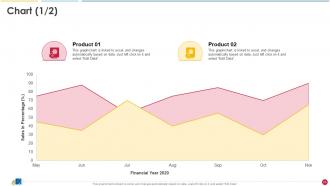
Slide 65: This slide displays chart with two products comparison.
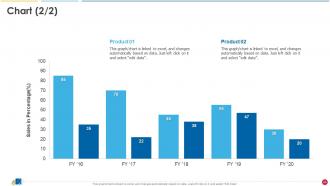
Slide 66: This is another slide presenting Chart.
Slide 67: This is a Thank You slide with address, contact numbers and email address.
Ecommerce Supply Chain Management And Planning Guide Powerpoint Presentation Slides with all 72 slides:
Use our Ecommerce Supply Chain Management And Planning Guide Powerpoint Presentation Slides to effectively help you save your valuable time. They are readymade to fit into any presentation structure.




















FAQs for Ecommerce Supply Chain Management And Planning Guide
Effective ecommerce supply chain management includes demand forecasting, inventory optimization, warehouse automation, order fulfillment systems, and last-mile delivery solutions. These components work together by streamlining operations, reducing costs, and accelerating delivery times, with many retailers finding that integrated platforms ultimately enhance customer satisfaction while delivering significant competitive advantages.
Predictive analytics enhances inventory forecasting by analyzing historical sales data, seasonal trends, customer behavior patterns, and market indicators to predict future demand with greater accuracy. Through machine learning algorithms, ecommerce retailers can optimize stock levels, reduce overstock costs, and minimize stockouts, ultimately improving customer satisfaction while delivering significant cost savings and competitive advantage in inventory management.
Technology revolutionizes ecommerce supply chain operations through AI-powered demand forecasting, automated inventory management, IoT tracking systems, cloud-based logistics platforms, and real-time analytics dashboards. These solutions enable online retailers to minimize stockouts, reduce warehousing costs, and accelerate delivery times, with many finding that integrated technology delivers enhanced customer satisfaction and significant competitive advantage.
Ecommerce businesses balance cost efficiency with fast delivery by implementing strategic warehouse placement, leveraging technology for demand forecasting, optimizing inventory levels, and forming strategic partnerships with multiple logistics providers. Through AI-driven route optimization and automated fulfillment centers, companies like Amazon and Walmart achieve faster processing while reducing operational costs, ultimately delivering competitive advantage in an increasingly demanding marketplace.
Effective ecommerce returns strategies include automated return portals, pre-paid shipping labels, quality inspection processes, refurbishment programs, and strategic partnerships with third-party logistics providers. These approaches streamline reverse logistics by reducing processing times, minimizing handling costs, and recovering product value through resale or recycling, with many retailers finding that efficient returns management ultimately enhances customer satisfaction and operational profitability.
Customer demand significantly impacts ecommerce supply chain decisions through inventory planning, distribution center locations, fulfillment speed requirements, and seasonal capacity adjustments. Retailers like Amazon and Walmart continuously analyze demand patterns to optimize warehouse positioning, automate sorting processes, and enhance last-mile delivery networks, ultimately delivering faster services and improved customer experiences while maintaining competitive advantage.
International ecommerce supply chain challenges include complex customs regulations, fluctuating currency exchange rates, extended shipping times, inventory management across multiple warehouses, and varying quality control standards. These obstacles significantly impact operational costs and customer satisfaction, with many retailers finding that strategic partnerships with local logistics providers, automated compliance systems, and regional distribution centers help minimize delays while enhancing global market competitiveness.
Sustainable practices in ecommerce supply chains include eco-friendly packaging materials, carbon-neutral shipping options, renewable energy in warehouses, ethical sourcing partnerships, and waste reduction technologies. These approaches streamline operations by reducing material costs, enhancing brand reputation, and meeting consumer expectations, with many retailers finding that sustainable practices ultimately deliver competitive advantage and improved customer loyalty.
Third-party logistics providers significantly enhance ecommerce supply chain efficiency by offering specialized warehousing, optimized shipping networks, advanced inventory management systems, and scalable fulfillment capabilities that reduce operational costs. Through strategic partnerships with 3PLs, ecommerce businesses streamline order processing, minimize shipping times, and access sophisticated logistics technology, while benefiting from reduced overhead and improved customer satisfaction across multiple distribution channels.
Ecommerce businesses should track order fulfillment accuracy, inventory turnover rates, delivery timeframes, stockout frequencies, and supplier performance metrics. These indicators enable retailers to streamline warehouse operations, minimize shipping delays, and enhance customer satisfaction, with many online businesses finding that comprehensive supply chain monitoring ultimately delivers reduced operational costs and competitive advantages in increasingly demanding markets.
Small ecommerce businesses can leverage supply chain management by focusing on niche specialization, direct supplier relationships, flexible fulfillment options, and technology automation to enhance customer experiences. These strategies enable faster response times, personalized services, and cost-effective operations, with many small retailers finding that streamlined supply chains ultimately deliver competitive advantages through agility and customer-centric approaches that larger retailers struggle to match.
Centralized supply chain management software delivers enhanced inventory visibility, streamlined order processing, automated demand forecasting, reduced operational costs, and improved supplier coordination across all channels. Through integrated dashboards and real-time analytics, ecommerce businesses achieve faster fulfillment cycles, minimize stockouts, and optimize warehouse operations, with many retailers finding that centralized systems ultimately enhance customer satisfaction while delivering significant competitive advantages.
Supply chain disruptions significantly impact ecommerce through inventory shortages, delayed deliveries, increased costs, and reduced customer satisfaction. These challenges force retailers to diversify suppliers, invest in automation, and enhance transparency systems, with many organizations finding that strategic supply chain resilience ultimately delivers competitive advantage and improved operational efficiency.
Customer experience significantly impacts ecommerce supply chain strategies by driving demand for faster delivery, flexible fulfillment options, real-time tracking, and seamless returns processing. Companies increasingly redesign their supply chains around customer expectations, with retailers like Amazon and Walmart investing heavily in last-mile delivery optimization and omnichannel integration, ultimately delivering competitive advantage through enhanced satisfaction and loyalty.
Ecommerce companies ensure supply chain compliance through comprehensive vendor auditing, automated regulatory tracking systems, robust documentation processes, and strategic partnerships with certified suppliers. These approaches enable organizations to maintain transparency across global operations, minimize compliance risks, and adapt quickly to evolving regulations, ultimately delivering customer trust and competitive advantage in increasingly regulated markets.
-
My presentations were a bit amateur before I found SlideTeam’s designs. I’ve been able to find slides for nearly every topic I’ve had to present. Thanks, Slideteam!
-
This design is not only aesthetically pleasing but it has many uses making the cost worthwhile. The graphics look stunning, and you can edit them as per your needs.