


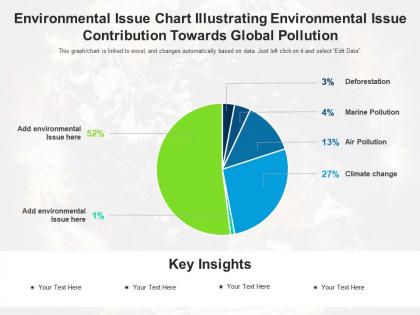
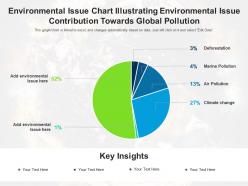
Environmental issue chart illustrating environmental issue contribution towards global pollution




Try Before you Buy Download Free Sample Product
 Impress Your
 Audience
 100%
100% Editable
 Save Hours
 of Time


This graph or chart is linked to excel, and changes automatically based on data. Just left click on it and select Edit Data.
People who downloaded this PowerPoint presentation also viewed the following :
Environmental issue chart illustrating environmental issue contribution towards global pollution with all 2 slides:
Use our Environmental Issue Chart Illustrating Environmental Issue Contribution Towards Global Pollution to effectively help you save your valuable time. They are readymade to fit into any presentation structure.
FAQs for Environmental issue chart illustrating environmental issue contribution
So there's four main types - air, water, soil, and noise pollution. Air pollution's mostly cars, factories, and power plants spewing stuff out. Water contamination comes from industrial waste, farm runoff, and sewage (seriously, it's pretty gross when you look into it). Pesticides and chemicals mess up soil quality, plus improper waste disposal doesn't help. Traffic and construction create the noise issues. Oh, and industrial activities too obviously. If you want to actually do something about it, cutting your carbon footprint and backing clean energy helps with several types at once. Way more efficient than tackling each one separately.
Ugh, air pollution is seriously rough on your body - we're talking respiratory problems, heart disease, asthma flare-ups. Your lungs basically get wrecked. But it's not just us humans suffering. Acid rain destroys forests and lakes, plus all that smog makes it harder for plants to photosynthesize properly. Animals can't migrate or reproduce normally either, which honestly breaks my heart a little. The good news though? Taking the bus instead of driving or pushing for cleaner energy actually does help your local air quality. Small wins, you know?
Yeah so basically industrial stuff is huge for water pollution. Manufacturing plants just dump chemicals and heavy metals straight into rivers and groundwater - it's honestly pretty gross when you think about it. Mining operations are terrible too. A lot of it's "point source" pollution where you can literally track it back to like one specific pipe. Oh, and here's something useful - you can actually look up your local EPA discharge permits online. Companies have to report what they're releasing, so you'll see exactly what's going into your water. Kinda eye-opening tbh.
Construction sites are brutal on soil - all that heavy machinery just crushes it to death. Then you've got chemical runoff from roads and industry dumping oils and heavy metals everywhere. Honestly, cities are terrible at this. All the concrete basically suffocates the ground, so water can't even soak in naturally anymore. The soil loses all its good organic stuff and becomes this lifeless dirt. Oh, and don't get me started on road salt in winter - that stuff's poison for soil. Green roofs and permeable pavement can help though. Some cities are finally catching on.
Ugh, plastic pollution is seriously messing up our oceans. Marine animals eat plastic thinking it's food, which starves them or kills them outright. You've seen those awful turtle photos, right? Microplastics work their way up the entire food chain too. Fish get tangled in bigger pieces, and all the toxic chemicals build up in their bodies - screws with their ability to reproduce. Coral reefs basically get suffocated by plastic debris. Honestly, some areas are so polluted that fish populations just crash. Best thing you can do is go reusable when possible and vote for politicians who actually care about this stuff.
Ugh, city noise is brutal for your mental health. It keeps your stress hormones jacked up constantly - like your body thinks it's always under threat from all the traffic and construction. Sleep gets wrecked, you can't focus, and anxiety just builds up over time. Your brain literally never gets used to it, which is kind of depressing when you think about it. White noise apps help me sleep better. Good earplugs are worth the investment too. Some people even push for quieter zones in their neighborhoods, though honestly I'm not sure how much luck they have with that.
Okay so basically we're looking at rising sea levels displacing millions of people, plus way more extreme weather. Your grandkids might see entire coastal cities underwater - which is honestly terrifying to think about. Droughts will make farming nearly impossible in places that used to grow tons of food. Water supplies get disrupted too. The worst part? Ecosystems start collapsing, creating refugee crises and political chaos. Everything feeds into everything else, making it exponentially worse. I know it sounds overwhelming but maybe start thinking about climate resilience in whatever you're working on now.
So basically they work by hitting companies where it hurts - their wallets. Carbon taxes make pollution expensive, while cap-and-trade lets businesses buy/sell emission credits (kinda like trading cards but for CO2 lol). Companies also have to do environmental assessments before big projects. The paperwork is insane and honestly slows things down, which probably helps the environment. But here's the thing - without actual enforcement, these are just fancy suggestions. Your area probably mixes incentives like tax breaks for clean tech with penalties for violations. That combo works best.
Hey! So there's some really cool stuff happening in environmental cleanup right now. Bioremediation is probably the wildest - they're literally engineering bacteria to eat pollution. Nanomaterials can filter contaminants at the molecular level, which is crazy precise. There's also plasma tech that breaks down those stubborn chemicals that won't go away otherwise. Plants are getting in on the action too with phytoremediation - they just soak up toxins naturally. Oh, and AI systems are optimizing cleanup strategies in real-time now. Honestly, the bioengineered microorganism research is where I'd focus if you're diving into this - that's where the real breakthroughs are happening.
So basically, fertilizer runoff is killing our waterways. When farmers use nitrogen and phosphorus on crops, rain washes the leftover nutrients straight into streams and rivers. Think of it like dumping Miracle-Gro into a lake - sounds innocent but it's not. All those nutrients make algae go absolutely crazy, blooming everywhere and sucking up oxygen. Fish literally can't breathe and you get these dead zones. It's honestly pretty depressing to see. Your best bet? Plant buffer strips along waterways and don't over-fertilize in the first place.
Dude, e-waste is seriously out of control - we're dumping 50+ million tons every year. Most of it gets shipped to poor countries where people literally burn old phones and laptops to get the metals out. The toxic stuff just goes straight into their water and soil, which is honestly fucked up. Lead poisoning, breathing problems, the whole deal. I probably sound preachy but it's wild how we dump this problem on the poorest places. Try finding actual certified recyclers near you instead of just tossing stuff. Also maybe don't upgrade your phone every single year?
Honestly, monthly cleanups work way better than one-off events - builds actual momentum. Get kids involved from local schools because they're weirdly effective at guilt-tripping adults into not littering. Push your city for more trash bins and recycling spots too. Education campaigns help, though some people are just gonna be slobs no matter what. You could lobby for heftier fines or get local businesses to sponsor cleanup supplies. The social aspect is huge - make it fun and people actually show up. Start small in your neighborhood and see what happens.
Honestly? Recycling does help - most programs divert like 25-35% of stuff from landfills. Paper and metals work great since there's actually infrastructure for them. Plastics though... ugh, anything beyond
-
Best Representation of topics, really appreciable.
-
Excellent work done on template design and graphics.
-
Easily Understandable slides.
-
Really like the color and design of the presentation.
-
Graphics are very appealing to eyes.