

Fraud Detection Using Machine Learning Techniques Powerpoint Presentation Slides ML CD





Try Before you Buy Download Free Sample Product
 Impress Your
 Audience
 100%
100% Editable
 Save Hours
 of Time


Grab our professionally created Fraud Detection Using Machine Learning Techniques PowerPoint presentation. This PPT deck presentation highlights the need to manage fraud incidents across various sectors using machine learning technology. It starts by conducting a current scenario assessment of the level of fraud by analyzing the growth rate of fraudulent transactions and the solutions mentioned for reduced errors. Moreover, the Identity Fraud PPT templates mention a spectrum of machine learning techniques that users can use for fraud detection, including Logistic Regression, Decision Trees, Random Forests, and Neural Networks. Furthermore, the Anti Money Laundering PPT slides also discuss various fraud detection use cases. They cover credit card fraud, insurance claims, identity theft, and anti-money laundering, highlighting these techniques versatility in real-world scenarios. Lastly, the PPT bundle equips users with practical knowledge to effectively implement and evaluate ML-driven fraud detection algorithms, enabling them to conduct rigorous performance assessments and impact analyses. Download Now
People who downloaded this PowerPoint presentation also viewed the following :
Content of this Powerpoint Presentation
Slide 1: This slide introduces Fraud Detection Using Machine Learning Techniques. State your company name and begin.
Slide 2: This slide states Agenda of the presentation.
Slide 3: This slide shows Table of Content for the presentation.
Slide 4: This slide highlights title for topics that are to be covered next in the template.
Slide 5: This slide showcases quarterly fraud trends over a year, highlighting a clear and accelerating increase in fraud incidents per 10,000 transactions with corresponding key insights.
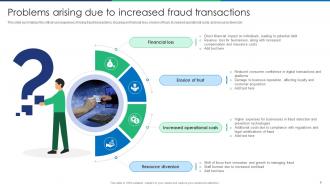
Slide 6: This slide summarizes the critical consequences of rising fraud transactions, focusing on financial loss, erosion of trust, increased operational costs, and resource diversion.
Slide 7: This slide introduces four potential solutions for enhancing fraud detection, including machine learning, multi-factor authentication, blockchain technology, and behavioral analytics.
Slide 8: This slide highlights title for topics that are to be covered next in the template.
Slide 9: This slide explains machine learning's role in fraud detection, emphasizing its ability to learn from past data and identify fraud patterns.
Slide 10: This slide explains the process of developing machine learning system for fraud detection with steps including data input, feature analysis, algorithm training, and the creation of a specialized model.
Slide 11: This slide contrasts the traditional rule-based approaches with the dynamic, data-driven capabilities of ML-based fraud detection, showcasing the latter's ability to adapt to emerging fraud tactics.
Slide 12: This slide outlines the key advantages of machine learning in fraud detection, emphasizing quicker anomaly detection, more accurate predictions, and operational efficiencies.
Slide 13: This slide highlights challenges in deploying machine learning for fraud detection, including prediction accuracy, model interpretability, cost implications, and the supplementing human intelligence.
Slide 14: This slide highlights title for topics that are to be covered next in the template.
Slide 15: This slide introduces logistic regression as a pivotal machine learning algorithm for distinguishing between fraudulent and non-fraudulent transactions, with an illustrative use case.
Slide 16: This slide explains Decision Tree algorithm, highlighting its role in fraud detection with example illustrating how specific transaction characteristics are analyzed to predict fraud.
Slide 17: This slide introduces the Random Forest algorithm as a machine learning method combining multiple decision trees for superior fraud detection accuracy.
Slide 18: This slide outlines how neural networks use layered processing and cognitive computing to detect fraud by learning from data and improving over time.
Slide 19: This slide highlights title for topics that are to be covered next in the template.
Slide 20: This slide outlines the process and importance of detecting credit card fraud using machine learning, emphasizing the method's effectiveness using key facts.
Slide 21: This slide showcases machine learning's impact on fraud detection, emphasizing improved accuracy, reduced manual labor, fewer errors, and adaptability to new threats.
Slide 22: This slide outlines the step-by-step implementation of machine learning in fraud detection, from data evaluation and model development to system integration.
Slide 23: This slide outlines how leading companies leverage machine learning for credit card fraud detection, showcasing their strategies and achievements in minimizing fraud losses.
Slide 24: This slide highlights the key challenges in deploying machine learning for fraud detection: handling imbalanced data, defending against adversarial attacks, and improving model interpretability.
Slide 25: This slide highlights the future of ML in credit card fraud detection, focusing on graph analytics, explainable AI, and federated learning to advance detection capabilities
Slide 26: This slide highlights title for topics that are to be covered next in the template.
Slide 27: This slide presents an overview of how machine learning revolutionizes insurance claim fraud detection by analyzing vast datasets for pattern recognition.
Slide 28: This slide explains the functionality of ML in insurance claim fraud detection, highlighting its risk scoring mechanism, the importance of diverse data for accuracy, and its superiority over rule-based systems.
Slide 29: This slide highlights the application of machine learning in detecting insurance fraud through improved analysis of inconsistencies in claims, upcoding, duplicate claims, and overstated repair costs.
Slide 30: This slide breaks down the essential steps for constructing an ML model for insurance fraud detection, from data preparation and feature engineering to choosing algorithms, refining the model, and practical application.
Slide 31: This slide highlights the major advantages of integrating machine learning into fraud detection within the insurance sector, including enhanced pattern recognition, automation, real-time trend analysis, and scalable learning capabilities.
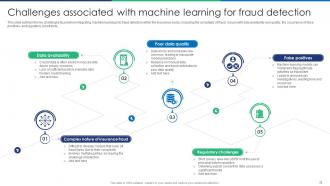
Slide 32: This slide outlines the key challenges faced when integrating machine learning into fraud detection within the insurance sector, including the complexity of fraud, issues with data availability and quality, the occurrence of false positives, and regulatory constraints.
Slide 33: This slide highlights title for topics that are to be covered next in the template.
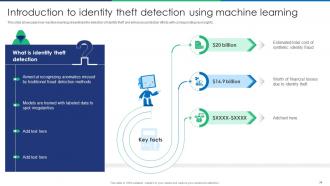
Slide 34: This slide showcases how machine learning streamlines the detection of identity theft and enhances protection efforts with corresponding key insights.
Slide 35: This slide outlines the need of ML in identity fraud detection, highlighting its role in reducing false positives/negatives, preventing account fraud, analyzing telecom networks, enhancing accuracy, and identifying fraudulent charges.
Slide 36: This slide presents the workflow of using machine learning for identity theft detection, from data collection and analysis through to the evaluation and comparison of machine learning techniques against traditional methods.
Slide 37: This slide delves into ML's applications in theft detection, showcasing strategies such as instant authentication, pattern recognition, and behavioral analytics for advanced identity protection.
Slide 38: This slide highlights title for topics that are to be covered next in the template.
Slide 39: This slide outlines the application of machine learning in anti-money laundering efforts, highlighting its role in detecting suspicious activities.
Slide 40: This slide emphasizes the critical role of machine learning in refining AML operations by minimizing false alerts, recognizing shifts in user behavior, and efficiently processing complex data sources.
Slide 41: This slide explains the workflow involved in implementing machine laundering for anti money laundering by authorities, starting from analyzing transactional data to flagging transactions.
Slide 42: This slide outlines the essential features of an ML-based AML solution, highlighting the importance of robust security, rule-based alerts, risk scoring, real-time monitoring, and entity link analysis for effective money laundering prevention.
Slide 43: This slide addresses the challenges in integrating machine learning into anti-money laundering efforts, focusing on data quality, comprehensive insights, sector expertise and regulatory compliance.
Slide 44: This slide highlights title for topics that are to be covered next in the template.
Slide 45: This slide outlines steps for setting up an ML system for fraud detection, focusing on analysis, design, data processing, model training, and deployment.
Slide 46: This slide highlights title for topics that are to be covered next in the template.
Slide 47: This slide outlines critical metrics for assessing the performance of ML models in fraud detection, emphasizing their roles in precision, recall, and overall effectiveness.
Slide 48: This slide highlights title for topics that are to be covered next in the template.
Slide 49: This slide presents real-world examples of companies using ML for fraud detection, showcasing significant improvements in detection rates, reduction in false positives, and operational efficiencies.
Slide 50: This slide highlights title for topics that are to be covered next in the template.
Slide 51: This slide showcases quarterly fraud trends over a year, highlighting a decreasing trend in fraud incidents due to ML integration with corresponding key insights.
Slide 52: This slide highlights title for topics that are to be covered next in the template.
Slide 53: This slide highlights the pivotal advancements in ML-driven fraud detection, emphasizing streamlined, secure, and proactive approaches to combatting fraudulent activities.
Slide 54: This slide contains all the icons used in this presentation.
Slide 55: This slide is titled as Additional Slides for moving forward.
Slide 56: This slide shows AI based anti money laundering solutions market analysis.
Slide 57: This slide presents Fraud detection machine leaning job market analysis.
Slide 58: This slide displays Insurance fraud detection using machine leaning workflow.
Slide 59: This is Our Mission slide with related imagery and text.
Slide 60: This slide presents Bar chart with two products comparison.
Slide 61: This is Our Team slide with names and designation.
Slide 62: This slide shows Post It Notes. Post your important notes here.
Slide 63: This slide depicts Venn diagram with text boxes.
Slide 64: This is a Timeline slide. Show data related to time intervals here.
Slide 65: This slide provides 30 60 90 Days Plan with text boxes.
Slide 66: This is a Financial slide. Show your finance related stuff here.
Slide 67: This is Our Target slide. State your targets here.
Slide 68: This is a Thank You slide with address, contact numbers and email address.
Fraud Detection Using Machine Learning Techniques Powerpoint Presentation Slides ML CD with all 76 slides:
Use our Fraud Detection Using Machine Learning Techniques Powerpoint Presentation Slides ML CD to effectively help you save your valuable time. They are readymade to fit into any presentation structure.
















FAQs for Fraud Detection Using Machine Learning Techniques Powerpoint Presentation
Honestly, the biggest red flags I'd watch for are weird transaction patterns - like someone suddenly moving huge amounts or doing a bunch of small transfers just under reporting limits. That's sketchy behavior 101. Geographic stuff is massive too. If a card gets used in different countries within hours? Yeah, that's not happening legitimately. Multiple failed login attempts are obvious, but also look for tons of transactions in short bursts and purchases that don't match someone's usual spending habits. Oh, and round numbers like exactly $500 or $1000 - real people don't shop like that. Set up alerts for these patterns first, then dig deeper when several flags hit the same account.
Dude, ML is honestly a game-changer for catching fraud. Traditional systems just flag anything over $5K, but fraudsters figured that out ages ago. Machine learning looks at everything at once - spending habits, where you are, what device you're using, timestamps. It gets better over time too, which is sick. False positives drop way down while you catch way more real fraud. Start with anomaly detection on your transaction data. You'll see better results in weeks, not months. Way better than those old rule-based systems that miss half the sketchy stuff anyway.
Visualizing data is a game-changer for catching fraud. Heat maps show you where sketchy transactions cluster. Network graphs reveal how suspicious accounts connect - that's where the real insights are, honestly. Time series charts catch weird activity spikes that you'd totally miss in spreadsheets. I've seen fraud teams crack cases just because the visualization made patterns obvious. Oh, and automated dashboards that flag visual anomalies? Total lifesaver. Your team won't waste time digging through endless rows of data anymore.
Honestly, you want to be smart about this - only add extra steps when something actually looks sketchy. Regular customers shouldn't even notice the security stuff happening in the background. Machine learning is clutch here because it learns what's normal vs suspicious for each user. Map out your checkout flow first and figure out where you can hide security checks (device fingerprinting is great for this). The visible verification should only kick in when needed. Oh, and definitely track both fraud AND abandonment rates - no point stopping fraud if you're also killing sales, right? Test different thresholds until you find what works.
So blockchain's pretty solid for catching fraud - basically creates this permanent record that's super hard to mess with. Real-time verification is nice too. Smart contracts can spot sketchy patterns automatically, which I think is actually the coolest part. But honestly? It's still pricey and kind of a pain to roll out everywhere. My take - if you're thinking about it, maybe test it on your riskiest stuff first. See if it actually saves you money before going all in. The tech works, it's just whether the costs make sense for your situation.
Dude, start with real case studies from your industry - people actually retain stuff when they see concrete examples of fraud that hit companies like theirs. Role-playing is clutch too. Have your team practice spotting sketchy behavior in fake scenarios. Oh, and make the reporting process crystal clear. Nobody should be confused about who to contact or when. This might sound weird, but reward people for reporting suspicious activity - even false alarms. You want that "speak up" culture. Also, do refreshers every six months because these scammers are always coming up with new tricks.
So basically you analyze all your old transaction data and customer behavior to build models that catch sketchy stuff before it happens. The algorithms study past fraud cases and spot weird patterns - like someone suddenly buying tons of stuff or logging in from random countries. Way better than just reacting after you've been hit, you know? Machine learning picks up on things that would totally fly under the radar otherwise. You'll need clean data on both legit transactions and fraud cases first. Then get your data team to build models that score each transaction for how likely it's fraud. Pretty neat how it flips the whole thing from defense to offense.
Honestly, payment fraud's probably your biggest headache - stolen cards, fake accounts, the usual stuff. Account takeovers are brutal too when someone steals a customer's login. Then there's return fraud where people buy things just to return them for cash. Chargeback fraud makes me want to scream - customers lying about never receiving orders they totally got. Oh, and don't get me started on promo abuse. People will create like 20 accounts just to stack your discount codes. Focus on these patterns first since they're probably 80% of what you'll see. Build from there.
Oh man, social engineering is basically when scammers mess with your head to get what they want. They'll pretend to be your bank or create some fake emergency to stress you out. The "tech support" ones are so annoying - they always want you to act RIGHT NOW. Honestly, the emotional manipulation stuff really gets to me. But here's what works: hang up and call back using the real number from your statement. Don't give out personal info on calls you didn't start. Legit companies won't rush you like that.
Look, you need to watch four main things. Detection rate first - how much fraud you're actually catching. False positives matter too because angry customers calling support gets expensive fast. Speed counts - how long between when fraud happens and when you spot it? Oh, and track the money side: losses prevented vs what you're spending on detection. I'd check these monthly to start. The false positive thing is huge though - nothing kills customer trust like blocking legit purchases. Dig into any weird patterns you see.
Sharing fraud data across industries is honestly a game-changer because you get this way broader view of how scammers actually operate. Like, the same person will use stolen cards for online shopping, then pivot to identity theft with phone companies, then hit up banks next week. Each company only catches one slice of what they're doing. Without that cross-industry intel, you're basically playing whack-a-mole. Most fraudsters don't stick to one sector anyway - they're too smart for that. Your best bet is looking into fraud-sharing platforms or industry groups. Some work better than others, but it's worth exploring what's available in your space.
Honestly, this stuff gets tricky fast. Your fraud detection has to work well but still follow privacy laws like GDPR. Fair lending regulations are probably the biggest headache - your algorithms can't accidentally discriminate against protected groups, even if that wasn't the intent. Document everything because regulators will ask for it later. Oh, and be upfront with customers about how you're monitoring their data. The models need to be explainable too, not just black boxes you can't defend. I'd start with auditing your current system for bias issues.
Freeze those accounts immediately - don't even think twice about it. Your legal team needs to know ASAP, and so do the authorities. I'd document literally everything, even stuff that seems random right now. Here's the thing though - resist the urge to start fixing things until you've got the full picture mapped out. You could accidentally wipe evidence. Be upfront with customers about what happened. Oh, and once the dust settles? Do a proper deep-dive on how this went down so you can patch those holes for next time.
Ugh, fraud hits you everywhere - the actual loss, then chargeback fees, investigation costs, compliance stuff. Your team wastes so much time on cleanup instead of growing the business (seriously annoying). But decent fraud detection usually saves 3-5x what you spend on it by stopping bad transactions upfront. Less false positives too, so customers aren't pissed when their real purchases get blocked. Just calculate what fraud's costing you now - that number alone should make the decision pretty obvious. The math works out.
Honestly, teaching your customers about fraud is like giving them a superpower - they'll spot sketchy stuff way before it becomes a problem. Send them quick tips about common scams and red flags. Don't overwhelm them with tech jargon though, that's where most companies mess up. A simple monthly email works great - just highlight one scam type and how to avoid it. I've noticed people actually read these if you keep them short and relevant. When customers know what unexpected info requests look like, they'll protect themselves better than any security system can.
-
Innovative and creative templates with high-quality designs. Helped me with my presentation as the slides were easy to edit.
-
The visual appeal of the templates is just unparalleled! I was so worried about the design of my presentation but SlideTeam made it all so easy.