

Guidelines To Prepare Standard Operating Procedures




Try Before you Buy Download Free Sample Product
 Impress Your
 Audience
 100%
100% Editable
 Save Hours
 of Time


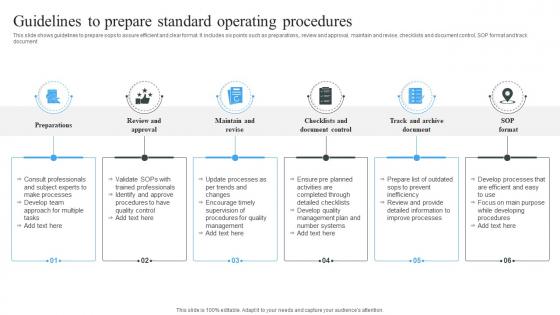
This slide shows guidelines to prepare sops to assure efficient and clear format. It includes six points such as preparations,, review and approval, maintain and revise, checklists and document control, SOP format and track document
People who downloaded this PowerPoint presentation also viewed the following :
Guidelines To Prepare Standard Operating Procedures with all 6 slides:
Use our Guidelines To Prepare Standard Operating Procedures to effectively help you save your valuable time. They are readymade to fit into any presentation structure.





FAQs for Guidelines To Prepare
Honestly, SOPs are pretty straightforward once you know what to include. Start with a clear title and purpose - what's this thing actually for? Then list your steps in order, define who's responsible for what (because nobody likes confusion about roles), and don't forget safety stuff if it applies. Version control is huge too - like, seriously, having old versions floating around will mess things up fast. Oh, and include any forms or tools people need. The real test? Hand it to someone else first. If they're asking a million questions, you need to rewrite it. Been there!
Honestly, SOPs are game-changers because they cut out all that "wait, how do we do this again?" confusion. Your team stops winging it and starts following the same steps every time. Fewer mistakes, faster onboarding, and when Sarah calls in sick, someone else can actually cover her work without panicking. I used to spend half my day answering the same questions over and over - so annoying. Now I can focus on bigger picture stuff instead of constantly troubleshooting. Oh, and start with whatever you're doing most often. Those repetitive tasks are low-hanging fruit.
Dude, healthcare and manufacturing are huge for this stuff - mess up there and people literally die. Food service too, obviously. Finance and airlines can't afford screw-ups either because lawsuits and compliance nightmares are expensive as hell. But honestly? Any place with crazy turnover rates benefits since you're not constantly explaining the same basic stuff to new hires. I always tell people to think about worst-case scenarios first. If screwing up means someone gets hurt or you lose serious money, then yeah, you need those procedures written down ASAP.
First thing - figure out exactly where your process starts and stops. What kicks it off? What's the end result? Don't get crazy trying to document everything at once. Pick one specific workflow and stick to it. I learned this the hard way after creating a mess of an SOP that covered way too much ground. Who's gonna actually follow this thing? Think about the decisions they'll face. If you're writing "it depends" constantly, you've probably bitten off more than you can chew. Start narrow. You can always build more SOPs later for the other stuff.
Dude, you HAVE to train people on your SOPs or they're basically useless. I mean, what's the point of writing amazing procedures if nobody knows how to use them? Training helps your team actually understand the steps - and honestly, when people get the reasoning behind stuff, they're way more likely to follow it. Can't tell you how many times I've watched companies skip this part then act shocked when everything goes sideways. Oh, and don't forget refresher sessions because let's be real - we all forget things after a while.
Honestly, getting people to actually follow SOPs is the worst part - especially if they weren't involved in writing them. Most procedures just sit there unused after like 6 months, which is super frustrating. You'll also struggle with making them too complicated (seriously, no one's reading a novel-length process doc). Different departments doing their own thing is another headache. Oh, and finding time to keep updating them? Good luck with that. Start basic though - get your team helping create them from the beginning and set up reviews every few months. Skip that step and you're basically writing expensive paperwork no one touches.
Dude, you've gotta try tools like Confluence or Notion - multiple people can jump in and edit at once instead of that nightmare email chain with Word docs. Version control tracks all your changes automatically. There's workflow automation that handles approvals too, which is honestly a game changer. AI can even help you draft the boring first versions (though sometimes it gets a bit weird with technical stuff). The search function alone makes it worth switching - no more digging through folders for that one procedure. I'd say pick whatever tool your team already uses for other stuff and just migrate your top 3 SOPs first.
Start with compliance rates - are people actually following your SOPs or just making stuff up? Error rates matter too, plus how long tasks take and how quickly new hires get up to speed. Customer satisfaction is probably your biggest tell since good processes usually equal happy customers. Don't sleep on employee feedback though - they'll call out when something's overcomplicated or missing key steps. Honestly, pick maybe 3-4 metrics that tie to what you're trying to accomplish. Otherwise you'll drown in spreadsheets and still not know if things are working.
Think of SOPs as your paper trail that proves you're doing everything by the book - FDA stuff for pharma, safety protocols for manufacturing, whatever applies to your industry. When auditors show up (and they will), you can literally point to the exact steps your team followed instead of scrambling for explanations. Everyone follows the same "approved" process, which regulators love to see. The trick is keeping them current - nobody cares about your 2019 procedures if regulations changed last year. I'd start with whatever processes get audited most often, honestly those are your biggest risk areas anyway.
Minimum once a year, but honestly that's cutting it close. Fast-moving industries or anything with compliance? Every 6 months, no joke. I've watched teams crash and burn because their procedures were totally outdated - nobody wants to be that guy. Calendar reminders are your friend here, and definitely assign someone to own each SOP. Don't wait for your scheduled review if you notice something's broken though. Fix it immediately or you'll just keep dealing with the same annoying problems over and over.
Process maps are basically the bird's eye view - they show you the whole workflow from A to Z. SOPs dive way deeper with all the step-by-step details, plus they explain the reasoning behind each step. Work instructions? Those are super specific - like exactly how to complete one small task within the bigger process. Honestly though, every company seems to use these terms differently, which is annoying. I'd start by mapping out your process visually first. Makes everything clearer. Then you can build your SOPs around that framework and get into the weeds with work instructions later.
Dude, getting your team involved in writing SOPs is seriously a game-changer. They're doing the actual work, so they'll catch stuff you totally missed - like confusing steps or things that sound good on paper but suck in practice. Plus people are way more likely to follow procedures they helped create, you know? I've seen this work so well at my last job. Set up some feedback sessions or just make it easy for people to shoot you suggestions when they hit snags. Your SOPs will actually be useful instead of gathering dust somewhere.
So first thing - write out exactly what you're trying to accomplish at the top. Then number everything step by step. Trust me, people get lost without numbers. Don't use fancy jargon either. Write like you're explaining it to someone who's half-asleep on a Monday morning. Short sentences work better than long rambling ones. Include the nitty-gritty details too - measurements, how long things take, when to make decisions. Here's what I learned the hard way: test it with someone fresh. What makes perfect sense to you might confuse the hell out of everyone else. If you can't skim through and immediately know what to do next, it needs work.
Dude, visual aids are a game changer for SOPs. Nobody wants to read through massive text blocks - it's like torture. Screenshots and flowcharts show people exactly what buttons to click instead of making them guess from wordy descriptions. Honestly, I've seen compliance go up just from adding some arrows and highlights to procedures. Complex processes especially need visuals for those tricky decision points. Visual learners will actually follow your steps instead of improvising (which never ends well). Even simple diagrams beat paragraphs every time when you're rushed and need to get stuff done quickly.
SOPs are like your backup plan when stuff gets risky or complicated. Having everything written down means people can't just wing it on important tasks - everyone does things the same way. Cuts down on mistakes big time. Plus if something goes sideways later, you've got proof you had real procedures in place, which helps legally. Honestly though, half the SOPs I've seen are totally outdated and buried somewhere nobody checks. Keep yours current and actually findable, or they're pretty much useless. Better than nothing, but not by much if they're gathering dust.
-
Delighted to see unique and eye-catching PowerPoint designs that are so easy to customize.
-
Designs have enough space to add content.