


Homecare Business Plan Powerpoint Presentation Slides




Try Before you Buy Download Free Sample Product
 Impress Your
 Audience
 100%
100% Editable
 Save Hours
 of Time


The healthcare industry has reached an interesting crossroads. While COVID 19 exposed the industrys lack of preparedness, it also heralded a new era of medical treatment and care in which any home can be converted into a healthcare facility. SlideTeam presents you with a detailed homecare business plan PPT that covers all the essential details, including executive summary, entity details, industry analysis, financial summary, etc. The PPT also edifies prospective clients about the different services the homecare start up provides. Furthermore, the presentation also leverages clients to assess market scenarios through a comprehensive SWOT analysis and porters framework. Customer profiling, geographical analysis, market sizing, sales funnel, Unique value propositions, competitive analysis, etc., are other sections that are catered to in the business plan. With this professionally crafted PPT, the customer can also access a detailed 5 year financial summary section covering revenue model, scenario analysis, balance sheet analysis, cash flow statement, and profit and loss statement. Download the fully editable homecare business plan PPT now.
People who downloaded this PowerPoint presentation also viewed the following :
Content of this Powerpoint Presentation
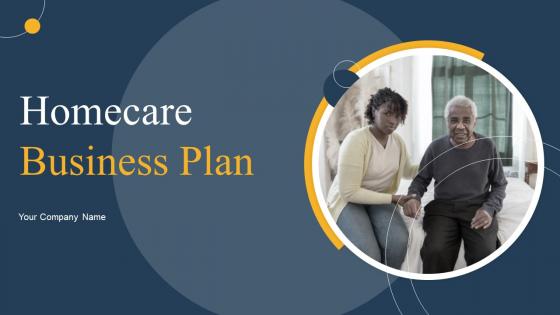
Slide 1: This slide displays the title Homecare Business Plan.
Slide 2: This slide displays the title Agenda for a home care agency.
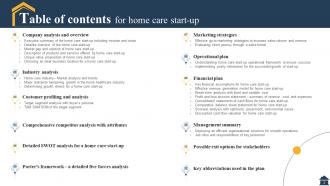
Slide 3: This slide exhibit table of content.
Slide 4: This slide exhibit table of content- Company analysis and overview.
Slide 5: The purpose of this slide is to provide a broader overview of the home healthcare industry.
Slide 6: The purpose of the slide is to portray organization details including name, incorporation date, web address, start-up investment, services etc.
Slide 7: The purpose of this slide is to highlight market gap and focus on devising solution to overcome those challenges.
Slide 8: The purpose of this slide is to express the benefits the firm provides to its customers or clients.
Slide 9: This slide is to highlight the key success factors of the home care firm which leverage them with a competitive edge in the market.
Slide 10: This slide portrays an ideal business location for home care start-up that minimize the risk of failure.
Slide 11: This slide exhibit table of content- Industry Analysis.
Slide 12: The purpose of this slide is to conduct a thorough assessment of the home care industry in addition to its market trends.
Slide 13: The purpose of this slide is to conduct a thorough assessment of the home care industry in addition to its market trends.
Slide 14: The purpose of this slide is to conduct a thorough assessment of the home care industry in addition to its market trends.
Slide 15: The purpose of this slide is to guide stakeholders about the problems prevailing in the industry.
Slide 16: This slide caters to details about various growth drivers resulting in the firm’s progress.
Slide 17: This slide exhibit table of content- Customer Profiling and Analysis.
Slide 18: This slide covers an assessment of how the firm’s products and services will fit into a certain market and where they will acquire the most traction with customers.
Slide 19: This slide covers an assessment of how the firm’s products and services will fit into a certain market and where they will acquire the most traction with customers.
Slide 20: This slide is to depict the market potential of the home care industry in terms of TAM, SAM, and SOM to assist startups and enterprise firms.
Slide 21: This slide exhibit table of content- Comprehensive competitor analysis with attributes.
Slide 22: The purpose of this slide is to provide a glimpse of key competitors in the industry to gain insight into their products, services, sales, and marketing tactic.
Slide 23: The purpose of this slide is to provide a glimpse of key competitors in the industry to gain insight into their product, services, sales, and marketing tactic.
Slide 24: This slide exhibit table of content- Detailed SWOT analysis for a home care start-up.
Slide 25: The slide includes the strengths, weaknesses, opportunities, and threats analysis of the home care start-up.
Slide 26: This slide exhibit table of content: Porter’s framework – A detailed five forces analysis.
Slide 27: The slide highlights porter’s framework and its implications in the home care industry.
Slide 28: This slide exhibit table of content- Marketing Strategies.
Slide 29: The purpose of this slide is to implement an effective go-to-market strategy for bringing home care start-up services.
Slide 30: This slide highlights customer journey mapping to track users' actions and key touch points across levels.
Slide 31: This slide exhibit table of content- Operational Plan.
Slide 32: The purpose of this slide is to outline the key objectives and goals of an organization and how to reach them by crafting an operational plan.
Slide 33: The purpose of this slide is to facilitate managers to convey project progress updates to stakeholders and get their approvals.
Slide 34: This slide exhibit table of content- Financial Plan.
Slide 35: This slide provides a glimpse of important financial assumptions that are to be made while setting up the firm in terms of income, expense, and balance sheet.
Slide 36: The slide shows the effective revenue model of the home care start-up, which displays the cost incurred and the various sources of income.
Slide 37: The slides highlight the break-even analysis of the firm.
Slide 38: The slides provide a glimpse of the projected profit and loss statement to visualize the platform’s financial performance for the next five years.
Slide 39: The slides provide a glimpse of the projected profit and loss statement to visualize the platform’s financial performance for the next five years.
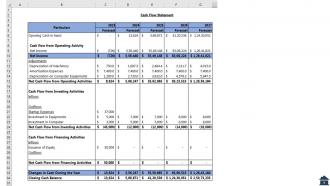
Slide 40: The slides highlight the cash flow statement of the company.
Slide 41: The slides highlight the cash flow statement of the company.
Slide 42: The slides cover the snapshot of the company's financial position at a specific time.
Slide 43: The slides cover the snapshot of the company's financial position at a specific time.
Slide 44: The purpose of this slide is to examine the effects of potential future events on the home care start-up performance.
Slide 45: The purpose of this slide is to examine the effects of potential future events on the home care start-up performance.
Slide 46: This slide is to calculate the amount of money an investor would get from an investment after adjusting for the time value of money.
Slide 47: This slide exhibit table of content- Management Summary.
Slide 48: The purpose of this slide is to craft a successful hierarchical framework for the firm to ensure smooth operations.
Slide 49: The purpose of this slide is to highlight key job roles and responsibilities of the staff to ensure effectiveness and efficiency in the operations.
Slide 50: The purpose of this slide is to highlight key job roles and responsibilities of the staff to ensure effectiveness and efficiency in the operations.
Slide 51: This slide exhibit table of content- Possible exit options for stakeholders.
Slide 52: This slide represents exit strategy for stakeholders such as IPO, Mergers, Acquisitions, Private offerings, and Venture Capital.
Slide 53: This slide exhibit table of content- Key abbreviations used in the plan.
Slide 54: The purpose of this slide is to highlight the shorter version of existing words to save time and take up less space.
Slide 55: This is the icons slide.
Slide 56: This slide presents title for additional slides.
Slide 57: This slide presents title About us.
Slide 58: This slide presents your company's vision, mission and goals.
Slide 59: This slide depicts posts for past experiences of clients.
Slide 60: This slide depicts 30-60-90 days plan for projects.
Slide 61: This slide presents Clustered column chart for different products.
Slide 62: This slide shows puzzle for displaying elements of company.
Slide 63: This slide shows details of team members like name, designation, etc.
Homecare Business Plan Powerpoint Presentation Slides with all 68 slides:
Use our Homecare Business Plan Powerpoint Presentation Slides to effectively help you save your valuable time. They are readymade to fit into any presentation structure.





























































FAQs for Homecare Business Plan
Okay so first thing - figure out your market and scope out the competition. What services are you offering? Personal care, companionship, that kind of stuff. Pricing is huge too. Financial projections will make or break your plan honestly. Show realistic numbers for revenue and costs. Staffing is obviously critical since caregivers ARE your business. Don't skip the boring stuff either - licensing and insurance requirements. Oh and marketing strategy - this one's big. Getting referrals from doctors and hospitals can literally transform everything. I'd probably spend the most time on that section if I were you.
Look, you really can't wing a homecare business without doing your homework first. Research shows you who you're up against and what people actually want to pay for. I'd start by scoping out competitor prices and talking to potential clients - their real needs might surprise you. The demographics in your area matter too. All this data helps you set revenue goals that aren't just wishful thinking. Honestly, I've seen too many people skip this step and regret it later. Find those market gaps and you've got your angle.
So you'll want to map out your revenue first - client capacity, hourly rates, plus what split you're expecting between private pay and insurance clients. Startup costs are huge: licensing fees, insurance, equipment, hiring people. Then there's the monthly stuff like payroll, benefits, transportation costs. Oh and definitely plan for slow insurance payments - cash flow can get tight real quick. I'd do three years of projections but break down year one monthly so you can actually track things. Break-even analysis is clutch too. Just make sure your numbers aren't too optimistic, you know?
Honestly, competitive analysis is a game-changer for positioning your homecare business. Look at what's working (and what isn't) in your area first. Most homecare companies have pretty awful marketing - I'm not even kidding - so there's usually room to stand out. You'll find pricing gaps, underserved groups, and service areas competitors are ignoring. Map out every provider within 20 miles and dig into their services, pricing, reviews. This helps you forecast realistic revenue numbers that actually make sense to investors. Oh, and you might discover potential referral partners who aren't direct competition.
First thing - get your licensing sorted out, both state and local. Staff background checks and caregiver certs come next. Insurance is huge though, don't sleep on that part (liability, workers comp, the whole deal). HIPAA compliance is non-negotiable if you're handling client info. Oh, and if you want Medicare/Medicaid payments later, that's a whole separate headache with extra hoops. Honestly? Call your state health dept ASAP because every state's different and this stuff takes forever to process. I learned that one the hard way.
Start with your local census data - age ranges, income, health stats. People 65+ are obvious targets, but younger folks with disabilities need help too. I always snoop on competitor websites to see their angle (honestly pretty helpful). Check what insurance most people have in your area and whether families live close enough to help with decisions. Income matters more than you'd think. Then make 2-3 detailed customer profiles - actual ages, real income numbers, specific problems they're dealing with. Way better than generic "elderly people need care" marketing that nobody connects with.
Figure out what makes you different first - maybe it's dementia care, bilingual staff, or being available 24/7. Most homecare sites look exactly the same (honestly kind of boring), so this shouldn't be too hard. Higher caregiver ratios work well, or specialized certifications your team has. Tech stuff like health monitoring apps can help too. Ask your current clients what they love most about your service - that's where the good stuff is. Partner with hospitals for referrals if you can. Oh, and get real testimonials, not the generic "great service" ones. People can tell the difference.
So you'll want to map out how you're finding caregivers and what your staffing ratios look like. Budget for background checks and certs too. Training is honestly where most places screw up - it totally makes or breaks everything. Cover initial orientation plus ongoing stuff, especially if you're dealing with dementia or diabetes clients. Oh, and factor in that training time costs money since you're paying people who aren't generating revenue yet. Don't skip the retention strategies either. High turnover will destroy your profits faster than anything else in this business.
Oh man, you definitely can't run a homecare business without solid tech these days. Care management software is a must - handles scheduling, client files, all that coordination stuff. Your caregivers need mobile apps too so they can document visits on the spot. Trust me, the paperwork would absolutely bury you otherwise! You'll also want telehealth features, family portals, automated billing. The cool thing is most platforms are built just for homecare now, so setup isn't the nightmare it used to be. My advice? Figure out what's driving you crazy operationally first, then find tech that fixes those exact headaches.
Okay so break your marketing plan into three parts: who you're targeting, how you'll reach them, and what you'll spend. Figure out if you're going after seniors directly, their kids, or maybe doctors for referrals. Word-of-mouth is absolutely everything in this business - I can't stress that enough. Partner with medical offices, run Facebook ads, do community events, build referral programs. Oh and budget realistically for each thing. Set actual goals like "20 new clients per month by month six." Your investors need to see exactly how you'll connect with families when they're dealing with this stuff. It's pretty straightforward once you map it out.
Honestly, the money part is what'll get you first - insurance reimbursements are so unpredictable it's not even funny. Then there's all the regulatory headaches. Each state has different licensing requirements and compliance standards you've gotta meet. I'd definitely hit up your state health department right away to figure out what certifications you need. Market research gets weird too since you're dealing with people's personal health stuff. Oh, and established providers already have relationships locked down, which makes breaking in harder. Build your whole financial plan around those regulatory requirements once you know what they are.
Definitely throw some testimonials into your market validation section - like 2-3 solid ones with actual numbers. "Cut hospital readmissions by 40%" hits way harder than generic praise. Case studies are perfect for the service descriptions too, shows you've actually solved real problems instead of just talking theory. Investors love this stuff because it's proof you're not making things up. Oh and obviously get permission from clients first - learned that one the hard way! Focus on both the measurable wins AND the emotional side. That combo really drives home your value.
Honestly, the hardest part is keeping staff - turnover's insane, like 75% a year. Cash flow gets messy too since insurance takes forever to pay out. Plus all the regulatory stuff changes constantly, which is exhausting to track. My advice? Hire way more people than you think you need and keep at least 3-6 months of expenses saved up. Get compliance software early - trust me, it's worth it. Oh, and build solid relationships with recruiters because you'll be hiring constantly. The money side almost killed my friend's agency until she figured out the cash reserve thing.
Honestly, treat your business plan like it's alive - review it every few months because regulations change constantly. COVID taught me that lesson the brutal way when everything flipped overnight! Don't box yourself into rigid operations that can't adapt when CMS tweaks reimbursement or your state drops new licensing rules. Google alerts for healthcare policy are clutch. Join your state homecare association too. Budget an extra 10-15% for compliance costs because new regs always bring surprise expenses. Oh, and keep a regulatory consultant on speed dial - trust me on this one.
Track your revenue per client and retention rates first - those are make-or-break numbers. Staff turnover is gonna be insane initially (honestly the worst part of this business), but you need to monitor it along with caregiver utilization rates. Client satisfaction scores matter too, obviously. Oh and compliance stuff - incident reports, audit results - boring but super critical since regulators don't mess around. Start simple with these basics, then add more detailed metrics once you figure out where your biggest headaches are.
-
Love how there are no boring templates here! The design is fresh and creative, just the way I like it. Can't wait to edit and use them for my extended projects!
-
One-stop solution for all presentation needs. Great products with easy customization.