

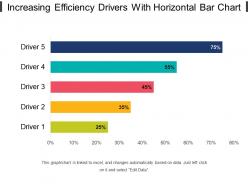
Increasing efficiency drivers with horizontal bar chart





Try Before you Buy Download Free Sample Product
 Impress Your
Audience
 100%
Editable
 Save Hours
of Time


Your audience will owe you a debt of gratitude. Lead them to profit with our Increasing Efficiency Drivers With Horizontal Bar Chart.
People who downloaded this PowerPoint presentation also viewed the following :
Increasing efficiency drivers with horizontal bar chart with all 5 slides:
Enhance intimacy with our Increasing Efficiency Drivers With Horizontal Bar Chart. Bring folks far closer than before.


FAQs for Increasing efficiency drivers with
Key factors influencing operational efficiency include process automation, resource allocation optimization, employee training and development, technology integration, and performance measurement systems. These drivers work together by streamlining workflows, reducing waste, and enhancing productivity, with many organizations finding that strategic combinations of these elements deliver significant cost reductions and improved service delivery.
Technology drives efficiency in modern enterprises through automation, data analytics, cloud computing, and integrated systems that streamline operations and eliminate redundancies. These solutions enable organizations to reduce manual processes, accelerate decision-making, and optimize resource allocation, with many companies finding that strategic technology adoption ultimately delivers significant cost savings and competitive advantages.
Employee training and engagement enhance workplace productivity by developing specialized skills, reducing errors, improving task completion speed, and fostering innovation through better problem-solving capabilities. Through targeted development programs, organizations streamline operations while boosting employee retention and collaboration, with many companies finding that engaged workers deliver significantly higher output and contribute to competitive advantage in increasingly demanding markets.
Data analytics plays a crucial role in identifying efficiency drivers by analyzing operational patterns, resource utilization, workflow bottlenecks, and performance metrics across business processes. Through predictive modeling and real-time monitoring, organizations streamline operations, reduce costs, and enhance productivity, with many finding that data-driven insights deliver measurable improvements in operational efficiency.
Process automation reduces operational costs by eliminating manual tasks, minimizing human errors, and accelerating workflow cycles across departments. Through intelligent automation technologies, organizations streamline resource allocation, reduce labor expenses, and enhance accuracy in operations like invoice processing, customer service, and inventory management, ultimately delivering significant cost savings while improving operational efficiency.
Organizational culture significantly impacts employee efficiency and motivation through shared values, leadership practices, communication patterns, recognition systems, and work environment dynamics. Companies with strong collaborative cultures, like Google and Zappos, see enhanced productivity, reduced turnover, and higher engagement levels, while toxic cultures create barriers that ultimately undermine performance and competitive advantage.
Supply chain management practices significantly enhance production efficiency by optimizing inventory levels, reducing lead times, improving supplier coordination, and minimizing waste throughout operations. Through strategic supplier partnerships and real-time tracking systems, manufacturers achieve faster production cycles, lower operational costs, and better resource allocation, with many organizations finding that integrated supply chain approaches ultimately deliver competitive advantages in increasingly demanding markets.
Businesses can minimize waste through lean manufacturing principles, automated inventory management, energy-efficient technologies, circular economy practices, and data-driven resource allocation strategies. These approaches streamline operations by reducing excess inventory, optimizing energy consumption, and repurposing materials, with many organizations finding that strategic resource optimization delivers significant cost savings while enhancing competitive advantage.
Setting clear goals and KPIs drives project efficiency by establishing measurable targets, aligning team priorities, and enabling data-driven decision making throughout project lifecycles. These frameworks streamline resource allocation, minimize scope creep, and enhance accountability across departments, with many organizations finding that well-defined metrics ultimately deliver faster project completion and improved stakeholder satisfaction.
Cross-department collaboration enhances operational efficiency by eliminating silos, streamlining workflows, reducing duplicated efforts, and accelerating decision-making processes across organizational boundaries. This strategic integration enables faster project completion, improved resource allocation, and enhanced communication, with many companies finding that collaborative teams deliver 25% better performance while reducing operational costs and improving customer experiences.
Regular performance reviews and feedback mechanisms improve efficiency by identifying skill gaps, aligning individual goals with organizational objectives, and providing targeted development opportunities. Through structured feedback systems, organizations streamline workforce productivity, enhance employee engagement, and accelerate professional growth, with many companies finding that consistent performance dialogue ultimately delivers higher output quality and reduced operational bottlenecks.
Essential tools include process mining software, business intelligence dashboards, workflow automation platforms, performance analytics systems, and real-time monitoring applications. These technologies streamline operations by identifying bottlenecks, automating repetitive tasks, and providing data-driven insights, with many organizations finding that strategic integration ultimately delivers measurable cost reductions and enhanced competitive advantage.
Customer feedback influences service delivery efficiency by identifying bottlenecks, highlighting process gaps, and revealing customer pain points that slow operations. Through systematic feedback analysis, organizations streamline workflows, reduce response times, and optimize resource allocation, with many service providers finding that customer insights enable faster problem resolution and ultimately deliver enhanced operational efficiency while improving customer satisfaction.
Best practices for implementing lean management include value stream mapping, continuous improvement processes, employee empowerment initiatives, waste elimination protocols, and standardized work procedures. These approaches streamline operations by reducing redundancies, optimizing resource allocation, and enhancing workflow transparency, with many manufacturing and service organizations finding that systematic lean implementation delivers faster cycle times, lower operational costs, and improved customer satisfaction.
Small businesses can compete on efficiency by leveraging automation tools, adopting cloud-based solutions, streamlining operations through digital workflows, and focusing on specialized market niches where agility matters most. While larger enterprises have resource advantages, smaller organizations often deliver faster decision-making, personalized customer experiences, and rapid adaptation to market changes, ultimately enabling competitive positioning through strategic focus and operational flexibility.
-
Presentation Design is very nice, good work with the content as well.
-
Great designs, really helpful.