

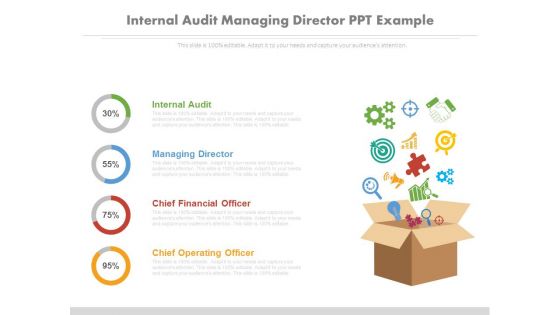
Internal audit managing director ppt example




Try Before you Buy Download Free Sample Product
 Impress Your
 Audience
 100%
100% Editable
 Save Hours
 of Time


An internal audit is a dynamic process to help organizations attain their goals. Since it covers such an important area for any business, this internal audit managing director PPT Example can help you lead in the field. For fulfilment of trade goals, a company certainly need to frame a structured design, which can be executed on easily. However, this internal audit managing PPT template icon is a catalyst for convalescing of your company’s governance, risk management and related processing. This Internal audit PPT design use graphical templates with a variety of icons to actually create an impression on the users. It engages the fundamental purpose, business structure, employee behaviour and every aspect that contributes in making a company achieve its respective goals. Whether your organization has set marketing, financial or some business related goals, this is an ideal internal audit managing director PPT design to let you come out of the dilemmas and lead to success. Follow the guidelines with our Internal Audit Managing Director Ppt Example. Your thoughts will acquire accurate alignment.
People who downloaded this PowerPoint presentation also viewed the following :
Internal audit managing director ppt example with all 6 slides:
Being of assistance is the default condition of our Internal Audit Managing Director Ppt Example. They are happy to give all the help.




FAQs for Internal audit managing
So basically you'd run the whole audit department. The role involves developing audit strategy, managing risk assessments, and overseeing all company audits. Presenting findings to the board is part of it too - honestly pretty nerve-wracking but satisfying when you catch something big. Your team depends on you for leadership during complex investigations and compliance stuff. Building relationships with senior management is huge because otherwise your recommendations just sit there collecting dust. Oh, and process improvements are always on your plate. Short version: work on those executive communication skills now if you're thinking about this path.
So your Internal Audit Managing Director is basically like having a risk detective on payroll. They're constantly scanning for problems before they blow up - compliance issues, operational gaps, sketchy processes that could bite you later. What's cool is they work directly with the C-suite and board, so they actually have clout. Their team does regular deep-dives across departments and spots patterns that individual teams miss. Honestly, you'd be crazy not to include them in strategic planning meetings. They've got this bird's-eye view of where things could go sideways organization-wide. Plus they'll tell you if your current safety nets are actually working or just for show.
Honestly, you'll need solid technical chops - risk assessment, financial analysis, that stuff. But the soft skills are huge too. C-suite presentations require you to explain complex findings without putting people to sleep (harder than it sounds). Strategic thinking matters because you can't just tick compliance boxes. Managing your team is one thing, but dealing with pushback from stakeholders who don't want to be audited? That's the real challenge. Oh, and work on your executive presence early. Sounds cheesy but it's what separates decent auditors from the ones who actually move up to leadership roles.
Dude, start with data analytics tools like ACL or IDEA - they'll let you test every single transaction instead of just random samples. Game changer. Workflow platforms can automate all that tedious tracking stuff that's probably driving your team crazy right now. AI risk assessment tools are honestly incredible, way better than the old-school methods we used to rely on. Oh, and automated dashboards give you real-time updates on everything. My advice? Pick one area where manual work is absolutely killing you guys and start there. Once you see how much time it saves, you can expand to other processes.
Honestly, you're always chasing risks that came out of nowhere. Tech moves way faster than we can even figure out what we're auditing, regulations flip constantly, and half this stuff literally didn't exist a few years ago. Your team's scrambling to learn new skills every few months just to keep up. The real killer? You can't do quality audits when you're constantly changing your approach mid-stream. Annual planning is basically dead when companies pivot every quarter. My advice - build flexibility into everything from day one and get your team into continuous learning mode. Oh, and ditch those rigid frameworks because they'll tank your results fast.
Look, you gotta walk the walk first - nobody follows a leader who doesn't. Explain WHY the rules exist instead of just dumping policies on people. Interactive training beats boring presentations every time (seriously, those PowerPoint marathons are torture). Set up ways for people to ask questions without getting in trouble. Oh, and here's something most managers miss - actually celebrate when someone does compliance right. Public recognition works wonders. Don't make it feel like busy work either. Build it into how your team naturally operates. People buy in when they feel ownership.
Dude, communication is like 70% of your job as Managing Director - maybe more honestly. The C-suite and board don't care about your technical findings if they can't understand what it means for their business. I learned this the hard way my first year. You're translating risk into dollars and strategy basically. Short sentences work better than audit-speak paragraphs. Your recommendations die without buy-in from department heads. Build relationships before you need them - grab coffee, don't just send formal reports. Regular check-ins beat quarterly dumps of information every time.
So you'll need both hard numbers and softer feedback stuff. Track your audit plan completion rate, how long each audit takes, whether management actually follows through on action plans, and satisfaction scores from stakeholders. Risk coverage is huge too - make sure you're consistently hitting the high-risk stuff. Honestly, the hardest part is not just chasing speed metrics because quality matters more. I'd also watch for repeat findings since those show if your recommendations are actually working. Oh, and start with maybe 4-5 key metrics instead of drowning in data you won't use anyway.
Honestly, you've got to get out of that annual planning bubble and actually talk to your C-suite regularly. Map everything back to what they're losing sleep over - revenue, costs, the risks that could tank the business. I see audit teams just recycling the same old stuff year after year, which is kind of pointless if those processes don't even matter anymore. When you present findings, skip the compliance jargon. Show them dollar signs instead. Like, "this control gap could cost us X" or "fixing this saves Y." That's when leadership starts paying attention to what you're doing.
Honestly, data analytics completely changes the internal audit game. Instead of always playing catch-up, you can actually predict problems before they blow up. Spotting fraud patterns and control gaps happens way faster than the old sampling approach - which was honestly pretty hit or miss. Your exec team will eat up those real-time risk dashboards too. You'll look like you have everything under control. The trick is prioritizing audits based on actual risk data instead of just following some outdated annual schedule. Just make sure your team can actually interpret what they're seeing, not just make things look pretty. I'd start with your riskiest processes first.
Managing an audit team is basically juggling development with getting stuff done on time. I always start with clear expectations and rotate people through different areas - builds way better experience that way. One-on-ones are honestly where the magic happens though, that's when you can really dig into what each person needs. Push for certifications and formal training when budget allows. Create challenging assignments but don't throw them in the deep end completely. Oh, and focus on business skills too, not just the technical stuff. Your team needs both to actually advance their careers.
Three things matter most: be brutally honest about risks, stay independent from management, and communicate like a normal person. Don't sugarcoat findings even when leadership pushes back - honestly, that's the whole point of your role. Keep reports tight but thorough, covering both problems and wins. Meet privately with the audit committee regularly, and if something's truly critical, don't wait around for the next scheduled meeting. Oh, and always bring solutions alongside the issues you're flagging. Figure out how your specific board likes to receive info and adjust accordingly.
Honestly, staying current is all about building good habits. I'd start with subscribing to Internal Auditor Magazine and those Friday compliance roundups - they're actually pretty digestible. Google alerts help too, just set them up for your specific regs. Join the IIA if you haven't already; networking there is clutch. Hit up webinars when you can (virtual ones are fine, saves the commute). But here's the real game-changer: get tight with your compliance and legal folks so they give you a heads up on new stuff. I try to read at least one regulatory update weekly, even if it's boring as hell.
Three things will make a huge difference for you. First, get some decent audit management software and analytics tools - seriously saves so much time on the boring stuff and spots risks way faster. Standardize everything too, like your procedures and templates, so your whole team's doing things the same way. Oh and match your auditors to what they're actually good at instead of just throwing anyone at any audit. The real winner though? Switch to continuous monitoring. Set up automated testing so you're catching problems as they happen, not finding out about them months later when it's too late to fix easily.
Get the MD to set up quarterly meetings where both audit teams can actually talk to each other - saves so much duplicated effort it's not even funny. Internal auditors should share their docs early, external does the same. Honestly, the biggest thing is stopping them from seeing each other as rivals. Create shared access to workpapers and do joint updates to the audit committee. Both teams need to understand they're complementary, not competing. Oh, and definitely coordinate on risk assessments and testing areas upfront - trust me on this one.
-
Great product with effective design. Helped a lot in our corporate presentations. Easy to edit and stunning visuals.
-
Excellent Designs.