

Leadership and management learning outcomes powerpoint presentation slides




Try Before you Buy Download Free Sample Product
 Impress Your
 Audience
 100%
100% Editable
 Save Hours
 of Time


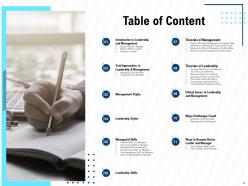
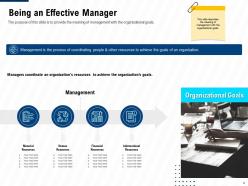
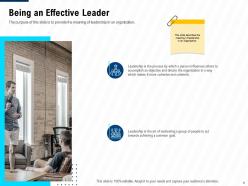
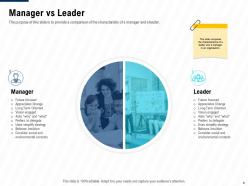
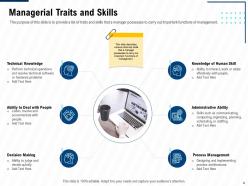
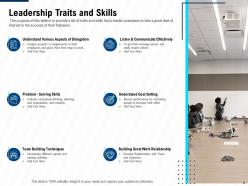
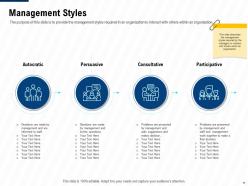
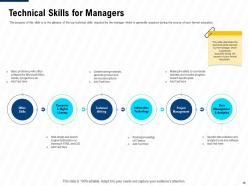
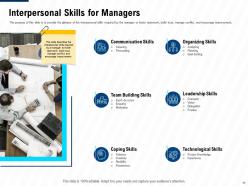
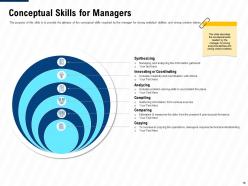
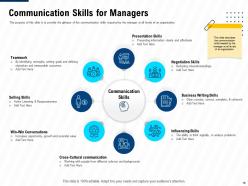
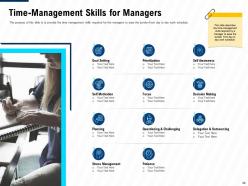
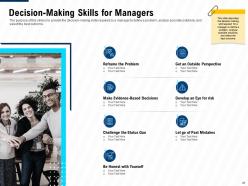
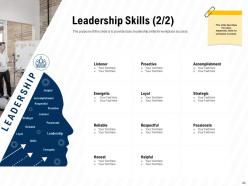
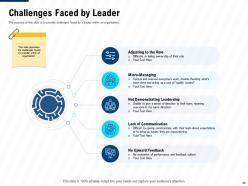
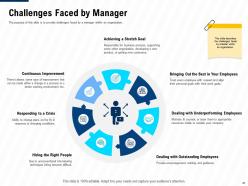
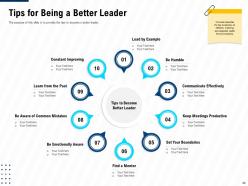
Introducing this Leadership and Management Learning Outcomes PowerPoint Presentation Slides that will help you to showcase the importance of an effective business management system, clearly and concisely. Highlight the process involved in being an effective manager with the help of these leadership studies PPT templates. Our strategic management PPT slideshow is expertly designed to create a clear demarcation between a manager and a leader to help you make an informed comparison. Elaborate on the various traits and skills of a well-qualified manager like decision making, human skill, administrative ability, process management, and technical skills, by taking the assistance of our leadership ppt layouts. This organizational behaviour PPT presentation allows you to discuss the advantages and disadvantages of varied management styles like autocratic, consultative, persuasive, and participative to choose the most suitable style for your organization. Create a well-defined analysis of the processes, skills, theories, and trait approaches of both leadership and management by taking the assistance of this governance PPT visual. Download this management development PPT deck to develop an efficient and effective strategy for your business administration.
People who downloaded this PowerPoint presentation also viewed the following :
Leadership and management learning outcomes powerpoint presentation slides with all 50 slides:
Use our Leadership And Management Learning Outcomes Powerpoint Presentation Slides to effectively help you save your valuable time. They are readymade to fit into any presentation structure.




FAQs for Leadership and management learning outcomes
Leadership focuses on vision, inspiration, and change while management emphasizes planning, organizing, and control systems. Leaders drive innovation, motivate teams, and navigate strategic transformation, whereas managers coordinate resources, ensure operational efficiency, and maintain established processes, with many organizations finding that successful executives seamlessly blend both capabilities for competitive advantage.
Effective leadership practices enhance team performance through clear communication, strategic goal-setting, regular feedback, recognition programs, and empowering decision-making autonomy. These approaches streamline collaboration, boost accountability, and foster innovation, with many organizations finding that leaders who combine emotional intelligence with performance transparency ultimately deliver higher employee retention, increased productivity, and sustained competitive advantage.
Essential managerial skills include effective communication, strategic decision-making, emotional intelligence, conflict resolution, and team development capabilities. These competencies enable managers to inspire collaboration, navigate organizational challenges, and drive performance across diverse teams, with many organizations finding that leaders who master these skills deliver higher employee engagement, improved productivity, and sustainable business growth in increasingly competitive markets.
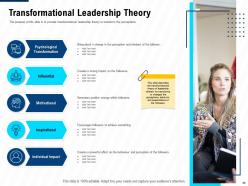
Leadership styles significantly impact organizational culture by shaping communication patterns, decision-making processes, employee autonomy levels, recognition systems, and collaborative approaches within teams. Transformational leaders often cultivate innovation-focused cultures with higher engagement, while authoritative styles may enhance efficiency but potentially reduce creativity, with many organizations finding that adaptive leadership approaches ultimately deliver stronger employee retention and improved performance outcomes.
Organizations can measure training effectiveness through performance metrics, 360-degree feedback assessments, employee engagement surveys, retention rates, and productivity indicators before and after programs. These measurement approaches enable companies to track leadership skill development, team performance improvements, and organizational culture changes, with many finding that comprehensive evaluation frameworks ultimately deliver better ROI and sustained competitive advantage.
Emotional intelligence enables successful leadership by enhancing self-awareness, empathy, social skills, and relationship management, while improving decision-making under pressure. Leaders with strong emotional intelligence streamline team communication, reduce workplace conflicts, and drive higher employee engagement, with many organizations finding that emotionally intelligent managers deliver significantly better performance outcomes and foster more collaborative, productive work environments.
Managers foster continuous learning cultures by encouraging experimentation, providing regular feedback, allocating time for skill development, celebrating knowledge sharing, and modeling lifelong learning behaviors themselves. Through mentorship programs, cross-functional projects, and learning stipends, organizations like Google and Microsoft create environments where teams continuously upskill, ultimately delivering enhanced innovation, employee retention, and competitive advantage.
Effective conflict resolution strategies include active listening, facilitating open dialogue, implementing structured mediation processes, establishing clear communication protocols, and addressing underlying issues proactively. These approaches enable leaders to transform workplace tensions into collaborative problem-solving opportunities, with many organizations finding that systematic conflict management ultimately enhances team cohesion, productivity, and employee retention.
Servant leadership prioritizes empowering and developing team members first, contrasting with traditional management's focus on authority, control, and top-down decision-making. This approach enhances employee engagement, fosters innovation, and builds stronger organizational cultures, with many companies finding that servant leaders ultimately deliver better long-term performance and retention outcomes.
Effective methods include mentorship programs, cross-functional project assignments, leadership assessment centers, succession planning initiatives, and 360-degree feedback systems. These approaches identify high-potential employees by evaluating their decision-making capabilities, emotional intelligence, and strategic thinking skills, while providing targeted development opportunities that ultimately strengthen organizational leadership pipelines and competitive advantage.
Technology facilitates leadership and management learning outcomes through AI-powered simulations, virtual reality training environments, data analytics platforms, personalized learning paths, and collaborative digital tools. These technologies enhance skill development by providing real-time feedback, immersive decision-making scenarios, and performance tracking, with many organizations finding that leaders develop stronger strategic thinking and emotional intelligence through technology-enhanced programs.
Diversity and inclusion significantly enhance leadership effectiveness by improving decision-making, fostering innovation, expanding market understanding, and increasing employee engagement across organizations. Leaders in diverse environments develop stronger emotional intelligence, cultural competency, and adaptive management skills, while inclusive teams demonstrate higher performance, creativity, and retention rates, ultimately delivering competitive advantage and sustainable growth.
Experiential learning integrates into leadership training through simulations, case studies, mentoring programs, cross-functional projects, and real-world problem-solving exercises. These methods enhance decision-making skills, emotional intelligence, and strategic thinking by providing hands-on experience, with many organizations finding that practical application accelerates leadership development and improves retention rates significantly.
New leaders transitioning from management roles commonly face challenges including shifting from task execution to strategic vision, building influence without relying solely on authority, developing emotional intelligence for complex interpersonal dynamics, and learning to delegate effectively while maintaining accountability. These transitions require mastering stakeholder communication, decision-making under uncertainty, and organizational change management, with many executives finding that developing coaching skills and strategic thinking capabilities ultimately delivers enhanced team performance and sustainable business growth.
Changes in the external environment significantly influence leadership and management practices by requiring adaptive strategies, enhanced digital capabilities, and agile decision-making frameworks. Through evolving market conditions, regulatory shifts, and technological advances, organizations streamline communication processes, enhance remote management skills, and develop crisis response protocols, with many financial services and healthcare institutions finding that flexible leadership approaches ultimately deliver competitive advantage and operational resilience.
-
The Designed Graphic are very professional and classic.
-
Easily Editable.
-
Content of slide is easy to understand and edit.
-
It saves your time and decrease your efforts in half.
-
Unique research projects to present in meeting.