

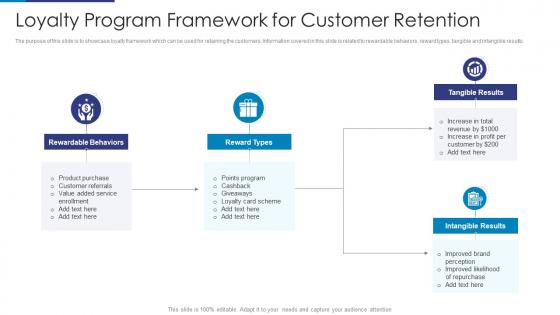
Loyalty Program Framework For Customer Retention




Try Before you Buy Download Free Sample Product
 Impress Your
 Audience
 100%
100% Editable
 Save Hours
 of Time


The purpose of this slide is to showcase loyalty framework which can be used for retaining the customers. Information covered in this slide is related to rewardable behaviors, reward types, tangible and intangible results.
People who downloaded this PowerPoint presentation also viewed the following :
Loyalty Program Framework For Customer Retention with all 6 slides:
Use our Loyalty Program Framework For Customer Retention to effectively help you save your valuable time. They are readymade to fit into any presentation structure.





FAQs for Loyalty Program Framework
Effective loyalty programs include clear reward structures, personalized offerings, seamless digital integration, tiered membership levels, and meaningful redemption options. These components work together by enhancing customer engagement, streamlining reward tracking, and delivering personalized experiences, with many retail and hospitality businesses finding that strategic combinations ultimately drive repeat purchases and competitive advantage.
Businesses measure loyalty program success through customer retention rates, repeat purchase frequency, average order value increases, and program engagement metrics like active member participation. These analytics enable organizations to track revenue growth from loyal customers, calculate customer lifetime value improvements, and assess cost-per-acquisition reductions, with many retailers finding that data-driven optimization delivers significantly higher program ROI.
Customer data plays a fundamental role in designing effective loyalty programs by enabling personalized rewards, targeted communications, behavior prediction, and preference analysis. Through data analytics, retailers and service providers can segment customers, customize offers based on purchase history, and optimize program mechanics, with many brands finding that data-driven loyalty programs increase engagement rates and customer lifetime value significantly.
Loyalty programs enhance customer retention rates by offering personalized rewards, exclusive benefits, and tiered incentives that encourage repeat purchases and deeper engagement. Through strategic point systems and targeted offers, businesses across retail, hospitality, and financial services create emotional connections with customers, ultimately reducing churn while increasing lifetime value and purchase frequency.
Customer preferences vary significantly across demographics, with millennials favoring experiential rewards like exclusive events and early access, while older segments prefer traditional cashback and discounts. Successful loyalty programs increasingly combine tiered benefits, personalized offers, and convenience rewards like free shipping, with many retailers finding that customizable rewards and surprise bonuses drive the highest engagement rates.
Digital loyalty programs typically deliver higher engagement through personalized offers, real-time tracking, and seamless mobile integration, while physical programs like punch cards offer tangible simplicity and work without technology barriers. Many retailers find that digital programs generate more data insights and automated communications, ultimately enabling better customer segmentation and targeted marketing, though physical programs still resonate with demographics preferring traditional approaches.
Innovative loyalty programs include Starbucks' mobile-integrated rewards system, Amazon Prime's membership benefits, Sephora's tiered beauty insider program, Nike's personalized fitness rewards, and Patagonia's environmental activism points. These programs enhance customer engagement by combining personalization, convenience, and value-aligned experiences, with many retail organizations finding that strategic loyalty initiatives significantly increase customer lifetime value and competitive differentiation.
Businesses can leverage gamification in loyalty programs through points systems, achievement badges, tier-based rewards, challenges, and leaderboards that encourage repeat engagement. These interactive elements transform routine purchases into engaging experiences, with retailers like Starbucks and airlines finding that gamified loyalty programs increase customer retention, boost purchase frequency, and ultimately deliver stronger brand loyalty and higher lifetime customer value.
Companies face challenges including customer acquisition costs, program complexity management, data integration difficulties, reward fulfillment logistics, and measuring meaningful ROI. These obstacles often stem from inadequate technology infrastructure, unclear value propositions, and insufficient customer segmentation, with many retailers finding that successful programs require strategic alignment between marketing goals, operational capabilities, and genuine customer value creation.
Small businesses can create impactful loyalty programs through simple point systems, referral incentives, birthday rewards, social media engagement contests, and personalized email offers. These cost-effective approaches leverage existing customer relationships and digital platforms, with many local retailers finding that basic punch cards or app-based programs significantly increase repeat purchases while building stronger community connections.
Mobile apps improve customer engagement in loyalty programs through personalized push notifications, gamification features, location-based offers, seamless point tracking, and exclusive mobile-only rewards. These digital tools enable retailers and service providers to deliver real-time value, streamline reward redemption, and create interactive experiences, with many businesses finding that app-based programs generate significantly higher participation rates and customer lifetime value.
Loyalty programs can be tailored by personalizing rewards based on purchase history, offering tiered benefits for different customer segments, creating experiential rewards beyond discounts, and integrating seamless digital touchpoints across channels. Through data analytics and behavioral insights, retailers and hospitality brands enhance customer satisfaction, increase retention rates, and drive repeat purchases, ultimately delivering competitive advantage in increasingly crowded markets.
Strategies include migrating customer data to digital platforms, implementing mobile apps with personalized rewards, integrating social media engagement features, and creating omnichannel experiences that connect online and offline touchpoints. Retailers and hospitality brands find that phased transitions, combined with enhanced analytics and real-time personalization capabilities, significantly improve customer engagement while reducing operational costs and delivering competitive advantages in increasingly digital marketplaces.
Reciprocity drives loyalty programs by creating a psychological obligation where customers feel compelled to return value after receiving benefits, rewards, or exclusive experiences from brands. Through strategic reward timing and personalized offers, retailers and hospitality companies leverage this principle to build emotional connections, increase purchase frequency, and foster long-term customer retention, ultimately enhancing lifetime value.
Ethical loyalty programs should prioritize transparent terms, fair reward structures, genuine value delivery, responsible data collection practices, and inclusive accessibility across customer segments. Businesses must balance profit objectives with customer trust by avoiding manipulative tactics, ensuring clear redemption processes, and protecting personal information, ultimately building sustainable relationships that enhance brand reputation while delivering measurable customer retention and satisfaction outcomes.
-
Great quality slides in rapid time.
-
Awesome presentation, really professional and easy to edit.