

Major Industries Adopting Robotic Process Automation Powerpoint Presentation Slides





Try Before you Buy Download Free Sample Product
 Impress Your
 Audience
 100%
100% Editable
 Save Hours
 of Time


Robotic Process Automation RPA, also known as software robotics, has become a game changer in various industries. This comprehensive Major industries adopting automated process automation deck demonstrates how RPA tools integrate APIs and user interfaces to execute repetitive tasks. Moreover, the RPA tools presentation explores the adoption techniques of RPA in different sectors, including customer service, retail, marketing, sales, human resources, and information technology. Furthermore, the Robotic Process Automation template covers strategies for RPA implementation, the RPA implementation timeline, and the impact of RPA on various processes. Lastly, automotive industry automation PPT also delves into significant implementation challenges, organizational results, and performance measurement dashboards. Get access to this powerful template now.
People who downloaded this PowerPoint presentation also viewed the following :
Content of this Powerpoint Presentation
Slide 1: This slide displays the title Major industries adopting robotic process automation.
Slide 2: This slide displays the title Agenda.
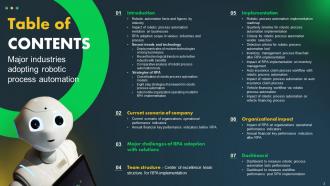
Slide 3: This slide exhibit table of content.
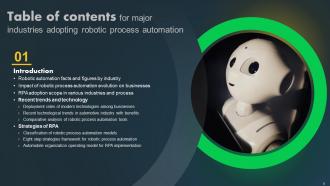
Slide 4: This slide exhibit table of content.
Slide 5: This slide showcase table of content that is to be discuss further.
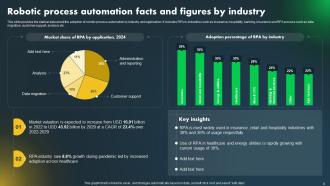
Slide 6: This slide provides the statical data about the adoption of robotic process automation by industry and application.
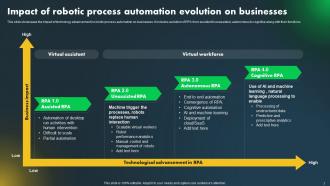
Slide 7: This slide showcases the impact of technology advancement in robotic process automation on businesses.
Slide 8: Mentioned slide showcases the level of adoption scope of robotic process automation among various industries and processes.
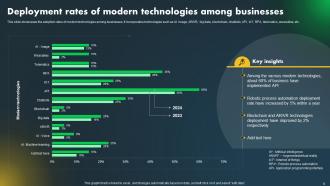
Slide 9: This slide showcases the adoption rates of modern technologies among businesses.
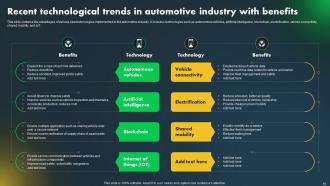
Slide 10: This slide contains the advantages of various new technologies implemented in the automotive industry.
Slide 11: This slide provides the robotic process automation tools comparative analysis.
Slide 12: This slide categorize the types of robotic process automation.
Slide 13: This slide illustrates the steps of developing a successful robotic process automation strategy.
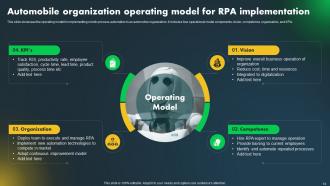
Slide 14: This slide showcase the operating model for implementing robotic process automation in an automotive organization.
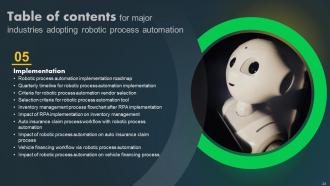
Slide 15: This slide showcase table of content that is to be discuss further.
Slide 16: This slide showcases the present situation of technical and operational performance parameters.
Slide 17: This slide covers current annual financial indicators of organization before the implementation of automation.
Slide 18: This slide covers current annual financial indicators of organization before the implementation of automation.
Slide 19: This slide showcase table of content that is to be discuss further.
Slide 20: This slide showcases the significant challenges of enforcing robotic process automation in organizations and solutions.
Slide 21: This slide showcase table of content that is to be discuss further.
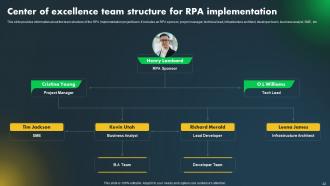
Slide 22: This slide provides information about the team structure of the RPA implementation project team.
Slide 23: This slide showcase table of content that is to be discuss further.
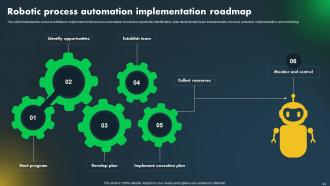
Slide 24: This slide illustrates the series of activities to implement robotic process automation.
Slide 25: This slide provides the quarterly action plan of sequential events and activities required to implement and execute robotic process automation in an organization.
Slide 26: This slide provides the selection criteria to choose suitable RPA vendor based on certain parameters.
Slide 27: The mentioned slide provides the selection criteria scorecard to choose suitable RPA tool based on certain parameters.
Slide 28: This slide illustrates the flowchart of inventory management process after robotic process implementation.
Slide 29: The mentioned slide showcases the effect of executing RPA on inventory management workflow based on specific parameters.
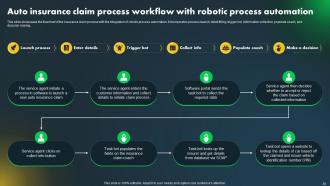
Slide 30: This slide showcases the flowchart of the insurance claim process with the integration of robotic process automation.
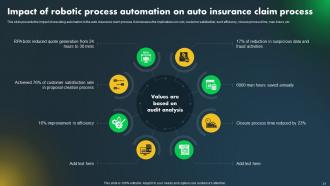
Slide 31: This slide presents the impact of executing automation in the auto insurance claim process.
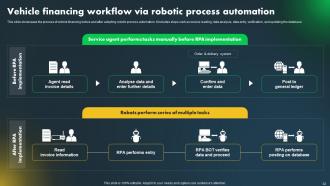
Slide 32: This slide showcases the process of vehicle financing before and after adopting robotic process automation.
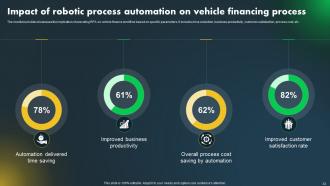
Slide 33: The mentioned slide showcases the implication of executing RPA on vehicle finance workflow based on specific parameters.
Slide 34: This slide showcase table of content that is to be discuss further.
Slide 35: This slide showcases the overall impact of RPA implementation on operational performance parameters of an organization.
Slide 36: This slide covers annual financial indicators of organization after the implementation of automation.
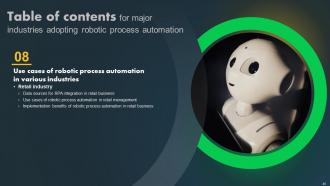
Slide 37: This slide showcase table of content that is to be discuss further.
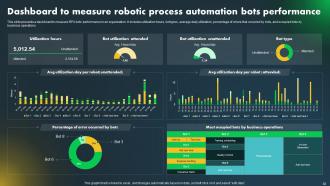
Slide 38: This slide presents a dashboard to measure RPA bots' performance in an organization.
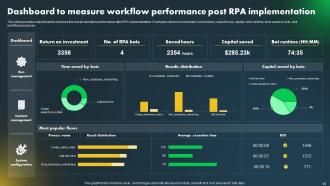
Slide 39: This slide presents a dashboard to measure the overall operation performance after RPA implementation.
Slide 40: This slide showcase table of content that is to be discuss further.
Slide 41: The mentioned slide showcase the various industries which implement RPA in their operations.
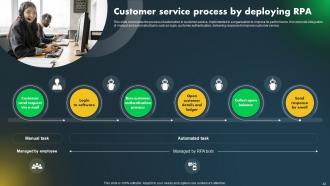
Slide 42: This slide showcases the process of automation in customer service, implemented in a organization to improve its performance.
Slide 43: This slide provides practical scenarios of robotic process automation in various customer service processes.
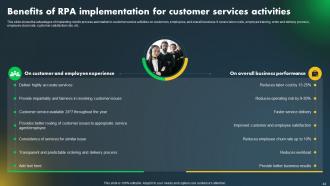
Slide 44: This slide shows the advantages of implanting robotic process automation in customer service activities on customers, employees, and overall business.
Slide 45: This slide showcase table of content that is to be discuss further.
Slide 46: The mentioned slide showcases the data and information sources required to execute automation and understand consumer behaviour.
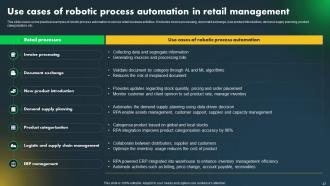
Slide 47: This slide covers some practical examples of robotic process automation in various retail business activities.
Slide 48: Mentioned slide covers some of the advantages of adopting robotic process automation in the retail sector.
Slide 49: This slide showcase table of content that is to be discuss further.
Slide 50: This slide provides some application scenarios of robotic process automation in various sales activities.
Slide 51: This slide provides practical illustrations of robotic process automation in various marketing activities and its impact.
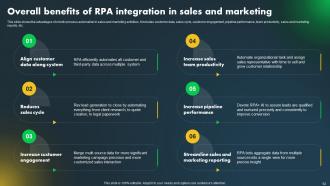
Slide 52: This slide shows the advantages of robotic process automation in sales and marketing activities.
Slide 53: This slide showcase table of content that is to be discuss further.
Slide 54: This slide showcases all the scope areas for integrating automation in healthcare systems.
Slide 55: The mentioned slide provides use cases of robotic process automation in various healthcare functions.
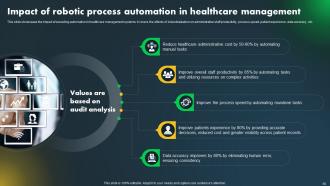
Slide 56: This slide showcases the impact of executing automation in healthcare management systems.
Slide 57: This slide showcase table of content that is to be discuss further.
Slide 58: The slide showcases the range of extent of robotic process automation in banking and finance operations.
Slide 59: The mentioned slide provides some application scenarios of robotic process automation in various banking operation activities.
Slide 60: This slide showcases the risk of implementing robotic process automation in banking and finance services.
Slide 61: This slide provides the effect of executing robotic process automation in the banking and finance business.
Slide 62: This slide showcase table of content that is to be discuss further.
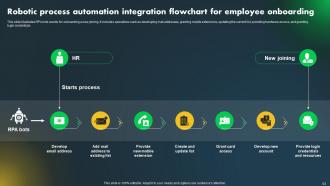
Slide 63: This slide illustrates RPA bots events for onboarding a new joining.
Slide 64: This slide showcases various human resources processes identified based on RPA importance and RPA adoption.
Slide 65: This slide illustrates some application scenarios of robotic process automation in human resources functions.
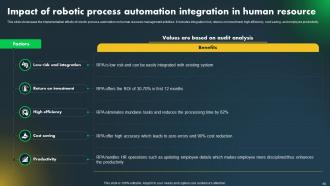
Slide 66: This slide showcases the implementation effects of robotic process automation on human resource management activities.
Slide 67: This slide showcase table of content that is to be discuss further.
Slide 68: The mentioned slide provides some application scenarios of robotic process automation in information technology business operations.
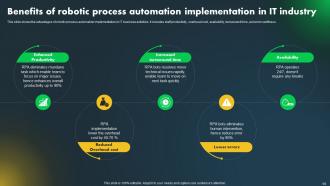
Slide 69: This slide shows the advantages of robotic process automation implementation in IT business activities.
Slide 70: This slide illustrates the change in the IT process flowchart before and after robotic process automation implementation.
Slide 71: This is the icons slide.
Slide 72: This slide presents title for additional slides.
Slide 73: This slide display Pie chart.
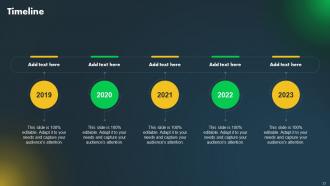
Slide 74: This slide exhibit yearly Timeline.
Slide 75: This slide showcase Comparison.
Slide 76: This slide showcase Magnifying glass.
Slide 77: This slide exhibit Idea generation.
Slide 78: This slide depicts posts for past experiences of clients.
Slide 79: This slide display Location.
Slide 80: This is thank you slide & contains contact details of company like office address, phone no., etc.
Major Industries Adopting Robotic Process Automation Powerpoint Presentation Slides with all 87 slides:
Use our Major Industries Adopting Robotic Process Automation Powerpoint Presentation Slides to effectively help you save your valuable time. They are readymade to fit into any presentation structure.









































FAQs for Major Industries Adopting Robotic Process Automation
Banking, healthcare, insurance, manufacturing, and retail lead RPA implementation, leveraging automation for data processing, claims management, quality control, and customer service operations. These industries streamline repetitive tasks like loan processing, patient record management, and inventory tracking, ultimately delivering faster services, reduced operational costs, and enhanced customer experiences.
RPA enhances operational efficiency in healthcare organizations by automating patient registration, claims processing, appointment scheduling, and medical record management. Through intelligent automation, hospitals and clinics streamline administrative workflows, reduce manual errors, and accelerate patient services, while minimizing operational costs and enabling staff to focus on direct patient care, ultimately delivering faster treatment and improved patient experiences.
RPA revolutionizes financial services by automating account opening, loan processing, compliance reporting, fraud detection, and transaction reconciliation. Through intelligent automation, banks and financial institutions streamline customer onboarding, accelerate loan approvals, and enhance regulatory compliance, while reducing operational costs and improving customer experiences, ultimately delivering competitive advantage in an increasingly digital banking landscape.
RPA streamlines supply chain operations by automating inventory tracking, purchase order processing, supplier communications, and shipment monitoring across multiple systems. Manufacturing companies and retail organizations leverage these automated workflows to reduce manual errors, accelerate order fulfillment, and enhance vendor relationship management, ultimately delivering faster delivery times and improved operational efficiency.
Manufacturing industries face key challenges including legacy system integration complexities, workforce resistance to automation changes, high initial implementation costs, process standardization requirements, and ensuring data security across interconnected systems. While these obstacles require strategic planning and change management, many manufacturers find that gradual RPA deployment in areas like inventory management and quality control ultimately delivers significant operational efficiency and competitive advantage.
RPA improves retail customer service by automating order processing, inventory updates, return handling, chatbot responses, and loyalty program management, enabling faster transaction times and 24/7 support availability. Through automated systems, retail businesses streamline customer interactions, reduce wait times, and deliver personalized shopping experiences, while freeing staff to focus on complex customer needs, ultimately enhancing satisfaction and competitive advantage.
RPA revolutionizes data entry tasks by automating repetitive processes, reducing human error, and accelerating processing speeds across multiple sectors. Financial institutions streamline loan applications, healthcare organizations enhance patient record management, and retail companies optimize inventory tracking, with many finding that automated data entry delivers 80% faster processing times while significantly improving accuracy and freeing employees for strategic work.
AI-integrated RPA transforms telecommunications by automating complex customer service workflows, network monitoring processes, and billing dispute resolutions while enabling predictive maintenance and intelligent resource allocation. Through machine learning capabilities, telecom companies streamline operations, reduce service downtime, and enhance customer experiences, with many providers finding that this strategic combination delivers significant cost reductions and competitive advantage in an increasingly digital marketplace.
Regulatory considerations for RPA in pharmaceuticals include FDA compliance validation, data integrity requirements, audit trail maintenance, change control documentation, and Good Manufacturing Practice adherence. These automated systems must demonstrate consistent regulatory reporting, traceable decision-making processes, and seamless integration with quality management systems, ultimately enabling pharmaceutical companies to accelerate compliance while reducing manual oversight costs.
SMEs typically approach RPA implementation with focused, departmental solutions targeting specific pain points, while large corporations deploy enterprise-wide strategic initiatives across multiple business units simultaneously. Small businesses often start with simple processes like invoice processing or customer onboarding, whereas enterprises implement comprehensive automation frameworks spanning finance, HR, and operations, ultimately delivering scalable efficiency gains.
Essential RPA success metrics include process cycle time reduction, error rate decreases, cost per transaction, employee productivity gains, and return on investment calculations. Financial services organizations track loan processing speed improvements, while healthcare institutions measure patient data accuracy enhancements and manufacturing companies monitor inventory management efficiency, with many finding that combining operational and financial metrics delivers the most comprehensive performance insights.
Legal organizations can leverage RPA by automating document review, contract analysis, case management workflows, regulatory compliance reporting, and client billing processes. These technologies streamline operations by reducing manual data entry, accelerating case preparation, and minimizing human error, with many law firms finding that automated workflows deliver faster client services, lower operational costs, and enhanced competitive advantage.
Emerging RPA trends include hyperautomation combining AI and machine learning, intelligent document processing, cloud-native platforms, process mining integration, and conversational automation through chatbots. These technologies are revolutionizing industries like healthcare with patient data management, financial services through enhanced fraud detection, and manufacturing via predictive maintenance, ultimately delivering greater operational efficiency and competitive advantage as organizations increasingly adopt end-to-end automation strategies.
RPA streamlines regulatory compliance in banking and insurance by automating data collection, report generation, and audit trail documentation while ensuring consistent adherence to regulatory requirements. Through intelligent automation, financial institutions can minimize human errors in compliance processes, accelerate regulatory reporting timelines, and maintain comprehensive documentation, ultimately reducing compliance costs while enhancing regulatory transparency and accuracy.
Organizations can ensure successful RPA adoption by conducting thorough process audits, starting with simple, high-volume tasks, establishing clear governance frameworks, and investing in comprehensive employee training programs. Manufacturing and financial services companies find that creating dedicated RPA centers of excellence, maintaining robust security protocols, and fostering cross-departmental collaboration ultimately delivers faster implementation timelines and higher automation ROI.
-
I was really impressed with the presentation I created with their templates. I’ll be using their services moving forward.
-
Colors used are bright and distinctive.