

Market Customer Segmentation Matrix To Understand Target Market Customer Segmentation Targeting And Positioning




Try Before you Buy Download Free Sample Product
 Impress Your
Audience
 100%
Editable
 Save Hours
of Time


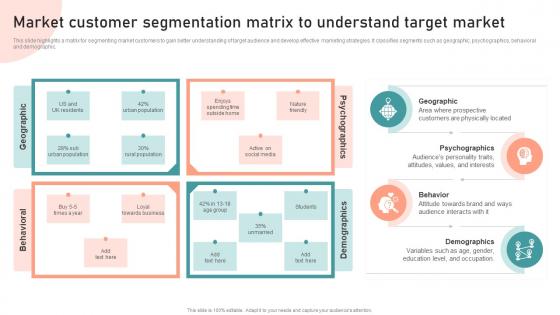
This slide highlights a matrix for segmenting market customers to gain better understanding of target audience and develop effective marketing strategies. It classifies segments such as geographic, psychographics, behavioral and demographic.
People who downloaded this PowerPoint presentation also viewed the following :
Market Customer Segmentation Matrix To Understand Target Market Customer Segmentation Targeting And Positioning with all 6 slides:
Use our Market Customer Segmentation Matrix To Understand Target Market Customer Segmentation Targeting And Positioning to effectively help you save your valuable time. They are readymade to fit into any presentation structure.






FAQs for Market Customer Segmentation Matrix To Understand Target Market Customer Segmentation
So there's four main ways to slice this up: demographics (age, income, gender stuff), geographic (where people live, climate), psychographic (their lifestyle and values - this one's actually pretty interesting), and behavioral (how they shop and if they stick with brands). Demographics are the obvious starting point since they're super easy to track. Geographic works great if your business depends on location. Psychographic gets into the psychology behind why people buy - like going after environmentally conscious shoppers. Behavioral focuses on actual purchase patterns. Don't try to use all of them though. Pick 2-3 that actually make sense for what you're selling.
So basically, demographic segmentation is where you split your audience by age, income, gender, education - that stuff. Makes way more sense than blasting everyone with the same message. A retirement ad for 25-year-olds? Total waste of money lol. When you actually speak to what each group cares about, you'll get better engagement and conversions. Your ad spend goes further too since you're not throwing darts blindfolded. I'd pick your top 2-3 segments first and test different messages with each. Way easier to start small than go crazy with like 10 segments right off the bat.
So basically, psychographic segmentation is way better than just looking at age and income - you're digging into what actually makes people tick. Their values, hobbies, political stuff, personality quirks. It's honestly pretty fascinating once you start. Two women who are both 35 might buy your product for totally different reasons, right? One's motivated by convenience, another by status or whatever. That's where the real insights live. Survey your current customers about their interests and beliefs first - that'll give you solid profiles to work with. Once you understand the "why" behind purchases, your messaging hits different.
Look at your sales data first - where are you actually making money? Maybe cities are killing it but smaller towns aren't biting. Once you know that, switch up your approach for each area. Different ad budgets, messaging that clicks with locals, whatever channels work there. Weather's another thing - don't be that company pushing winter coats in Miami, you know? I'd test small chunks in each market first. See what sticks, then throw more money at the winners instead of spraying budget everywhere and hoping something works.
Honestly, behavioral segmentation is super data-heavy and that's the main pain point. Collecting all that purchase history, usage patterns, and loyalty info costs a fortune. Plus people's behaviors change way faster than basic demographics - your segments go stale quick. Privacy laws don't make gathering data any easier these days either. The analysis part gets messy fast when you're drowning in behavioral signals trying to figure out what actually matters. My advice? Pick one behavioral metric you can reliably track instead of going crazy analyzing everything at once. Way less overwhelming that way.
Honestly, start with RFM analysis - recency, frequency, monetary. Super simple but it works. From there you can get fancy with clustering algorithms that'll group customers way better than just guessing based on age or whatever. I've watched teams find segments they never knew existed, which is pretty cool. The predictive stuff is where it gets interesting though - you can actually forecast who's about to bounce or convert. Just make sure your data's clean first (learned that one the hard way). Pull from all your touchpoints if you can. Way more accurate than going with your gut.
Get good data first - demographics, how they behave, what they're into. But seriously, don't create like 15 tiny segments because that's where teams lose their minds. Stick to 3-5 that are actually different enough to matter. Each one needs to be big enough to make money and you gotta be able to reach them somehow. Here's the thing though - test your segments with real campaigns to see if they actually act differently. I'd start with just one segment, see if it works, then build from there. Way less overwhelming that way.
So buyer personas are just detailed profiles of your dream customers inside each segment. Market segmentation splits people into big groups by age or behavior, but personas go way deeper - like into what actually drives someone to buy stuff. Say millennials are your segment. Your persona might be "Sarah, 28, pinches pennies and impulse-shops during her lunch hour." Makes it feel real, you know? I always tell people to pick one segment first and build 2-3 solid personas for it. Trust me, your marketing decisions will suddenly make way more sense. It's kinda wild how much clearer everything becomes once you've got actual "people" to target instead of just data points.
Start with Google Analytics and social media insights - they'll show you who your audience actually is. SurveyMonkey or Typeform work great for getting direct feedback about what customers want. But honestly? Just pick up the phone sometimes. I know everyone's obsessed with data now, but actual conversations reveal stuff you'd never find in spreadsheets. Excel's clustering tools are surprisingly decent for analysis, or go fancier with Tableau if you've got budget. My advice is stick with free tools first. You can always upgrade once you figure out what segmentation approach actually works for your business.
So segmentation totally shapes your product roadmap - it shows you what each customer group actually needs. You'll find gaps where nobody's solving certain problems, which is honestly where the best opportunities hide. Generic products that try to make everyone happy? They usually make nobody happy lol. Different segments have different budgets and pain points, so you can prioritize features that actually matter. I'd start by mapping what you already have against your segments first. You'll probably spot some obvious mismatches that are quick wins to tackle.
Honestly, the biggest red flags are discrimination and privacy stuff. Don't segment based on race, religion, any of that protected stuff - seems obvious but you'd be surprised. Also, be upfront about how you're grabbing customer data. Here's where it gets tricky though: sometimes your "harmless" behavioral segments accidentally line up with sensitive demographics. Like only targeting fancy products to certain zip codes, you know? Really think about whether you're actually helping customers or just squeezing more money out of them. Simple test: would you be cool with this strategy being used on you?
Look, small businesses can absolutely crush it with niche marketing - you don't have all that corporate red tape holding you back. Pick your most profitable customer type and go all-in on them. Big mistake I see everywhere? Companies trying to appeal to everyone and ending up bland as hell. When you focus tight, you actually get what makes your customers tick. You'll build better relationships, can charge more, and your marketing dollars stretch way further. My buddy did this with his landscaping business - went from "we do yards" to "drought-resistant gardens for eco-conscious homeowners" and tripled his rates.
So B2B segmentation is all about business stuff - company size, industry, who makes the buying decisions. B2C is more personal: demographics, lifestyle, what motivates someone to buy that random thing at 2am (we've all been there). Think of it this way: are you solving a business problem or fulfilling a personal want? That's your starting point right there. Though honestly, B2B is getting weirdly personal these days since you're still dealing with actual humans. But the core split remains - business needs versus "I want this because reasons." Figure out which camp you're in first, then build your segments around that.
So here's the thing - when you actually talk to specific customer groups instead of everyone at once, they feel like you understand them. That's huge. People stick with brands that "get it," you know? Like if you're selling to busy moms vs college students, obviously they want different things. Tailor your messaging to each group's actual problems and preferences. Honestly, most companies are still doing the spray-and-pray approach which is why this works so well. Your customers will stick around longer because they're getting something that feels made for them. I'd start with maybe 2-3 segments and just focus on different messaging for each one first.
Okay so conversion rates by segment - that's like your main thing to watch. Then look at customer lifetime value because some segments might seem great but actually suck long-term. Email opens, time on your site, social stuff - all broken down by segment obviously. Revenue per segment is kinda obvious but you still gotta track it. Honestly retention rates might be the most telling though, since I've seen segments that convert amazing then disappear after a month lol. Pick maybe 3 of these and check monthly - don't overwhelm yourself right away.
-
The slides are remarkable with creative designs and interesting information. I am pleased to see how functional and adaptive the design is. Would highly recommend this purchase!
-
The designs by SlideTeam are honestly the best I have seen so far. Will be definitely coming back for more.