

Monthly Comparison Graph For Operating And Gross Profit Margin





Try Before you Buy Download Free Sample Product
 Impress Your
Audience
 100%
Editable
 Save Hours
of Time


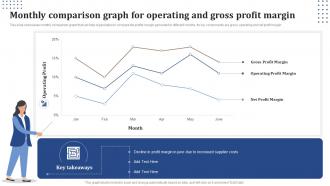
This slide showcases monthly comparison graph that can help organization to compare the profits margin generated in different months. Its key components are gross, operating and net profit margin.
People who downloaded this PowerPoint presentation also viewed the following :
Monthly Comparison Graph For Operating And Gross Profit Margin with all 7 slides:
Use our Monthly Comparison Graph For Operating And Gross Profit Margin to effectively help you save your valuable time. They are readymade to fit into any presentation structure.






FAQs for Monthly Comparison Graph For Operating And
Monthly profit margins are influenced by revenue fluctuations, cost of goods sold variations, operational expenses, seasonal demand patterns, and pricing strategies. Many businesses find that factors like supply chain costs, labor expenses, and market competition create monthly variations, with retail companies experiencing holiday spikes and manufacturing firms managing raw material price changes, ultimately requiring strategic monitoring to maintain consistent profitability.
Seasonal trends significantly impact monthly profit margin comparisons by creating predictable fluctuation patterns that vary dramatically across industries, with retail experiencing peaks during holidays, agriculture following harvest cycles, and tourism surging in specific seasons. These cyclical variations enable businesses to benchmark against industry-specific seasonal norms rather than year-round averages, ultimately delivering more accurate performance assessments and strategic planning insights.
Businesses should monitor revenue growth rate, cost of goods sold percentage, operating expense ratios, gross profit margins, and net profit margins when analyzing monthly performance. These KPIs enable organizations to identify cost inefficiencies, pricing opportunities, and operational bottlenecks, with many companies finding that consistent tracking delivers improved resource allocation and competitive advantage.
Fixed costs remain constant regardless of sales volume, providing stability but creating pressure during low-revenue months, while variable costs fluctuate directly with production levels, offering flexibility but reducing predictable profit calculations. Manufacturing companies and retail businesses find that managing this strategic combination effectively enables better cash flow forecasting, more accurate pricing strategies, and ultimately stronger competitive positioning during market fluctuations.
Monthly profit margin comparison best practices include using consistent color coding, clear trend lines, percentage change callouts, benchmark indicators, and standardized time periods across all data sets. These visualization techniques enhance audience comprehension by highlighting performance patterns, seasonal variations, and year-over-year improvements, while enabling stakeholders to quickly identify growth opportunities and operational challenges, ultimately delivering strategic insights for informed decision-making.
Visual aids enhance understanding of monthly profit margin trends by transforming complex numerical data into clear, immediately comprehensible formats like line graphs, bar charts, and trend visualizations. These tools enable executives and stakeholders to quickly identify patterns, seasonal fluctuations, and performance gaps across different time periods, ultimately facilitating faster strategic decisions and more effective communication of financial performance to investors and teams.
Competitive analysis enables businesses to benchmark their monthly profit margins against industry standards, identify pricing gaps, and uncover operational inefficiencies through comparative performance metrics. By analyzing competitor margins, companies can strategically adjust pricing strategies, optimize cost structures, and enhance market positioning, ultimately delivering improved profitability and sustainable competitive advantage in their sector.
Monthly profit margin comparisons enable businesses to identify seasonal trends, performance patterns, and operational inefficiencies by tracking profitability fluctuations across different periods. These insights facilitate strategic resource allocation, budget forecasting, and pricing adjustments, with many retail and manufacturing companies finding that consistent margin analysis enhances competitive positioning and ultimately delivers improved financial performance.
Common pitfalls include inconsistent accounting methods, failing to properly allocate overhead costs, ignoring seasonal variations, mixing gross and net margin calculations, and comparing dissimilar product lines or time periods. These errors can significantly distort financial analysis, with many organizations finding that standardized calculation methods, consistent cost allocation practices, and seasonal adjustments ultimately deliver more accurate performance insights and strategic decision-making capabilities.
Pricing strategy significantly impacts monthly profit margins by determining revenue per unit, influencing customer demand, and positioning against competitors across different market segments. Technology and pharmaceutical sectors often maintain higher margins through premium pricing, while retail and hospitality rely on volume-based strategies, with many organizations finding that dynamic pricing models enhance profitability by 15-25%.
Tools for tracking monthly profit margin data include QuickBooks, Xero, Sage, Power BI, Tableau, and Excel with specialized templates. These platforms streamline financial analysis by automating calculations, generating comparative reports, and creating visual dashboards, with many organizations finding that integrated accounting software combined with business intelligence tools delivers real-time insights and enhanced decision-making capabilities.
Companies can identify cost-cutting opportunities through monthly profit margin comparisons by analyzing expense patterns, tracking seasonal variations, and benchmarking against industry standards. This approach enables organizations to pinpoint underperforming periods, optimize resource allocation, and streamline operations, with many businesses finding that consistent margin analysis delivers improved profitability and competitive advantage.
Benchmarking monthly profit margins against industry standards provides critical insights into competitive positioning, operational efficiency, and pricing strategies relative to market peers. This comparative analysis enables businesses to identify performance gaps, optimize resource allocation, and adjust strategic approaches, with many organizations finding that consistent benchmarking ultimately delivers improved profitability and sustainable competitive advantage.
Currency fluctuations directly impact international businesses' monthly profit margins through revenue conversion, cost variations, and transaction timing differences. When companies operate across borders, strengthening home currencies reduce foreign revenue values while weakening currencies increase import costs, with manufacturers and retailers often experiencing margin swings of 2-5% monthly, ultimately requiring strategic hedging approaches to maintain consistent profitability.
Monthly profit margin trends significantly influence investor confidence, credit ratings, lending terms, and equity valuations, as they demonstrate operational efficiency and management effectiveness. Consistent upward trends enhance access to favorable financing rates and attract growth-oriented investors, while declining margins may trigger covenant reviews and require strategic communication, with many financial institutions finding that transparent margin analysis strengthens long-term stakeholder relationships.
-
The templates are handy and I can personalize them as per my needs. Glad to be your subscriber!
-
Kudos to SlideTeam for achieving the high success rate in delivering the top-notch slides.