

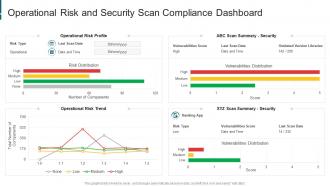
Operational risk and security scan compliance dashboard





Try Before you Buy Download Free Sample Product
 Impress Your
Audience
 100%
Editable
 Save Hours
of Time


Our Operational Risk And Security Scan Compliance Dashboard are topically designed to provide an attractive backdrop to any subject. Use them to look like a presentation pro.
People who downloaded this PowerPoint presentation also viewed the following :
Operational risk and security scan compliance dashboard with all 2 slides:
Use our Operational Risk And Security Scan Compliance Dashboard to effectively help you save your valuable time. They are readymade to fit into any presentation structure.

FAQs for Operational risk and security
The primary components of operational risk in financial institutions include internal fraud, external fraud, employment practices violations, client and product liabilities, business disruption, and system failures. These risk categories impact banks and investment firms through unauthorized trading, cyber attacks, regulatory compliance breaches, and technology outages, with many institutions finding that comprehensive risk frameworks ultimately enhance operational efficiency and regulatory compliance.
Organizations can effectively quantify operational risk exposure through risk assessment frameworks, data analytics, scenario modeling, key risk indicators, and loss event databases. These methodologies enable banks, hospitals, and manufacturing companies to measure potential losses, identify vulnerability patterns, and allocate resources strategically, ultimately delivering enhanced risk transparency and competitive advantage.
Technology enhances operational risk management through real-time monitoring systems, predictive analytics, automated compliance tracking, AI-powered threat detection, and integrated reporting platforms. These solutions enable organizations to identify vulnerabilities faster, streamline risk assessments, and automate response protocols, with many financial institutions and healthcare organizations finding that technology-driven approaches ultimately deliver greater operational resilience and regulatory compliance.
A robust risk culture helps manage operational risks by encouraging proactive identification, promoting transparent communication across departments, and empowering employees to escalate concerns without fear of retribution. This cultural foundation enables organizations to detect issues earlier, respond more effectively to emerging threats, and maintain consistent risk management practices, with many financial institutions and healthcare organizations finding that strong risk cultures significantly reduce incident frequency and regulatory violations.
The most common sources of operational risk include cybersecurity threats, supply chain disruptions, regulatory compliance failures, technology system breakdowns, and human error incidents. These risks significantly impact organizations across industries, with financial services facing fraud detection challenges, healthcare managing patient data security, and manufacturing addressing equipment failures, ultimately requiring comprehensive risk management frameworks to minimize operational disruptions and protect business continuity.
Organizations implement comprehensive operational risk management frameworks by establishing clear risk governance structures, conducting regular risk assessments, creating detailed process documentation, implementing robust monitoring systems, and developing incident response protocols. These frameworks enhance operational efficiency by identifying vulnerabilities early, streamlining compliance processes, and reducing potential losses, with many financial institutions and healthcare organizations finding that structured approaches ultimately deliver improved regulatory compliance and competitive advantage.
Regulatory requirements significantly enhance operational risk management by mandating comprehensive risk assessment frameworks, standardized reporting protocols, and robust internal controls across organizations. These regulations drive banks, insurance companies, and financial institutions to implement systematic monitoring processes, allocate dedicated resources for compliance, and maintain detailed documentation, ultimately delivering greater transparency and operational resilience.
Companies leverage data analytics to enhance operational risk assessments by implementing predictive modeling, real-time monitoring systems, automated anomaly detection, and comprehensive data visualization tools. Through machine learning algorithms, organizations can identify emerging risk patterns, streamline compliance processes, and minimize potential losses, with many financial institutions and manufacturing companies finding that these analytics-driven approaches ultimately deliver faster risk identification and significantly improved operational efficiency.
Businesses can foster resilience through diversified supply chains, robust business continuity planning, cross-trained employees, technology redundancies, and regular risk assessments. These strategies enable organizations to maintain operations during disruptions, with many financial services and manufacturing companies finding that strategic diversification and automated backup systems significantly reduce downtime while enhancing competitive advantage.
Operational risk varies significantly across industries, with financial services facing regulatory and cyber threats, healthcare managing patient safety and compliance risks, manufacturing dealing with equipment failures and supply chain disruptions, and retail handling inventory and customer data security. These industry-specific risk profiles require tailored management strategies, specialized monitoring systems, and customized compliance frameworks, ultimately enabling organizations to allocate resources more effectively while maintaining competitive advantage.
Crisis management best practices for operational risk include establishing comprehensive response protocols, maintaining clear communication channels, implementing rapid decision-making frameworks, conducting regular scenario planning, and ensuring robust backup systems. These approaches streamline crisis response by enabling faster threat assessment, coordinated stakeholder communication, and swift operational recovery, with many organizations finding that proactive crisis preparedness significantly minimizes downtime and reputational damage.
Organizations ensure effective communication during operational risk events by establishing pre-defined escalation protocols, designating crisis communication teams, maintaining real-time stakeholder updates, and utilizing multiple communication channels simultaneously. These frameworks enable rapid information flow across departments, minimize confusion through clear messaging hierarchies, and maintain transparency with regulators and customers, ultimately reducing response time and preserving stakeholder confidence.
Employee training plays a crucial role in minimizing operational risks by enhancing competency, ensuring compliance with procedures, reducing human errors, and building awareness of potential hazards across all organizational levels. Through comprehensive training programs, organizations streamline decision-making processes, improve incident response capabilities, and foster a risk-conscious culture, ultimately delivering enhanced operational efficiency and reduced liability exposure.
Inadequately addressing operational risks can result in significant financial losses, regulatory penalties, reputational damage, business disruptions, and competitive disadvantage. Organizations may face costly system failures, compliance violations, customer defections, and operational inefficiencies, with many companies finding that proactive risk management ultimately delivers enhanced resilience, cost savings, and sustainable growth.
Scenario analysis enables organizations to model potential operational disruptions by simulating various risk events, stress-testing current processes, and identifying vulnerabilities before they materialize. Through systematic evaluation of different scenarios, companies can develop contingency plans, allocate resources more effectively, and enhance response capabilities, with many financial institutions and healthcare organizations finding that proactive scenario planning significantly reduces operational downtime and regulatory compliance issues.
-
Best Representation of topics, really appreciable.
-
Nice and innovative design.
-
Enough space for editing and adding your own content.
-
Appreciate the research and its presentable format.
-
The content is very helpful from business point of view.