

Pitch deck for entrepreneurs raising money for a new business powerpoint presentation slides






Try Before you Buy Download Free Sample Product
 Impress Your
Audience
 100%
Editable
 Save Hours
of Time


Raising money from investors is a challenging task and requires a great pitch to convince them. The good news is that we have a content-ready pitch deck for entrepreneurs raising money for a new business PowerPoint presentation slides for you. In this investor pitch presentation, we have included 59 slides you need in your initial business proposal. It covers topics such as elevator pitch, problem, solution, product demo, market size, business model, proprietary technology, competitive analysis matrix, our offerings vs the competition, marketing plan, sales plan, social media marketing, client testimonials, and much more. Furthermore, these designs can also be utilized to craft a PPT on topics, like investor pitch, elevator statement, business angel funding, equity crowdfunding, seed fundraising, investor business proposal, and capital raising presentation. Download pitch deck for entrepreneurs raising money for a new business PowerPoint templates that will help you in your fundraising efforts. Our Pitch Deck For Entrepreneurs Raising Money For A New Business Powerpoint Presentation Slides enable judgement. Get a balanced insight into the issue at hand.
People who downloaded this PowerPoint presentation also viewed the following :
Content of this Powerpoint Presentation
Slide 1: This slide introduces Pitch Deck for Entrepreneurs: Raising Money for a New Business. State Your Company Name and begin.
Slide 2: This is an Agenda slide. State your agendas here.
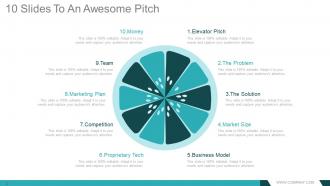
Slide 3: This is 10 Slides To An Awesome Pitch slide containing- Elevator Pitch, The Problem, Market Size, The Solution, Business Model, Proprietary Tech, Competition, Team, Marketing Plan, Money.
Slide 4: This slide is titled Teaser Slide. You may change as per need.
Slide 5: This slide presents the first template on Elevator Pitch.
Slide 6: This slide presents the second template on Elevator Pitch.
Slide 7: This slide presents the third template on Elevator Pitch.
Slide 8: This is The Problem displaying slide. State aspects of business problems etc. here.
Slide 9: This is a second slide displaying The Problem.
Slide 10: This is a third slide displaying The Problem.
Slide 11: This is the first slide displaying The Solution.
Slide 12: This is the second slide displaying The Solution.
Slide 13: This is the third slide displaying The Solution such as- Save Time, Save Money, Save Energy.
Slide 14: This is a Product Demo slide. State product aspects here.
Slide 15: This is the first slide on Market Size.
Slide 16: This is the second slide on Market Size showing- TAM, SAM, TARGET MARKET, TAM, SAM, Target Market, Advertisers, Event Organizers Mentors.
Slide 17: This is the third slide on Market Size.
Slide 18: This is the first slide on Business Model. Show how your business model would look like, its functioning aspects etc.
Slide 19: This is the second slide on Business Model. Show how your business model would look like, its functioning aspects etc.
Slide 20: This slide presents a Business Model Canvas displaying- Key partners, Key Activities, Key resources, Customer Relationships, Channels, Customer segments, Cost structure, Revenue streams, Value Propositions.
Slide 21: This slide presents Proprietary Technology/ Expertise with Competitive Advantages.
Slide 22: This slide presents Proprietary Technology/ Expertise with Competitive Advantages.
Slide 23: This slide presents Proprietary Technology/ Expertise with Competitive Advantages.
Slide 24: This is a Competition-Competitor Identification table showcasing- Substitutes, New entrants, Key national competitors, Key national competitors.
Slide 25: This slide presents Competition-Comparison Table showing- Criteria, Revenue, Profit, Market Share, Main Activity, Number Of Employee, Product Quality.
Slide 26: This is a Competition-Competitor Positioning slide showing- Average Market Growth, Company Growth (%), Gaining Market Share, Losing Market Share.
Slide 27: This slide showcases a Competitive Analysis Matrix.
Slide 28: This slide showcases a Competitive Analysis 2 X 2 Matrix to compare your company with competitors.
Slide 29: This is Our Offering Vs. The Competition table slide.
Slide 30: This slide shows Us Vs. The Competition in matrix form displaying- Share, Picture, Charts, News.
Slide 31: This slide presents Marketing Plan consisting of- Facebook, Social Referral, You Tube, Search Engine Marketing, Seo & Content, Instagram, Blog, Twitter, Email Referral, Affiliate, Direct Sales, Online Advertising, Offline Advertising, Social Commerce.
Slide 32: This slide showcases Marketing Launch Plan with a creative rocket launch imagery.
Slide 33: This is a Sales & Marketing Plan slide in tabular form.
Slide 34: This slide presents Sales & Marketing Plan with- Online, Market Research, Advertising.
Slide 35: This slide presents Tactical Marketing Plan Task Description, Person/DEPT Responsible, Progress Status, Cost Per Task, Timeline Status, Comments.
Slide 36: This slide presents Digital Marketing Plan showcasing- Projected coat to date, Actual coat to date.
Slide 37: This slide showcases a Digital Marketing Roadmap displaying- whitepaper development, webinars, Content creation initiative, Video w/lead capture, Blog post developments, Newsletter sing up plugin, Home page redesign, Content, Analytics implementation, Competitive analysis, Keyword research, Ad roll campaign iteration, Display advertising analysis, On-site SEO improvements, New bar, Paid/organic search initiative, Paid/organic search, a/b message testing, In trial drip campaign, Email marketing, Conversion initiative, Onboarding optimization, Influencer outreach program, Social media, Social media initiative.
Slide 38: This slide presents a Social Media Marketing Plan.
Slide 39: This slide presents Team showcasing- Geeks, Entrepreneurs, and Sales as examples to display.
Slide 40: This is an Our team slide with name, designation and text boxes to state information.
Slide 41: This is a Team slide with name, designation and text boxes to state information.
Slide 42: This slide shows Traction- What Have We Achieved So Far with- Partners, 200 Stores, Product Ready.
Slide 43: This slide showcases Financials- What Are We Expecting in graph form.
Slide 44: This slide shows How Much Money We Need with- How much are we raising? How much have we raised? How Will We Spend The Money?
Slide 45: This slide presents How We'll Spend The Money. State future expenditure facts here.
Slide 46: This is a Client Testimonials slide with name, designation and text boxes to state information.
Slide 47: This is another Client Testimonials slide with name, designation and text boxes to state information.
Slide 48: This is also a Client Testimonials slide with name, designation and text boxes to state information.
Slide 49: This slide is titled Additional Slides to move forward. You may alter/modify the slide content as per need.
Slide 50: This is Our Mission slide with Vision and Goal etc. accompanied by icon imagery. State them here.
Slide 51: This is an About Us slide. Show company/team specifications etc. here
Slide 52: This is Our Goal slide. State them here.
Slide 53: This slide showcases Comparison of two entities in monitor screen imagery form.
Slide 54: This slide presents Dashboard to present Kpis, metrics etc.
Slide 55: This is a Location slide of world map image to show global presence, growth etc.
Slide 56: This is a Timeline slide. State milestones, highlights, evolution etc. here.
Slide 57: This is a Bulb or Idea image slide to state information, specifications etc.
Slide 58: This is a Funnel image slide to show product/entity information, funneling aspects etc.
Slide 59: This is a Thank You slide with Email, Address# street number, city, state, Contact Numbers.
Pitch deck for entrepreneurs raising money for a new business powerpoint presentation slides with all 59 slides:
Establish a good impression on the audience with our Pitch Deck For Entrepreneurs Raising Money For A New Business Powerpoint Presentation Slides. Be able to ingratiate yourself.







FAQs for Pitch deck for entrepreneurs raising money for a new business
A successful pitch deck includes problem identification, solution presentation, market opportunity analysis, business model explanation, competitive landscape overview, financial projections, and team introductions. These components work together by establishing credibility, demonstrating market understanding, and showcasing growth potential, with many startups finding that clear storytelling and compelling visuals ultimately secure investor interest and funding opportunities.
Storytelling transforms pitch decks by creating emotional connections, simplifying complex concepts, and making presentations memorable through narrative flow. Through compelling narratives, entrepreneurs can engage investors more deeply, demonstrate market understanding and customer pain points, while building trust and credibility, ultimately increasing funding success rates significantly.
Common pitch deck mistakes include overloading slides with text, lacking clear value propositions, presenting unrealistic financial projections, ignoring competitive analysis, and failing to tell a compelling story. These errors undermine investor confidence by creating confusion, demonstrating poor market understanding, and suggesting weak business planning, with many startups finding that clarity and strategic focus ultimately deliver stronger funding outcomes.
Tailoring pitch decks involves adjusting content focus, messaging depth, and outcome emphasis based on audience priorities and decision-making criteria. For investors, emphasize market opportunity, scalability metrics, financial projections, and competitive advantages, while client-focused decks prioritize solution benefits, implementation processes, case studies, and ROI demonstrations, with many organizations finding that audience-specific customization significantly enhances engagement and conversion rates.
Effective pitch deck visual elements include clean typography, consistent color schemes, high-quality images, strategic white space, and compelling data visualizations. These design choices enhance readability and professional credibility by reducing cognitive load, reinforcing brand identity, and highlighting key metrics, with many startups finding that visually cohesive presentations significantly improve investor engagement and funding success rates.
Data visualization is crucial in pitch decks, transforming complex metrics into compelling stories that investors can quickly grasp and remember. Best practices include using clean charts with minimal text, selecting appropriate graph types for your data, maintaining consistent color schemes, and focusing on key trends rather than overwhelming detail, with successful startups finding that clear visual narratives significantly enhance investor engagement and funding outcomes.
Branding establishes credibility, memorability, and professional polish throughout a pitch deck by incorporating consistent visual elements, messaging tone, and value proposition alignment. Through strategic logo placement, color schemes, and typography, startups differentiate themselves from competitors while building investor confidence, with many funding presentations finding that cohesive branding significantly enhances perceived legitimacy and investment appeal.
Effectively conveying your unique value proposition requires clearly articulating what differentiates your solution, identifying specific customer pain points you solve, and demonstrating measurable outcomes through concrete data or case studies. This strategic combination enables investors and stakeholders to quickly grasp your competitive advantage, with many successful startups finding that visual storytelling paired with quantifiable results ultimately delivers the most compelling and memorable presentations.
The ideal pitch deck length is 10-15 slides for presentations and up to 20 slides for reading, with content prioritized around problem definition, solution clarity, market opportunity, and financial projections. Successful startups streamline their narratives by focusing on compelling storytelling, clear value propositions, and measurable traction, with many investors finding that concise, data-driven presentations ultimately deliver stronger funding outcomes.
Practice presentation feedback enables pitch deck refinement through content restructuring, visual enhancement, and delivery optimization based on audience reactions and comprehension gaps. Entrepreneurs can identify unclear value propositions, adjust financial projections based on investor questions, and streamline messaging flow, with many startups finding that iterative refinements significantly improve funding success rates and stakeholder engagement.
The best ways to incorporate multimedia elements include high-quality images, infographics, embedded videos, interactive charts, and professional animations that support your narrative. These elements enhance investor engagement by simplifying complex data, demonstrating product functionality, and creating memorable visual storytelling, with many startups finding that strategic multimedia use increases presentation retention and funding success rates.
**INPUT**: How do you ensure clarity and conciseness in your pitch deck? **OUTPUT**: Ensuring clarity and conciseness requires focusing on one key message per slide, using bullet points instead of paragraphs, and eliminating industry jargon that confuses investors. Successful startups streamline their decks by practicing the "10-second rule," where each slide communicates its core point within ten seconds, ultimately delivering compelling narratives that secure funding faster.
A compelling closing slide should include a clear call-to-action, contact information, funding amount requested, timeline for next steps, and a memorable summary statement. This slide serves as your final opportunity to reinforce key value propositions and create urgency, with many successful entrepreneurs finding that a confident, specific ask paired with immediate availability for questions drives investor engagement and accelerates funding conversations.
Virtual pitch decks require enhanced visual clarity, streamlined content flow, and interactive elements to maintain audience engagement through screens. They benefit from larger fonts, simplified graphics, and strategic use of animations or transitions, with many startups finding that shorter presentation times, built-in Q&A segments, and follow-up materials deliver stronger investor connections and memorable impressions.
Color schemes and font choices significantly influence audience perception by affecting readability, emotional response, and professional credibility of your pitch deck. Strategic color palettes can convey brand personality and guide attention to key data points, while consistent, professional typography enhances comprehension and trust, with many investors finding that polished visual design reflects organizational attention to detail and market readiness.
-
Excellent products for quick understanding.
-
Easily Understandable slides.