


Planned vs actual effort graph for software development project





Try Before you Buy Download Free Sample Product
 Impress Your
Audience
 100%
Editable
 Save Hours
of Time


Our Planned Vs Actual Effort Graph For Software Development Project are explicit and effective. They combine clarity and concise expression.
People who downloaded this PowerPoint presentation also viewed the following :
Content of this Powerpoint Presentation
Description:
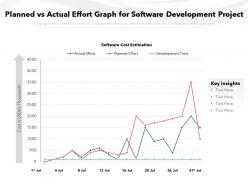
The image is a PowerPoint slide titled "Planned vs Actual Effort Graph for Software Development Project," featuring a line graph comparing three different metrics over the course of a month: Actual Effort, Planned Effort, and Development Time. The X-axis represents the time frame (from 1st July to 31st July), and the Y-axis represents cost in USD (in thousands).
The graph shows fluctuations in all three metrics, indicating variances between what was planned and what actually occurred, as well as the amount of development time. To the right of the graph, there is a section titled "Key insights" with bullet points where specific observations and conclusions drawn from the data can be added.
Use Cases:
This type of slide can be useful in various industries that manage projects and track performance metrics:
1. Software Development:
Use: Monitoring project budget and timeline adherence
Presenter: Project Manager
Audience: Development Team, Stakeholders
2. Construction:
Use: Tracking project costs and scheduling
Presenter: Construction Manager
Audience: Investors, Contractors
3. Marketing Agencies:
Use: Evaluating campaign spend versus planned budgets
Presenter: Account Manager
Audience: Clients, Marketing Team
4. Manufacturing:
Use: Comparing production costs against forecasts
Presenter: Operations Manager
Audience: Production Team, Finance Department
5. Event Planning:
Use: Assessing event costs and timelines against initial estimates
Presenter: Event Coordinator
Audience: Clients, Service Providers
6. Healthcare Administration:
Use: Tracking medical project expenditures and timelines
Presenter: Healthcare Project Manager
Audience: Administrative Staff, Healthcare Providers
7. Educational Institutions:
Use: Managing educational program developments and budget
Presenter: Academic Project Manager
Audience: Educators, Administration
Planned vs actual effort graph for software development project with all 2 slides:
Give your audience a fulfilling experience. They will find our Planned Vs Actual Effort Graph For Software Development Project elevating.

FAQs for Planned vs actual effort graph for
Key benefits of implementing effort tracking in software development include enhanced project visibility, accurate resource allocation, improved deadline estimation, better budget control, and data-driven decision making. These practices streamline project management by identifying bottlenecks early, optimizing team productivity, and delivering more predictable outcomes, with many development teams finding that systematic tracking ultimately reduces costs while improving delivery timelines and client satisfaction.
Different effort tracking methodologies impact productivity by providing visibility into resource allocation, identifying bottlenecks, and enabling data-driven decision making. Agile teams using story points and velocity tracking often find improved sprint planning accuracy, while traditional hour-based tracking in enterprise environments delivers detailed cost analysis and timeline predictability, ultimately enhancing project delivery consistency and team accountability.
**INPUT**: What tools and software are most effective for tracking developer effort and resource allocation? **OUTPUT**: Effective developer effort tracking tools include Jira, Azure DevOps, Linear, Toggl Track, and Harvest, which streamline project management and time allocation. These platforms enhance operational efficiency by automating resource monitoring, integrating with development workflows, and delivering real-time insights, with many software teams finding that strategic tool combinations ultimately reduce project overruns while improving delivery predictability.
Effort tracking improves communication by providing transparent project visibility, clear progress metrics, realistic timeline updates, and data-driven decision making capabilities. Through detailed tracking systems, development teams can proactively communicate bottlenecks, resource needs, and delivery expectations to stakeholders, while management gains accurate insights for strategic planning, ultimately fostering trust and alignment.
Effort tracking serves different purposes in agile versus waterfall methodologies, with waterfall emphasizing upfront planning and milestone tracking, while agile focuses on iterative sprint planning and continuous velocity measurement. In waterfall environments, organizations track effort against predetermined phases and deliverables, whereas agile teams use effort data for sprint retrospectives, capacity planning, and adaptive project management, ultimately enabling more flexible resource allocation and faster response to changing requirements.
Accurate effort estimation requires breaking projects into granular tasks, leveraging historical data from similar projects, involving experienced developers in planning sessions, and using techniques like story points or time-boxing. Teams increasingly combine multiple estimation methods, regularly calibrate against actual outcomes, and build in buffer time for uncertainties, ultimately delivering more predictable timelines and better resource allocation across development cycles.
Metrics for evaluating effort tracking effectiveness include estimation accuracy, velocity consistency, resource utilization rates, project delivery timelines, and budget variance analysis. These measurements enable development teams to identify bottlenecks, optimize sprint planning, and improve resource allocation, with many software organizations finding that consistent tracking delivers enhanced project predictability and competitive advantage.
Teams can address effort reporting inaccuracies through automated time tracking tools, regular calibration sessions, clear reporting guidelines, and creating psychologically safe environments where honest reporting is encouraged rather than penalized. These approaches streamline accuracy by reducing manual entry errors, establishing consistent measurement standards, and fostering transparency, with many software organizations finding that combining technology with cultural change ultimately delivers more reliable project estimates and improved resource allocation.
Real-time effort tracking significantly enhances project timeline accuracy and budget control by providing continuous visibility into resource allocation, identifying bottlenecks early, and enabling immediate corrective actions. Through automated monitoring systems, software development teams streamline sprint planning, minimize cost overruns, and deliver projects more predictably, with many organizations finding that real-time insights ultimately reduce project delays by 25-30% while improving budget adherence.
Cultural differences significantly influence effort tracking adoption through varying attitudes toward hierarchy, transparency, and individual versus collective accountability across teams. Teams from high-context cultures may prefer collaborative tracking methods, while individualistic cultures often embrace personal productivity metrics, with many global organizations finding that culturally-adaptive tracking systems ultimately deliver higher engagement and more accurate project insights.
Encouraging consistent effort tracking requires clear communication of benefits, streamlined processes, and integrated workflows that minimize administrative burden. Teams respond well when tracking tools are user-friendly, data insights are regularly shared to demonstrate value, and tracking becomes part of daily standups and sprint planning, ultimately delivering improved project visibility and resource allocation across development cycles.
Historical effort tracking data enables software teams to create more accurate project estimates by analyzing past sprint velocities, task completion rates, and resource allocation patterns across similar projects. By examining trends in actual versus estimated effort, development teams can identify bottlenecks, adjust planning methodologies, and improve timeline predictions, with many organizations finding that data-driven estimation reduces project overruns and enhances delivery reliability.
Excessive effort tracking can reduce developer productivity through constant monitoring overhead, create anxiety that stifles creativity and innovation, and shift focus from quality outcomes to mere time spent coding. While tracking provides valuable project insights, over-emphasis can lead to micromanagement cultures, decreased team morale, and gaming behaviors where developers prioritize appearing busy over delivering meaningful results, ultimately hindering long-term software quality.
Integration between effort tracking tools and version control systems enhances project management by providing real-time visibility into development progress, automatically linking time spent to specific code changes, and enabling accurate sprint planning through historical data analysis. This strategic combination streamlines reporting workflows, reduces manual documentation overhead, and delivers comprehensive project insights, with many development teams finding that automated time-to-code correlation significantly improves resource allocation and delivery predictability.
Best practices for visualizing effort data include burndown charts, velocity tracking dashboards, sprint progress indicators, resource allocation heatmaps, and comparative timeline views. These visualization tools enhance project transparency by highlighting bottlenecks, predicting delivery timelines, and optimizing resource distribution, with many software teams finding that clear visual data ultimately accelerates decision-making and improves project outcomes.
No Reviews