


PMO Roles In Implementation Of Digitalization Strategy Powerpoint Presentation Slides




Try Before you Buy Download Free Sample Product
 Impress Your
 Audience
 100%
100% Editable
 Save Hours
 of Time


Project Management Office PMO is a group or department inside a corporation, agency, or enterprise that establishes and maintains project management standards within the organization. Grab our professionally designed PMO Roles in Implementation of Digitalization Strategy template that explains the requirement to reshape the role of the PMO in the digital era, focus on supporting digital transformation, etc. A PMO leader is in charge of consolidating projects into a single portfolio, implementing governance and protocols, and prioritizing projects based on strategic goals. This presentation provides the details on the Traditional Roles of the PMO leaders, the organizational structure, and significant issues in the traditional roles of PMOs. Also, this template provides details on new parts of PMO leaders, strategy-related PPM capability support, significant challenges in the implementation of new roles, portfolio management maturity model, etc. This presentation also covers critical elements of an effective change management plan and change management plan implementation. This template also provides information on change management communication plans for stakeholders and the benefits of shifting PMO priorities. Get access to our digitalization ppt now.
People who downloaded this PowerPoint presentation also viewed the following :
Content of this Powerpoint Presentation
Slide 1: This slide introduces PMO Roles in Implementation of Digitalization Strategy. State Your Company Name and begin.
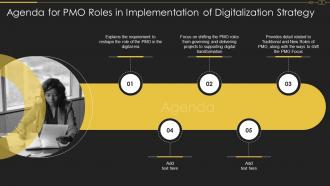
Slide 2: This is an Agenda slide. State your agendas here.
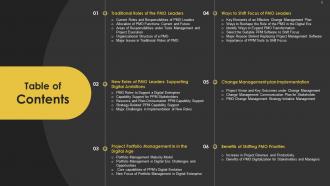
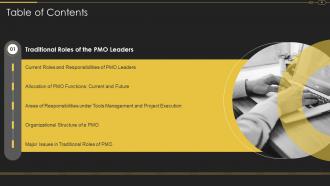
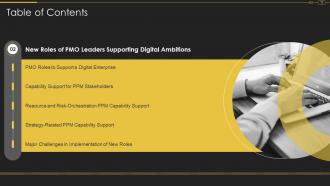
Slide 3: This slide presents Table of Content for the presentation.
Slide 4: This slide highlights title for topics that are to be covered next in the template.
Slide 5: This slide displays Current Roles and Responsibilities of PMO Leaders.
Slide 6: This slide represents Allocation of PMO Functions: Current and Future.
Slide 7: This slide shows Areas of Responsibilities under Tools Management and Project Execution.
Slide 8: This slide presents various advantages of PMO leaders in project management, including advancing project management culture, increasing level of maturity, etc.
Slide 9: This slide shows hierarchy structure of PMO, that includes PMO head, departments under the PMO, and various projects under each department
Slide 10: This slide displays several issues in the traditional roles of PMO.
Slide 11: This slide highlights title for topics that are to be covered next in the template.
Slide 12: This slide shows PMO Roles to Support a Digital Enterprise.
Slide 13: This slide presents the various capabilities to provide talent-enablement-related support for PPM stakeholders.
Slide 14: This slide shows Resource and Risk-Orchestration PPM Capability Support.
Slide 15: This slide displays the various capabilities to provide strategy-related PPM capability support.
Slide 16: This slide represents Major Challenges in Implementation of New Roles.
Slide 17: This slide highlights title for topics that are to be covered next in the template.
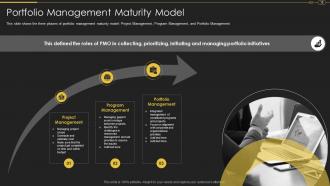
Slide 18: This slide presents the three phases of portfolio management maturity model.
Slide 19: This slide shows Portfolio Management in Digital Era: Challenges and Opportunities.
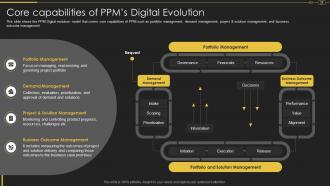
Slide 20: This slide displays Core capabilities of PPM’s Digital Evolution.
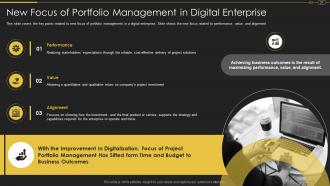
Slide 21: This slide represents New Focus of Portfolio Management in Digital Enterprise.
Slide 22: This slide highlights title for topics that are to be covered next in the template.
Slide 23: This slide presents Key Elements of an Effective Change Management plan.
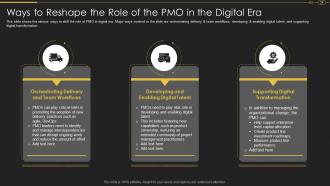
Slide 24: This slide shows Ways to Reshape the Role of the PMO in the Digital Era.
Slide 25: This slide displays focus areas to extends the PMO transformation.
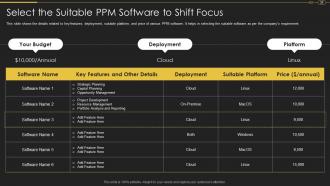
Slide 26: This slide represents the details related to key features, deployment, suitable platform, etc.
Slide 27: This slide shows Major Reason Behind Replacing Project Management Software.
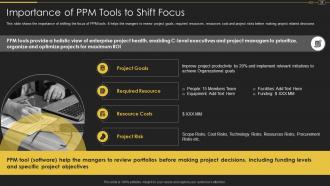
Slide 28: This slide presents the importance of shifting the focus of PPM tools.
Slide 29: This slide highlights title for topics that are to be covered next in the template.
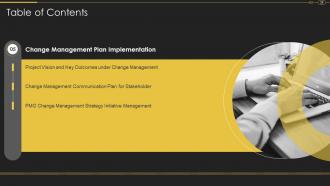
Slide 30: This slide displays Project Vision and Key Outcomes under Change Management.
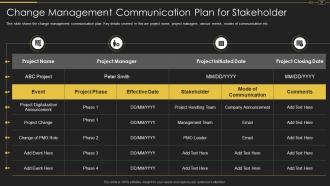
Slide 31: This slide represents Change Management Communication Plan for Stakeholder.
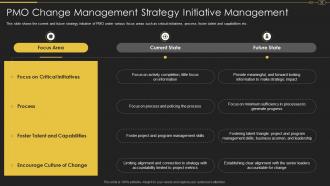
Slide 32: This slide shows the current and future strategy initiative of PMO under various focus areas such as critical initiatives, process, etc.
Slide 33: This slide highlights title for topics that are to be covered next in the template.
Slide 34: This slide shows the graphical presentation of increase in revenue and productivity of the project.
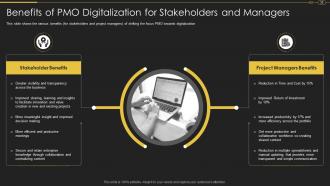
Slide 35: This slide displays the various benefits (for stakeholders and project managers) of shifting the focus PMO towards digitalization.
Slide 36: This slide displays Icons for PMO Roles in Implementation of Digitalization Strategy.
Slide 37: This slide is titled as Additional Slides for moving forward.
Slide 38: This is Our Mission slide with related imagery and text.
Slide 39: This is About Us slide to show company specifications etc.
Slide 40: This is Our Team slide with names and designation.
Slide 41: This is Our Goal slide. State your firm's goals here.
Slide 42: This slide shows Post It Notes. Post your important notes here.
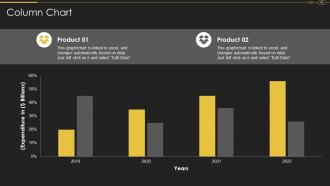
Slide 43: This slide displays Column chart with two products comparison.
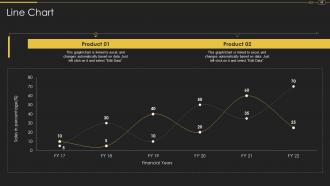
Slide 44: This slide describes Line chart with two products comparison.
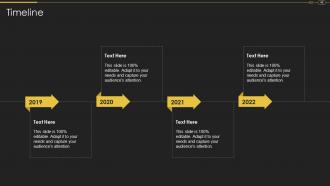
Slide 45: This is a Timeline slide. Show data related to time intervals here.
Slide 46: This is a Thank You slide with address, contact numbers and email address.
PMO Roles In Implementation Of Digitalization Strategy Powerpoint Presentation Slides with all 51 slides:
Use our PMO Roles In Implementation Of Digitalization Strategy Powerpoint Presentation Slides to effectively help you save your valuable time. They are readymade to fit into any presentation structure.






















FAQs for PMO Roles In Implementation Of Digitalization Strategy
PMOs drive digitalization strategy through governance oversight, resource allocation, stakeholder alignment, progress monitoring, and risk management across transformation initiatives. These roles enable organizations to streamline technology adoption, enhance operational efficiency, and accelerate digital capabilities, with many enterprises finding that strategic PMO involvement ultimately delivers competitive advantage and sustainable growth.
A PMO measures digital initiative success through key performance indicators like ROI, user adoption rates, process efficiency improvements, timeline adherence, and customer satisfaction scores. These metrics enable organizations to track tangible outcomes such as cost reduction, faster service delivery, and enhanced operational efficiency, with many PMOs finding that combining quantitative data with qualitative feedback delivers comprehensive insights for strategic decision-making.
PMOs can leverage project management platforms like Microsoft Project and Asana, data analytics tools including Tableau and Power BI, collaboration software such as Slack and Teams, and automation solutions like Zapier and UiPath. These technologies streamline project tracking, enhance stakeholder communication, and accelerate decision-making processes, with many organizations finding that strategic tool integration delivers faster transformation timelines and improved operational efficiency.
The PMO ensures alignment by establishing strategic governance frameworks, implementing standardized evaluation criteria, and conducting regular portfolio reviews against organizational objectives. Through digital dashboards and stakeholder engagement protocols, PMOs enable consistent project prioritization, resource optimization, and performance tracking, with many organizations finding that this structured approach accelerates digital transformation while maintaining strategic focus.
PMOs face challenges including resistance to change, skills gaps, budget constraints, technology integration complexities, and stakeholder alignment issues during digitalization implementation. These obstacles can be addressed through comprehensive change management, strategic training programs, and phased rollouts, with many organizations finding that early stakeholder engagement and clear communication ultimately streamline adoption and deliver sustainable competitive advantages.
A PMO supports stakeholder engagement in digital projects by establishing clear communication frameworks, creating stakeholder mapping matrices, facilitating regular update meetings, and implementing feedback collection mechanisms throughout project lifecycles. These structured approaches enable organizations to maintain transparency and alignment, with many financial services and healthcare institutions finding that systematic stakeholder management reduces project risks while accelerating digital adoption and user acceptance rates.
PMOs balance resource allocation by implementing portfolio management frameworks that evaluate projects based on strategic value, risk assessment, and digital transformation goals, while maintaining operational continuity through phased resource transitions. Many organizations find that dedicating 60-70% resources to digital initiatives while preserving critical traditional operations enables competitive advantage, with financial services and manufacturing sectors successfully using hybrid allocation models that ultimately deliver faster innovation cycles and improved operational efficiency.
PMO teams managing digital transformation need technical proficiency in digital tools, change management expertise, data analysis capabilities, stakeholder communication skills, and agile project management experience. These competencies enable teams to navigate complex technology implementations, facilitate organizational adoption, and measure transformation outcomes, with many organizations finding that cross-functional PMO expertise ultimately delivers faster digital adoption and sustainable competitive advantage.
A PMO fosters innovation culture by establishing innovation-focused governance frameworks, creating cross-functional collaboration platforms, implementing agile project methodologies, and developing metrics that reward creative problem-solving and experimentation. Through structured innovation pipelines and dedicated innovation labs, PMOs enable organizations to systematically capture, evaluate, and scale innovative ideas while maintaining operational excellence, ultimately delivering faster time-to-market and sustained competitive advantage.
PMOs can adopt Agile, Scrum, Kanban, Design Thinking, and Lean methodologies to manage digitalization projects effectively. These frameworks streamline project delivery by enabling iterative development, enhanced collaboration, and rapid adaptation to changing requirements, with many organizations finding that combining multiple methodologies accelerates digital transformation while reducing implementation risks and costs.
A PMO facilitates change management during digitalization by establishing structured communication frameworks, training protocols, and stakeholder engagement strategies that minimize resistance and accelerate adoption. Through dedicated change management offices, PMOs coordinate cross-functional teams, monitor adoption metrics, and provide continuous support, with organizations like banks and healthcare systems finding that centralized change oversight reduces implementation timelines by 30-40% while ensuring smoother digital transitions.
Data analytics enables PMOs to monitor digital initiative performance through real-time dashboards, predictive modeling, risk assessment tools, and ROI tracking systems. These capabilities streamline project oversight by identifying bottlenecks early, optimizing resource allocation, and measuring transformation outcomes, with many organizations finding that data-driven PMO governance accelerates digital delivery timelines while reducing implementation costs.
A PMO can adapt by implementing flexible project methodologies, leveraging digital collaboration tools, establishing continuous feedback loops, and creating cross-functional teams that respond quickly to market changes. Through agile frameworks and real-time analytics, organizations streamline decision-making, enhance resource allocation, and accelerate project delivery, with many companies finding that adaptive PMOs deliver faster innovation cycles and stronger competitive positioning.
PMO cybersecurity best practices include implementing security-by-design frameworks, conducting regular risk assessments, establishing clear data governance protocols, integrating security reviews at project milestones, and maintaining continuous threat monitoring. These approaches enable organizations to proactively address vulnerabilities while streamlining project delivery, with many financial services and healthcare institutions finding that embedded security processes ultimately reduce costs and accelerate digital transformation timelines.
PMOs should prioritize digital projects by evaluating strategic alignment, ROI potential, resource requirements, risk factors, and implementation timelines through structured scoring frameworks. This approach enables organizations to focus on high-impact initiatives like customer-facing automation or operational efficiency improvements, while balancing quick wins with long-term transformation goals, ultimately delivering maximum value within resource constraints.
-
Use of different colors is good. It's simple and attractive.
-
Use of different colors is good. It's simple and attractive.