

Price optimization dashboard target revenue management tool




Try Before you Buy Download Free Sample Product
 Impress Your
Audience
 100%
Editable
 Save Hours
of Time


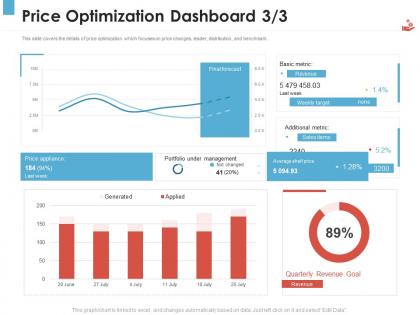
This slide covers the details of price optimization which focuses on price changes, leader, distribution, and benchmark.
People who downloaded this PowerPoint presentation also viewed the following :
Price optimization dashboard target revenue management tool with all 2 slides:
Use our Price Optimization Dashboard Target Revenue Management Tool to effectively help you save your valuable time. They are readymade to fit into any presentation structure.


FAQs for Price optimization dashboard target
Key factors influencing price optimization include demand elasticity, competitor pricing, production costs, market positioning, and customer segmentation across industries. While retail focuses on inventory turnover and seasonal demand, financial services emphasize risk assessment and regulatory compliance, with manufacturing prioritizing supply chain costs, ultimately delivering competitive advantage and enhanced profitability.
Data analytics enhances price optimization by analyzing customer behavior patterns, competitive pricing trends, demand fluctuations, and market conditions in real-time. Through predictive modeling and machine learning algorithms, retailers and e-commerce platforms can dynamically adjust pricing strategies, maximize profit margins while remaining competitive, and ultimately deliver increased revenue and improved customer satisfaction across diverse market segments.
Customer segmentation enables businesses to tailor pricing strategies based on distinct customer behaviors, purchasing power, demographics, and price sensitivity across different market segments. Through advanced analytics and AI-driven insights, companies like retailers and subscription services can implement dynamic pricing models, personalized discounts, and targeted promotions, ultimately maximizing revenue while enhancing customer satisfaction and competitive positioning.
Businesses can balance competitive pricing and profitability through dynamic pricing algorithms, competitor price monitoring, demand elasticity analysis, and customer segmentation strategies. These optimization approaches enable companies to adjust pricing in real-time while maintaining margins, with retailers and e-commerce platforms finding that strategic pricing delivers increased revenue and market positioning simultaneously.
Common price optimization mistakes include ignoring competitor pricing, relying solely on cost-plus models, overlooking customer value perception, failing to segment markets properly, and neglecting dynamic pricing opportunities. These missteps often result from insufficient data analysis and rigid pricing structures, with many organizations finding that comprehensive market research, customer feedback integration, and flexible pricing strategies ultimately deliver improved margins and competitive positioning.
Psychological pricing strategies significantly influence consumer behavior by leveraging cognitive biases, emotional responses, and perception patterns to drive purchasing decisions. Techniques like charm pricing, anchoring, and bundling create perceived value advantages, with retailers finding that strategic price positioning enhances conversion rates, increases average order values, and ultimately delivers competitive advantage in increasingly price-sensitive markets.
Seasonality significantly impacts price optimization models by creating predictable demand fluctuations, inventory cycles, and customer purchasing patterns that algorithms must account for. Retail businesses, hospitality companies, and airlines leverage seasonal data to adjust pricing strategies dynamically, with many finding that incorporating weather patterns, holidays, and industry-specific cycles ultimately delivers higher profit margins and improved inventory turnover.
Machine learning algorithms improve price optimization accuracy by analyzing vast datasets, identifying complex pricing patterns, and continuously adapting to market changes through predictive modeling. These systems enable retailers, airlines, and e-commerce platforms to process competitor pricing, customer behavior, and demand fluctuations in real-time, ultimately delivering more precise pricing strategies and enhanced profit margins.
Businesses should track revenue growth, profit margins, conversion rates, customer acquisition costs, and competitive market share to evaluate price optimization success. These metrics work together by revealing pricing impact across different customer segments, with retail and SaaS companies finding that monitoring price elasticity and customer lifetime value ultimately delivers sustainable competitive advantage and improved profitability.
Price elasticity of demand significantly influences pricing strategies by determining how sensitive customers are to price changes, enabling businesses to optimize revenue through strategic adjustments. Companies with inelastic demand, like utilities or essential medications, can implement higher pricing, while those with elastic demand focus on competitive pricing and value-driven approaches, ultimately delivering enhanced profitability and market positioning.
Effective price optimization tools include dynamic pricing platforms, competitive intelligence software, customer analytics solutions, machine learning algorithms, and A/B testing frameworks. These technologies streamline pricing strategies by analyzing market data, tracking competitor movements, and predicting customer behavior, with many retailers and e-commerce businesses finding that automated pricing delivers improved margins and competitive positioning.
A/B testing enables price optimization by comparing different pricing strategies across customer segments, measuring conversion rates, revenue impacts, and customer responses simultaneously. Through systematic testing, retailers and service providers can identify optimal price points, assess demand elasticity, and refine pricing models, ultimately delivering increased profitability and competitive positioning while minimizing revenue risks.
Ethical price optimization considerations include transparency in pricing methods, avoiding discriminatory practices, ensuring fair access to essential goods, protecting consumer privacy in data collection, and maintaining reasonable profit margins. While these technologies enable competitive advantage and operational efficiency, businesses must balance revenue optimization with social responsibility, particularly in healthcare, utilities, and financial services, ultimately delivering sustainable growth without exploiting vulnerable populations.
E-commerce retailers leverage dynamic pricing algorithms, A/B testing capabilities, and real-time competitor monitoring, while brick-and-mortar stores focus on location-based pricing, inventory turnover optimization, and in-store promotional strategies. Through digital tools, online retailers can adjust prices instantly based on demand patterns, whereas physical stores benefit from geographic pricing strategies and experiential value propositions, ultimately delivering competitive advantages tailored to each channel's unique customer behaviors.
Best practices for communicating price changes include transparent messaging about value improvements, advance notification timelines, personalized explanations based on customer segments, and clear documentation of enhanced benefits. Through strategic communication frameworks, companies streamline customer retention, minimize churn concerns, and enhance trust, with many retail and SaaS organizations finding that proactive transparency ultimately delivers stronger customer relationships and sustained revenue growth.
-
Content of slide is easy to understand and edit.
-
Visually stunning presentation, love the content.
-
Illustrative design with editable content. Exceptional value for money. Highly pleased with the product.