

Procurement Purchase Orders And Cost Reduction Dashboard




Try Before you Buy Download Free Sample Product
 Impress Your
 Audience
 100%
100% Editable
 Save Hours
 of Time


Our Procurement Purchase Orders And Cost Reduction Dashboard are akin to your best friends. They genuinely care for your growth.
People who downloaded this PowerPoint presentation also viewed the following :
Content of this Powerpoint Presentation
Accenture, Amazon Business, Zycus, Oracle, and many other procurement firms have transformed the procurement market by supporting organizations in the effective purchase and distribution of goods and services.
This has helped every business achieve excellent operational and financial performance.
Explore the Procurement Dashboard Templates to efficiently monitor, appraise, and optimize each acquisition process.
Procurement dashboards are used to help firms gain an overview of their sourcing and make data-driven decisions. The reports contribute to cost savings, quality maintenance, and risk management in the firm.
This blog offers a visualization tool to help you track, evaluate, and enhance purchase order decisions. This PowerPoint Template enables you to summarize acquisition orders to assess the purchasing and spending process. Use it to monitor procurement activities performance, trends, and make decisions.
Want to find providers of high-quality products and services quickly and effectively? Check out the pre-designed templates for Procurement Negotiation Strategies Solutions, Cost and Purchase Order Procurement Dashboard, and Procurement Purchase Order Cycle Dashboard.
Template 1: Procurement Purchase Orders and Cost Reduction Dashboard
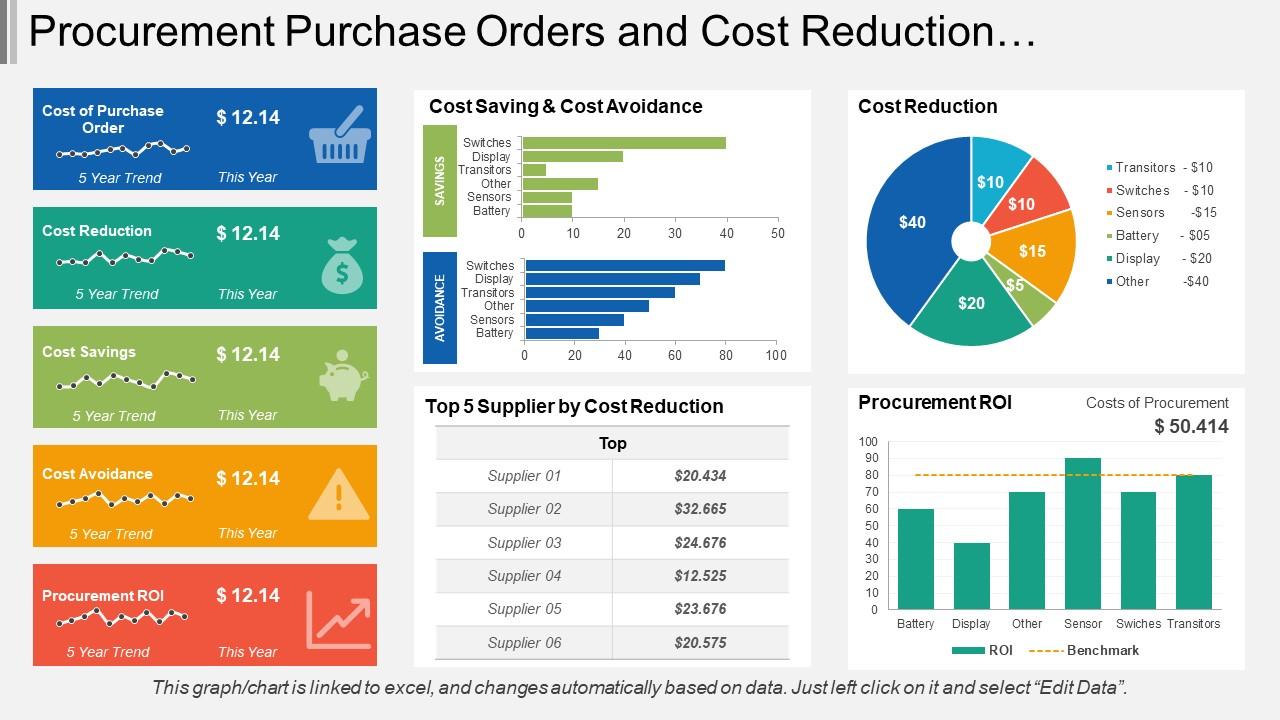
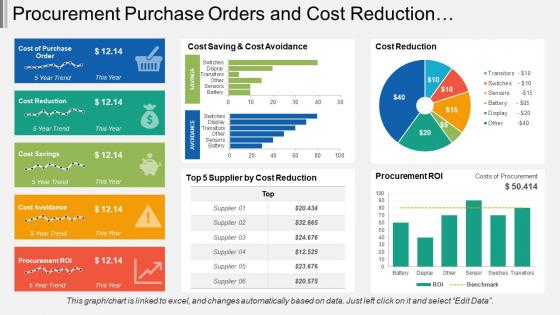
This procurement purchase orders and cost reduction dashboard allows you to display complete procurement-related information on a single page. It divides the data into four primary categories: cost saving and avoidance, cost reduction, the top five suppliers by cost reduction, and procurement ROI to provide a comprehensive spend breakdown by category. This will help in streamlining purchase order operations.
A vital tool of Supply Chain Management.
This procurement dashboard is crucial for better understanding your company’s supply chains. Use SlideTeam’s PPT Template to track, evaluate, and optimize all procurement processes.
PS Check out SlideTeam’s pre-designed templates on Procurement Management to optimize your business processes.
Procurement Purchase Orders And Cost Reduction Dashboard with all 6 slides:
Break out of the cage with our Procurement Purchase Orders And Cost Reduction Dashboard. They enable you to do as you fancy.
FAQs for Procurement Purchase Orders And
Honestly, procurement strategy boils down to five main things. Start with categorizing your spend - it's the clearest way to see what actually matters to your business. Map out your suppliers next (boring but necessary). You'll want to spot any risky suppliers before they bite you. Budget and compliance stuff obviously can't be ignored. Oh, and get your internal people on board early - I've seen strategies fail just because nobody bothered talking to the actual users. The spend analysis really should be your first move though, gives you the best foundation for everything else.
Look, start with whatever's eating up most of your time manually - that's where you'll see the biggest wins. Automated purchase orders and approvals can cut your processing time in half, no joke. E-procurement platforms are pretty solid for centralizing all your vendor stuff and comparing suppliers side by side. Real-time spend tracking helps you catch savings opportunities you'd totally miss otherwise. Oh, and automated invoice matching cuts way down on errors - saved my sanity more than once. Don't try to fix everything at once though, just tackle your worst bottlenecks first.
Yeah, sustainability isn't optional anymore in procurement - it's pretty much table stakes now. Companies are weighing suppliers' environmental practices and labor standards just as heavily as cost and quality. I know it seems like a lot at first (honestly, the carbon footprint calculations alone made my head spin initially), but you pick it up quick. Your buying decisions directly tie into those ESG goals everyone's obsessing over. Best move? Build sustainability questions right into your RFP templates from day one. Trust me, it'll save you tons of headaches down the road and keep you competitive.
Ugh, supply chain stuff is such a headache right now. Basically you can't rely on just one supplier anymore - diversify or you're screwed when things go sideways. Build in way more lead time than you think you need. Yeah, backup options cost more but it's worth it. I'd start mapping out who your critical suppliers are and find alternatives before you actually need them. Also, work on those vendor relationships - they'll bump you up the priority list when everything's crazy. Oh and definitely stress-test your whole setup now while you can still think straight.
Okay so first things first - set your evaluation criteria before you start looking. Cost, quality, reliability, that whole deal. I made the mistake of going cheap once and it was a nightmare lol. Check their references like your life depends on it. Maybe try a small pilot project if you can swing it? After you pick someone, communication is everything. Regular check-ins, quarterly reviews, document literally everything. I know it sounds boring but trust me. Oh and don't treat them like they're disposable - your best vendors should feel more like actual partners.
Honestly, don't get too cozy with just one supplier - even if they're giving you killer deals. I learned this the hard way when our main guy had issues and we were scrambling. Map out your whole supply chain first so you can see where things might break down. Talk to suppliers about their backup plans (most don't even have them, which is kinda scary). Track delivery times and quality religiously. Keep a shortlist of backup suppliers already vetted and ready. The whole point is staying ahead of problems instead of panicking when stuff hits the fan.
Honestly, traditional procurement is just buying stuff when you run out - super reactive. Strategic sourcing flips that completely. You're actually analyzing your whole supply chain, tracking market trends, building real partnerships with suppliers instead of treating them like vending machines. Think 3-5 years ahead rather than scrambling every quarter. Way more collaborative too. Start by mapping your key suppliers and figure out which relationships could shift from transactional to partnership mode. Makes a huge difference once you get the hang of it.
Honestly, data analytics is a game-changer for procurement. Start by tracking your spending patterns - you'll quickly see which suppliers are reliable and which ones are ripping you off. I'd pick one category first and dig into those numbers. The predictive features are actually pretty slick; they'll flag demand spikes before they hit. You can also benchmark against industry standards to see how you stack up. Real-time KPIs help catch inefficiencies early. It's basically like getting insider info on your entire supply chain, showing you exactly where contracts need renegotiation and who's worth keeping around.
Hey! So basically you want to keep everything fair and transparent - give all qualified vendors the same shot at bidding. Be super clear about your evaluation criteria upfront. Never take gifts from suppliers (I know, seems obvious but people mess this up constantly). Also think about the bigger picture stuff like whether they treat workers fairly or care about sustainability. Oh and definitely document everything well so if someone questions your choice later, you can show exactly why you picked vendor A over vendor B. Trust me, you'll thank yourself for that paper trail!
So procurement basically saves you money in a few ways. First, they negotiate better deals and get volume discounts when you buy in bulk instead of having every department do their own thing. Honestly, the biggest win is stopping people from going off-script and buying random stuff without checking existing contracts first - you'd be surprised how much that adds up! They also build solid relationships with good suppliers, which means less drama with delays and quality problems. The trick is actually getting your teams to stick with the approved vendors instead of wandering off to buy whatever.
Honestly, procurement works way better when you get other departments involved from the start. Finance can give you budget heads-ups, IT knows the technical stuff you don't, and operations has the real usage numbers. Monthly check-ins with these teams - sounds boring but it actually prevents so many headaches later. You'll negotiate smarter contracts and avoid ordering totally wrong things (been there). The best part? People stop complaining about your decisions because they helped make them. It's like... when everyone's invested, they can't really throw you under the bus afterward.
Honestly, you'll need solid analytical skills to dig into supplier performance and contracts. Negotiation is huge too - gotta be able to get good deals without burning bridges. The communication piece is probably what takes up most of your day though, since you're always talking to vendors, internal teams, different departments. Tech skills matter way more now than they used to (kind of annoying but whatever) - procurement platforms, data analysis tools, all that stuff. Oh and strategic thinking helps you connect purchases to bigger business goals instead of just hunting for the cheapest option. I'd focus on whatever feels like your weakest area first.
Honestly, you need both the numbers and the fuzzy stuff to really know what's going on. Track your cost savings, supplier ratings, and how long it takes from "hey I need this" to actually getting it. Contract compliance rates matter too. But here's the thing - if your end users are constantly complaining, that's a red flag even if your spreadsheets look pretty. Don't go overboard though. Pick maybe 4-5 things that actually move the needle for your company and stick with those. Oh, and throw in some sustainability metrics if your boss cares about that green stuff.
Honestly, everything's going digital right now - AI picking suppliers, automated purchase orders, the works. Supply chain resilience is massive too after all the chaos we've seen lately. Companies are also way more concerned about sustainability and ethics than before, which is actually pretty refreshing. Data analytics isn't optional anymore if you want to make smart sourcing decisions. My advice? Figure out what you can automate first and get familiar with procurement analytics tools. The businesses that adapt quickly are crushing it while others are still playing catch-up.
Look, procurement hits your profit in two major ways - cost control and risk management. Better contracts and smarter supplier choices mean money saved goes straight to your bottom line. Good procurement also saves you from those panic buys when everything goes sideways - you know, when you're suddenly paying double for rush orders. Strategic sourcing alone can bump profitability 3-5% (honestly, most people don't realize how huge that is). The trick is measuring their impact on actual margins, not just how much they cut purchase prices. Treat it like a profit driver, not just expense management.
-
great
-
Great
-
THANK YOU