

Procurement Risk Analysis For Supply Chain Management Powerpoint Presentation Slides





Try Before you Buy Download Free Sample Product
 Impress Your
Audience
 100%
Editable
 Save Hours
of Time


When acquiring or sourcing goods, services, or resources turns out to be unreliable, procurement risks arise. Get our procurement Risk Analysis for the Supply Chain Management template. It aids the business in identifying the risks connected to purchasing goods or services, which are then evaluated, reduced, and tracked. By examining the present business environment and identifying crucial milestones in the procurement process, our Supplier Assessment deck assesses the current circumstances. It also identifies the main risks connected to the procurement process and analyses their effects. Supply chain disruption, inadequate need analysis, poor supplier selection, procurement without negotiations, etc. are a few of these hazards. Then, our Risk Management PPT presents crucial steps to reduce risks in the procurement process, such as optimizing supply chain disruptions and enhancing supplier selection. A schedule for implementing an e-procurement solution is also included in our E-Procurement module. Further, it emphasizes the importance of automating processes, putting training plans into place, and minimizing procurement risks. Finally, it describes various dashboards for tracking and managing risks in supply chain distribution and procurement channels. Get access to our supply chain management ppt right away.
People who downloaded this PowerPoint presentation also viewed the following :
Content of this Powerpoint Presentation
Slide 1: This slide introduces Procurement Risk Analysis for Supply Chain Management. Commence by stating Your Company Name.
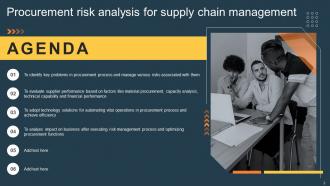
Slide 2: This slide depicts the Agenda of the presentation.
Slide 3: This slide includes the Table of contents.
Slide 4: This slide highlights the Title for the Topics to be covered further.
Slide 5: This slide provides an overview of exiting scenario of business to analyze organizational performance.
Slide 6: This slide presents various steps of procurement process in supply chain management to acquire material for smooth running of operations.
Slide 7: This slide showcases various metrics to measure and analyze performance of procurement process.
Slide 8: This slide portrays the Heading for the Contents to be discussed next.
Slide 9: This slide states the various steps of procurement process in supply chain management to acquire material for smooth running of operations.
Slide 10: This slide highlights the various steps of procurement process in supply chain management to acquire material for smooth running of operations.
Slide 11: This slide indicates risk analysis of procurement risks to evaluate level of impact on business.
Slide 12: This slide mentions about the Title for the Ideas to be covered further.
Slide 13: The following slide identifies multiple supply chain disruptions at different locations of business.
Slide 14: The following slide presents various tactics to manage and proactive preparation of supply chain disruptions.
Slide 15: This slide mentions about the Heading for the Ideas to be discussed next.
Slide 16: This slide exhibits risk assessment of suppliers based on multiple procurement risks to identify supplier change requirements.
Slide 17: The following slide showcases performance analysis of material suppliers in industry to procure material at low cost.
Slide 18: The slide exhibits capacity analysis of vendor to improve procurement process and minimize costs.
Slide 19: This slide reveals technology ability analysis of supplier to improve procurement process ands reduce cost.
Slide 20: This slide presents performance assessment of financial position of supplier to select and qualify vendor based on financial strength.
Slide 21: This slide includes the Title for the Contents to be covered further.
Slide 22: The slide illustrates identification of multiple cost drivers of procurement process to reduce cost.
Slide 23: The slide presents various levers to minimize procurement costs with measures of each step.
Slide 24: This slide includes the Heading for the Topics to be discussed next.
Slide 25: The slide evaluates performance gap of employees in procurement department to prepare skill development training plan.
Slide 26: This slide presents an overview of employee training program plan to guide them about activities and techniques in procurement process.
Slide 27: This slide contains the Title for the Topics to be covered in the upcoming template.
Slide 28: This slide presents statistical data providing information of industry trends in procurement and sourcing sector.
Slide 29: The slide provides information about various technology tools/software business can adopt to enhance procurement process and mitigate supplier risks.
Slide 30: The slide highlights assessment of multiple software to automate procurement process.
Slide 31: The slide showcases various advantages of implementing procurement management software solutions for supply chain management.
Slide 32: The following slide presents functioning of procurement software solution to automate vital tasks for material acquisition.
Slide 33: This slide indicates the Heading for the Contents to be discussed further.
Slide 34: The following slide presents a one month timeline for implementing procurement software solution to automate vital tasks for material acquisition.
Slide 35: This slide highlights the Title for the Ideas to be covered further.
Slide 36: This slide showcases various steps of procurement process in supply chain management to acquire material for smooth running of operations.
Slide 37: The slide portrays effect of providing training to employees for improving procurement process and reduce cost.
Slide 38: This slide illustrates effect on business after automating vital activities of procurement process.
Slide 39: This slide showcases various metrics to measure and analyze performance of procurement process.
Slide 40: This slide contains the Heading for the Ideas to be discussed next.
Slide 41: This slide presents a dashboard for tracking and monitoring risk status in procurement process.
Slide 42: The following slide showcases a dashboard to track and manage cost and savings in procurement order.
Slide 43: This slide reveals a dashboard to supervise and manage procurement order cycle time an supplier performance.
Slide 44: The following slide displays a dashboard to monitor and evaluate spending in procurement process.
Slide 45: This is the Icons slide containing all the Icons used in the plan.
Slide 46: This slide is used for revealing some Additional information.
Slide 47: This slide states the organization's targets.
Slide 48: This is the Puzzle slide with related imagery.
Slide 49: This is the Idea generation slide for encouraging fresh ideas.
Slide 50: This is the Venn diagram slide.
Slide 51: This slide portrays the Timeline of the company.
Slide 52: This slide elucidates the firm's Roadmap.
Slide 53: This is the Pie chart slide.
Slide 54: This slide represents the SWOT analysis.
Slide 55: This is the 30,60,90 days plan slide for effective planning.
Slide 56: This slide contains the Post it notes for reminders and deadlines.
Slide 57: This is the Thank You slide for acknowledgement.
Procurement Risk Analysis For Supply Chain Management Powerpoint Presentation Slides with all 62 slides:
Use our Procurement Risk Analysis For Supply Chain Management Powerpoint Presentation Slides to effectively help you save your valuable time. They are readymade to fit into any presentation structure.








FAQs for Procurement Risk Analysis For Supply Chain Management
Key components include risk identification matrices, supplier financial assessments, market volatility analysis, compliance monitoring systems, and contingency planning protocols. These frameworks enhance procurement decisions by systematically evaluating vendor stability, regulatory compliance, and supply chain vulnerabilities, with many organizations finding that structured risk analysis ultimately delivers cost savings and operational resilience.
Organizations identify and prioritize procurement risks through comprehensive supplier assessments, financial stability analysis, geographic vulnerability mapping, contract compliance monitoring, and performance data evaluation. These strategic approaches enable businesses to streamline resource allocation, enhance operational resilience, and minimize supply disruptions, with many manufacturing and retail companies finding that proactive risk prioritization ultimately delivers competitive advantage and cost efficiency.
Supplier risk assessment forms the foundation of procurement risk analysis by evaluating vendor financial stability, operational capacity, compliance records, geographic vulnerabilities, and cybersecurity measures. Through systematic assessment frameworks, organizations identify potential supply chain disruptions, negotiate better contract terms, and develop contingency plans, with many companies finding that proactive supplier evaluation reduces procurement costs by 15-20% while enhancing supply chain resilience.
AI and machine learning enhance procurement risk analysis by automating supplier assessment, predicting market disruptions, and identifying hidden risk patterns across supply chains. These technologies enable organizations to process vast datasets in real-time, streamline vendor evaluations, and anticipate potential bottlenecks, with many financial services and manufacturing companies finding significantly improved decision-making and reduced procurement costs.
Common procurement risk assessment methodologies include supplier financial analysis, contract risk evaluation, market volatility assessment, operational risk mapping, and compliance auditing frameworks. These approaches streamline vendor selection, enhance supply chain transparency, and minimize procurement disruptions by identifying potential failures early, with many organizations finding that systematic risk evaluation ultimately delivers cost savings and stronger supplier relationships.
Geopolitical instability significantly elevates procurement risks by disrupting supply chains, increasing price volatility, creating regulatory uncertainties, and threatening supplier relationships across affected regions. Organizations mitigate these risks through supplier diversification across multiple countries, developing local sourcing capabilities, implementing scenario planning models, and establishing strategic inventory buffers, ultimately delivering greater supply chain resilience and operational continuity.
Organizations should track supplier financial stability ratings, contract compliance percentages, delivery performance metrics, cost variance analysis, quality defect rates, and supplier diversity indices. These comprehensive metrics enable procurement teams to identify potential disruptions early, optimize vendor relationships, and enhance supply chain resilience, with many companies finding that consistent monitoring ultimately delivers reduced operational costs and improved strategic sourcing decisions.
Collaborative supplier relationships reduce procurement risk by fostering transparent communication, enabling joint problem-solving, and creating shared accountability for performance outcomes. These partnerships allow organizations to gain deeper supply chain visibility, develop contingency plans together, and access suppliers' expertise for innovation, ultimately delivering more resilient operations and competitive advantage in volatile markets.
Regulatory compliance significantly influences procurement risk analysis by requiring thorough supplier audits, contract compliance verification, data protection assessments, and industry-specific regulatory adherence checks. Organizations must evaluate suppliers' ability to meet standards like GDPR, SOX, or healthcare regulations, with procurement teams increasingly integrating compliance scorecards into vendor selection processes, ultimately reducing legal exposure and operational disruptions.
Best practices for incorporating stakeholders include establishing cross-functional risk assessment teams, conducting regular stakeholder consultation sessions, implementing collaborative risk identification workshops, and creating transparent communication channels throughout the procurement lifecycle. These approaches enhance risk visibility by leveraging diverse expertise, improving risk mitigation strategies, and fostering stakeholder buy-in, with many organizations finding that inclusive processes ultimately deliver more comprehensive risk assessments and stronger vendor relationships.
Organizations develop adaptable risk response plans by establishing flexible procurement strategies, implementing real-time market monitoring systems, creating diversified supplier networks, and building scenario-based contingency protocols. These frameworks enable businesses to pivot quickly during market volatility, adjust sourcing strategies based on emerging threats, and maintain operational continuity, with many companies finding that dynamic response mechanisms ultimately deliver competitive advantage and enhanced supply chain resilience.
Procurement risk management tools include supplier risk assessment platforms, contract analytics software, spend analysis solutions, compliance monitoring systems, and predictive analytics tools. These technologies streamline risk identification by automating vendor evaluations, tracking performance metrics, and analyzing spending patterns, with many organizations finding that integrated platforms deliver enhanced visibility, faster decision-making, and ultimately stronger supplier relationships.
Direct procurement risks focus on supply chain disruptions, quality control, supplier reliability, and production delays since these materials directly impact manufacturing and product delivery. Indirect procurement faces different challenges including service quality variations, compliance issues, contract management complexities, and cost control difficulties, with many organizations finding that indirect spend requires more diverse risk assessment strategies due to its broader scope across multiple business functions.
Past procurement failures reveal critical lessons including inadequate supplier vetting, overreliance on single sources, insufficient contract terms, poor stakeholder communication, and lack of contingency planning. These insights enable organizations to strengthen their risk frameworks by implementing comprehensive due diligence processes, diversifying supplier bases, and establishing robust monitoring systems, ultimately delivering more resilient procurement strategies and competitive advantage.
Organizations align procurement risk analysis with business strategies by integrating risk assessments into strategic planning processes, establishing cross-functional governance committees, and mapping procurement risks to business objectives and performance metrics. This strategic alignment enables companies to prioritize supplier relationships that support growth initiatives, optimize resource allocation across critical business areas, and ultimately deliver competitive advantage through resilient supply chains.
-
The quality of the templates is as fine as it could get. It was a purchase well made!
-
What an exhaustive collection of templates you guys have there in slideteam. Impressive!!!