

Project Feasibility Assessment To Improve Financial Performance Powerpoint Presentation Slides





Try Before you Buy Download Free Sample Product
 Impress Your
Audience
 100%
Editable
 Save Hours
of Time


Project viability helps a project manager determine a particular projects worthiness. Grab our insightfully designed template for Project Feasibility Assessment to improve Financial Performance. It helps to assess the current performance of the task and analyze the factors evaluating its analysis. Our Economic Viability deck deals with the various feasibility studies and identifies the risks involved. It also incorporates the ways to mitigate the risks and details the components involved in the assessment. Our Project Assessment PPT exhibits information on the project overview, its current performance, types of feasibility studies for conduction, etc. It further covers details on the methodology for project assessment and its analysis. The presentation discusses project budget variance, identified risks during project execution, their evaluation, and ways of mitigation. Furthermore, Our Evaluating Project Profitability deck elucidates the benefits of conducting a feasibility study. Lastly, it provides a project management dashboard with priority projects and a category with a budget and upcoming deadlines. Get access now to our fully editable and customizable Feasibility analysis ppt .
People who downloaded this PowerPoint presentation also viewed the following :
Content of this Powerpoint Presentation
Slide 1: This slide displays the title Project Feasibility Assessment to Improve Financial Performance.
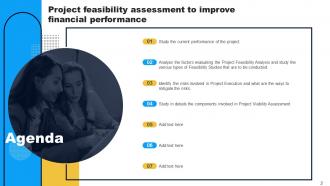
Slide 2: This slide displays the title Agenda.
Slide 3: This slide exhibit table of content.
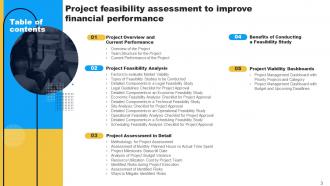
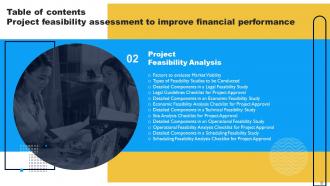
Slide 4: This slide showcase table of content that is to be discuss further.
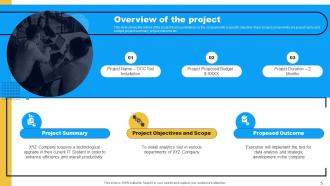
Slide 5: This slide shows the outline of the project that is undertaken by the company with a specific objective.
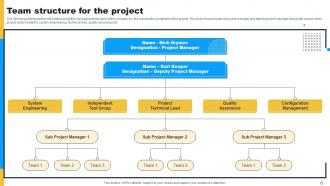
Slide 6: The following slide provides information about the management structure of the company for the successful completion of the project.
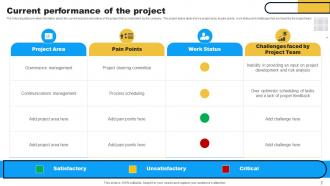
Slide 7: The following slide provides information about the current scenario and status of the project that is undertaken by the company.
Slide 8: This slide showcase table of content that is to be discuss further.
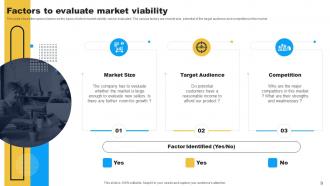
Slide 9: This slide shows the various factors on the basis of which market viability can be evaluated.
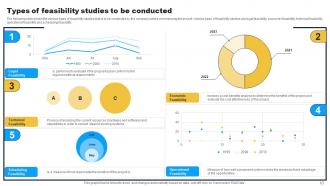
Slide 10: The following slide shows the various types of feasibility studies that is to be conducted by the company before commencing the project.
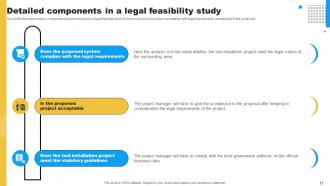
Slide 11: This slide shows the various components that are included in a legal feasibility study for the project.
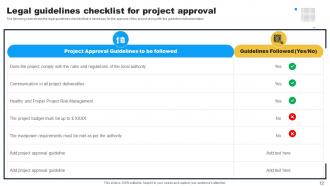
Slide 12: The following slide shows the legal guidelines checklist that is necessary for the approval of the project.
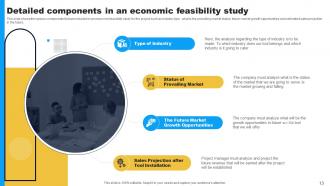
Slide 13: This slide shows the various components that are included in an economic feasibility study for the project.
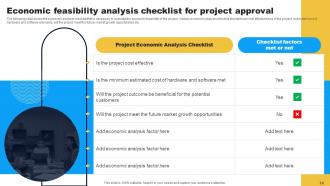
Slide 14: The following slide shows the economic analysis checklist that is necessary to evaluate the economic feasibility of the project.
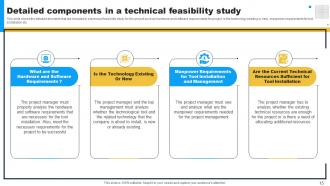
Slide 15: This slide shows the detailed elements that are included in a technical feasibility study for the project.
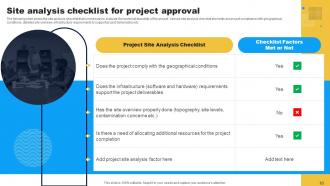
Slide 16: The following slide shows the site analysis checklist that is necessary to evaluate the technical feasibility of the project.
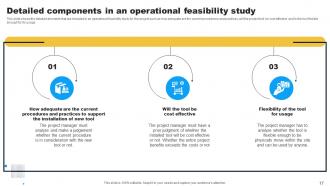
Slide 17: This slide shows the detailed elements that are included in an operational feasibility study for the project.
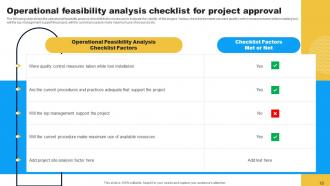
Slide 18: The following slide shows the operational feasibility analysis checklist that is necessary to evaluate the viability of the project.
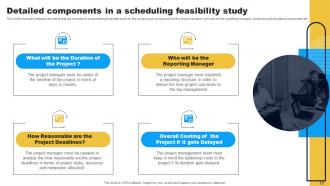
Slide 19: This slide shows the detailed elements that are included in a scheduling feasibility study for the project.
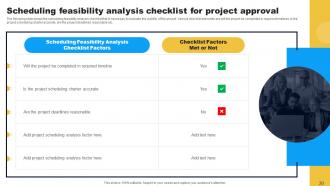
Slide 20: The following slide shows the scheduling feasibility analysis checklist that is necessary to evaluate the viability of the project.
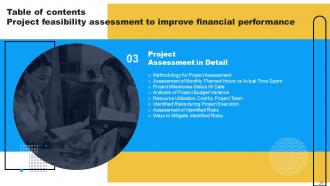
Slide 21: This slide showcase table of content that is to be discuss further.
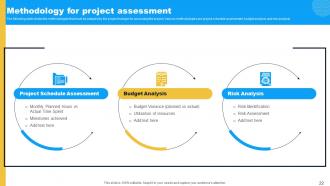
Slide 22: The following slide shows the methodologies that must be adopted by the project manger for assessing the project.
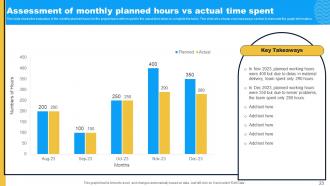
Slide 23: This slide shows the evaluation of the monthly planned hours for the project tasks with respect to the actual time taken to complete the tasks.
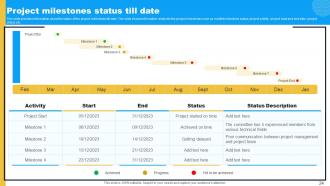
Slide 24: This slide provides information about the status of the project milestones till date.
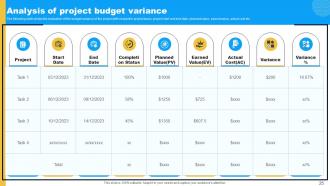
Slide 25: The following slide shows the evaluation of the budget variance of the project with respect to project tasks, project start and end date, planned value.
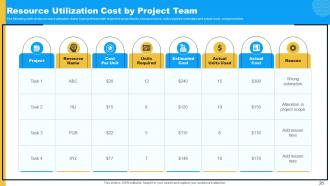
Slide 26: The following slide shows resource utilization status by project team with respect to project tasks, resource name, units required, estimated and actual costs.
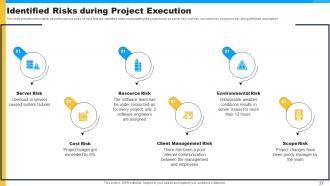
Slide 27: This slide provides information about the various types of risks that are identified while implementing the project.
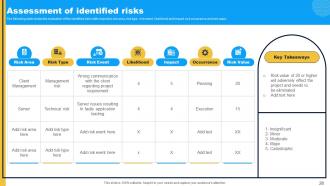
Slide 28: The following slide shows the evaluation of the identified risks with respect to risk area, risk type, risk event, likelihood and impact, risk occurrence.
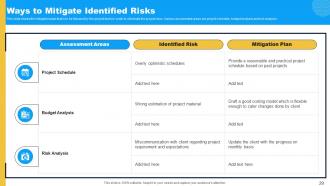
Slide 29: This slide shows the mitigation plan that is to be followed by the project team in order to eliminate the project risks.
Slide 30: This slide showcase table of content that is to be discuss further.
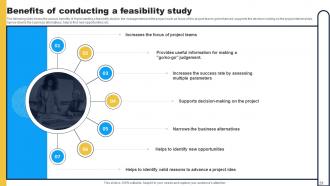
Slide 31: The following slide shows the various benefits of implementing a feasibility study to the management and the project.
Slide 32: This slide showcase table of content that is to be discuss further.
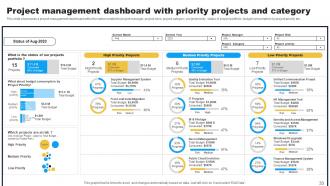
Slide 33: This slide showcases a project management dashboard with information related to project manager, project risks, project category, project priority.
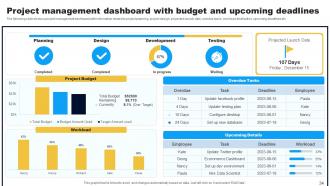
Slide 34: The following slide shows a project management dashboard with information related to project planning, project design, projected launch date, overdue tasks.
Slide 35: This is the icons slide.
Slide 36: This slide presents title for additional slides.
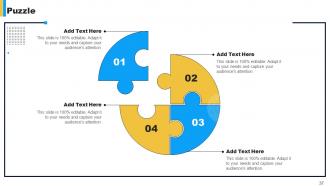
Slide 37: This slide shows puzzle for displaying elements of company.
Slide 38: This slide depicts posts for past experiences of clients.
Slide 39: This slide showcase Target.
Slide 40: This slide showcase Circular diagram.
Slide 41: This slide showcase SWOT.
Slide 42: This slide exhibits ideas generated.
Slide 43: This slide showcase SWOT.
Slide 44: This is thank you slide & contains contact details of company like office address, phone no., etc.
Project Feasibility Assessment To Improve Financial Performance Powerpoint Presentation Slides with all 49 slides:
Use our Project Feasibility Assessment To Improve Financial Performance Powerpoint Presentation Slides to effectively help you save your valuable time. They are readymade to fit into any presentation structure.






FAQs for Project Feasibility Assessment To Improve Financial Performance
So you'll want to hit five key areas: technical (can you actually build it?), economic (will it make financial sense), legal (any regulations that'll screw you over), operational (got the right team/processes), and schedule (realistic timeline). Technical and economic are usually your biggest killers, so I'd start there. Legal can bite you in the ass though - learned that one the hard way on a project last year. Honestly, just rank them by how risky they are for your specific thing and tackle the scariest ones first. Way better than finding out something's impossible after you've already invested months into it.
Get your stakeholders in from day one - seriously, don't wait. Figure out who's deciding what vs. who just needs updates. Skip the marathon meetings where half the room's on their phones. Instead, do quick regular check-ins and give people actual ways to contribute, like targeted surveys or workshops that tap into what they actually know. The whole thing should feel collaborative, not like you're going through some corporate checklist. Oh, and definitely show them how their feedback gets used - nothing kills participation faster than people thinking their input disappears into a black hole. Makes all the difference.
So basically you're just doing a reality check on whether your project actually makes financial sense. Weigh all your expected costs against what you think you'll get back. Will you see a decent ROI? Is it even worth doing from a business angle? Honestly, this is where a lot of "brilliant" ideas go to die - and that's probably a good thing. Better to find out early that the math sucks than after you've already spent a ton. Don't forget the sneaky stuff like opportunity costs and indirect expenses. Those'll bite you if you're not careful.
Oh man, don't skip market research - I've watched so many people learn this the hard way. You really need to figure out if anyone actually wants what you're building before you dive in. Talk to potential customers, see what problems they're dealing with, and check out your competition. It sounds boring but trust me, it's way better than spending months on something nobody cares about. Even just a few informal interviews beat guessing. The whole point is validating demand and understanding your market before you're too deep to pivot easily.
Honestly, just start with a prototype first - build something small to test if your core idea even works. I've watched so many projects crash because people skipped that step. Map out your actual tech requirements vs what's available right now. Risk matrices sound boring but they'll catch the stuff that'll bite you later. Also check if you've got the right people and tools on hand. Oh, and make sure whatever tech you're picking isn't some bleeding-edge thing that'll break constantly. The prototype thing though? That's your best bet for seeing what you're really up against.
Dude, regulations can totally kill your project before it even starts. Permit times alone will mess with your schedule - some take months, others drag on forever. Then there's compliance costs, design changes, monitoring fees... it adds up fast. My old boss learned this the hard way when he jumped into a project without checking zoning laws first. What a nightmare that was. Get your legal team involved early, like day one. Map out every regulation that might apply before you're too deep to back out. Trust me, surprises halfway through are way worse than dealing with red tape upfront.
Don't just slap risk assessment at the end - work it into every part of your feasibility study. Figure out what could go wrong at each stage: tech problems, money issues, market shifts, operational headaches. Then put numbers on how likely and damaging each risk would be. Build those into your financial forecasts and timelines. Most people mess this up by being way too optimistic (learned that the hard way). Make backup plans for the worst-case scenarios. Add extra time and budget cushions too. Trust me, stakeholders would rather see realistic projections than pretty ones that crash and burn.
Ugh, the timeline thing gets everyone - I swear we're all terrible at estimating how long stuff actually takes. Don't rush through those stakeholder interviews either, even when you're feeling pressured. Market assumptions are huge too - validate them with real data instead of just going with your gut (learned that one the hard way). Also? Stop sugarcoating the ROI numbers for leadership. Build buffer time into literally everything. Oh, and get a few people to sanity-check your risks before you submit anything. Trust me on this.
Honestly, team dynamics can totally torpedo your feasibility study. Good communication plus diverse skills? You'll nail realistic timelines and spot actual risks. But conflict or groupthink kills objective analysis fast. People either clam up about real problems or just nod along with whoever's loudest - both suck for getting honest assessment. I watched one team blow right past massive technical issues because everyone was scared to sound "negative." Which is ridiculous, right? You need people feeling safe enough to actually voice concerns and disagree when they see problems brewing.
Excel's still your best bet for financial stuff, but @RISK is solid for risk analysis if you need something fancier. Monday.com keeps all your tasks organized without being a pain. I'm weirdly obsessed with Miro right now - perfect for mapping out stakeholder needs visually. SurveyMonkey makes collecting market data so much easier than doing it manually. Start with whatever you've got already. You can always add the specialized tools later when things get more complicated. Oh, and Crystal Ball's good for Monte Carlo sims if you're into that level of detail.
Look, scope basically controls everything about your feasibility check. Bigger scope = more stuff to worry about - costs, timeline, risks, all of it. When scope's too vague or huge, you can't nail down accurate estimates. I've watched projects totally bomb because scope kept shifting while they were still figuring out if it was even doable! Clear boundaries help you actually evaluate what tech you need, what resources are available, and where things might go sideways. Honestly, lock down your scope first, then do the feasibility analysis. Trust me on this one.
Honestly, I'd focus on three main things: NPV, IRR, and payback period. NPV shows if you're actually making money. IRR gives you the return rate. Payback period tells you how fast you'll get your cash back - which matters more than people think. Cash flow projections are huge too since timing can make or break you. Oh, and definitely run some sensitivity analysis to stress-test your assumptions. Start with those core numbers first. If they look decent, then you can dive deeper into the weeds.
Do an Environmental Impact Assessment right when you start your feasibility study - seriously, don't wait on this. Map your project footprint first and check local regs. I've seen people get burned discovering protected wetlands way too late in the game. Look at air quality, water, wildlife habitats, waste stuff. The usual suspects. Factor in mitigation costs too because environmental approvals always take longer than you think. If it's looking complicated, just hire an environmental consultant upfront. They're worth it and they'll help you nail down the real costs before you're in too deep.
Look, timelines are basically what make or break your whole feasibility study. Map out your big milestones and figure out where things might get stuck - I've seen way too many projects die because someone promised impossible deadlines. It helps you spot when resources clash too. Honestly, if the math doesn't add up, you've got solid proof to either cut scope or tell people they need to wait longer. Oh and definitely pad your estimates - stuff always takes forever compared to what you think initially. Buffer time isn't optional.
Yeah, you should totally build a lessons learned database from past projects. Seriously, the number of times I've watched teams repeat the exact same timeline mistakes is painful. Start by looking back at your last 3-5 projects - what assumptions were completely wrong? Which risks actually hit you? Where were your estimates way off? Once you start documenting this stuff, you'll spot patterns that help you catch red flags way earlier. It's honestly like having a cheat sheet for future feasibility studies. Use that data to push back harder on overly optimistic projections next time.
-
Design layout is very impressive.
-
It’s really cool, and you can find pretty much everything you could need for your work or school.