

RACI Matrix For Agile Projects Agile Development Methodology




Try Before you Buy Download Free Sample Product
 Impress Your
 Audience
 100%
100% Editable
 Save Hours
 of Time


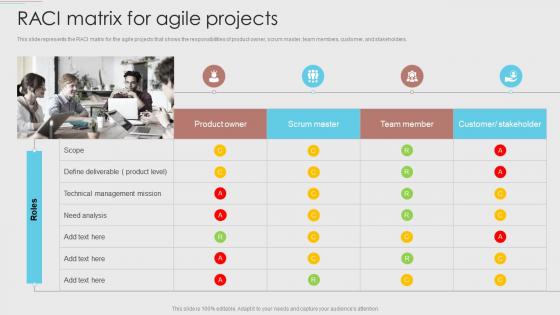
This slide represents the RACI matrix for the agile projects that shows the responsibilities of product owner, scrum master, team members, customer, and stakeholders.
People who downloaded this PowerPoint presentation also viewed the following :
RACI Matrix For Agile Projects Agile Development Methodology with all 6 slides:
Use our RACI Matrix For Agile Projects Agile Development Methodology to effectively help you save your valuable time. They are readymade to fit into any presentation structure.





FAQs for RACI Matrix For Agile Projects
A RACI matrix is a responsibility assignment chart that clarifies project roles using four categories: Responsible (who does the work), Accountable (who approves), Consulted (who provides input), and Informed (who receives updates). This framework streamlines project management by eliminating role confusion, enhancing communication across teams, and ensuring clear accountability, with many organizations finding that it significantly reduces project delays and improves stakeholder alignment.
A RACI matrix improves team collaboration by clearly defining roles, eliminating confusion about responsibilities, and establishing transparent communication channels across project stakeholders. Through structured accountability frameworks, teams streamline decision-making processes, reduce duplicated efforts, and enhance project transparency, with many organizations finding that defined role clarity ultimately delivers faster project completion and improved cross-functional coordination.
The key components of a RACI matrix include Responsible (who performs the work), Accountable (who ensures completion), Consulted (who provides input), and Informed (who receives updates). This strategic framework streamlines project management by clarifying roles, eliminating confusion, and enhancing accountability across teams, with many organizations finding that clear role definitions ultimately deliver faster project completion and improved operational efficiency.
Defining roles accurately in a RACI matrix requires understanding each stakeholder's actual involvement level, conducting thorough interviews with team members, and mapping specific deliverables to appropriate accountability levels. This systematic approach ensures clear ownership boundaries, eliminates role overlap confusion, and streamlines project execution, with many organizations finding that detailed upfront role definition significantly reduces project delays and communication bottlenecks.
Common RACI matrix implementation challenges include unclear role definitions, overlapping responsibilities, resistance to accountability changes, insufficient stakeholder buy-in, and matrix complexity in large organizations. These issues often arise when teams rush deployment without proper consultation, with many project managers finding that gradual implementation and regular refinement sessions ultimately deliver clearer workflows and stronger team alignment.
The RACI matrix adapts well to agile methodologies by defining sprint-level responsibilities, clarifying scrum master and product owner accountabilities, and streamlining decision-making within iterative cycles. Agile teams find that simplified RACI frameworks enhance collaboration during daily standups, sprint planning, and retrospectives, while maintaining clear ownership structures that support rapid delivery and continuous improvement processes.
Engaging stakeholders in RACI matrix development requires collaborative workshops, clear communication of roles and expectations, regular feedback sessions, and transparent documentation processes. Through structured facilitation and stakeholder mapping, organizations streamline accountability frameworks while ensuring buy-in, with many project teams finding that early involvement and ongoing validation sessions ultimately deliver stronger commitment and clearer operational boundaries.
The primary difference between RACI and RASCI matrices lies in the additional "S" designation, which stands for "Support" - identifying team members who provide resources, expertise, or assistance without direct accountability. While RACI focuses on Responsible, Accountable, Consulted, and Informed roles, RASCI enhances clarity by distinguishing between those who support the work and those who perform it, ultimately delivering better resource allocation and streamlined project coordination across complex organizational structures.
RACI matrices should be reviewed at major project milestones, during scope changes, and when team roles shift, typically every 2-4 weeks in active projects. Regular updates ensure accountability remains clear as project dynamics evolve, with many project managers finding that proactive matrix reviews prevent confusion, streamline decision-making, and maintain operational efficiency throughout complex initiatives.
A RACI matrix enhances risk management by clearly defining who is responsible, accountable, consulted, and informed for each risk mitigation activity, preventing confusion and ensuring comprehensive coverage. This structured approach streamlines decision-making processes, accelerates response times during critical incidents, and establishes clear accountability chains, with many organizations finding that defined roles significantly reduce both response delays and oversight gaps.
Technology tools facilitate RACI matrix creation through automated workflow mapping, real-time collaboration platforms, and integrated project management systems. These digital solutions streamline role assignment, enable instant updates across teams, and provide visual dashboards for tracking accountability, with many organizations finding that cloud-based RACI tools enhance transparency and reduce confusion in complex projects.
Successful RACI matrix implementations include software development projects at tech companies, hospital patient care workflows, manufacturing quality control processes, financial services compliance initiatives, and marketing campaign launches. These organizations streamline accountability by clearly defining roles, eliminating task overlap, and reducing decision bottlenecks, with many finding that systematic responsibility mapping accelerates project timelines while enhancing cross-functional collaboration and operational efficiency.
Role conflicts in RACI matrices are addressed by clarifying accountability boundaries, facilitating stakeholder discussions, and refining role definitions through collaborative review sessions. Organizations typically resolve overlapping responsibilities by reassigning conflicting roles, establishing clear escalation pathways, and conducting regular matrix updates, with many project teams finding that structured conflict resolution ultimately enhances operational efficiency and team alignment.
RACI matrices are most effective in complex, multi-stakeholder projects like software implementations, organizational restructuring, product launches, and cross-functional initiatives where role clarity is critical. These frameworks particularly benefit large-scale transformations, regulatory compliance projects, and matrix organizations, with many enterprises finding that clear accountability structures streamline decision-making, reduce conflicts, and ultimately accelerate project delivery timelines.
A RACI matrix clarifies project scope by defining who is Responsible, Accountable, Consulted, and Informed for each deliverable, eliminating ambiguity around ownership and expectations. This structured approach enables project managers to streamline communication, minimize scope creep, and ensure stakeholder alignment, with many organizations finding that clear accountability matrices ultimately deliver faster project completion and reduced miscommunication costs.
-
They guys always go the extra mile to meet the expectations of their customers. Almost a year has been associated with them.
-
It's always a delight to see new templates from you! I am extremely pleased with the fact that they are easy to modify and fit any presentation layout in seconds!