


RACI Matrix For Essential Construction Activities Assigned Construction Playbook




Try Before you Buy Download Free Sample Product
 Impress Your
 Audience
 100%
100% Editable
 Save Hours
 of Time


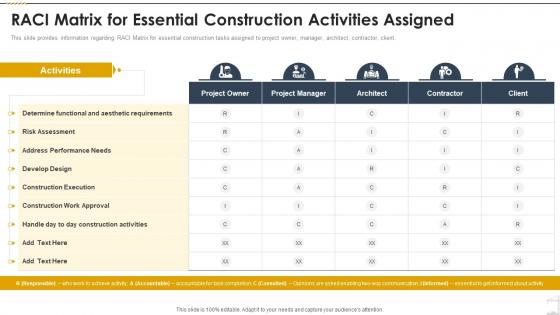
This slide provides information regarding RACI Matrix for essential construction tasks assigned to project owner, manager, architect, contractor, client.
People who downloaded this PowerPoint presentation also viewed the following :
RACI Matrix For Essential Construction Activities Assigned Construction Playbook with all 6 slides:
Use our RACI Matrix For Essential Construction Activities Assigned Construction Playbook to effectively help you save your valuable time. They are readymade to fit into any presentation structure.





FAQs for RACI Matrix For Essential Construction Activities
So basically it's four letters mapped to different roles. R is Responsible - they actually do the work. A is Accountable - that's the person whose butt is on the line if things go sideways. C gets Consulted before decisions happen, and I just needs to be Informed about what's going on. You make a grid with your project tasks down one side and people across the top, then drop in the right letters. Honestly, the hardest part is usually figuring out who's actually accountable versus responsible - those two get mixed up all the time. But once you've got it mapped out, it's pretty clear who does what and when they need to be looped in.
Oh dude, RACI matrices are actually game-changers. So basically you map out who's Responsible, Accountable, Consulted, and Informed for each task. No more of that awkward "wait I thought YOU were handling this" stuff. Your team has to hash out ownership upfront instead of scrambling later when deadlines hit. Stakeholders finally know when to actually weigh in vs. just sit back and get updates. I swear, once you assign those roles to your deliverables everything clicks into place. Way less chaos, way more getting stuff done.
A RACI matrix is a lifesaver when projects get messy with multiple teams stepping on each other. Cross-functional stuff like product launches or system rollouts? That's where it really pays off. I honestly should've used one way earlier - would've saved me so much headache on that marketing disaster we had. The biggest win is clearing up who actually makes decisions vs who just gets copied on emails. Start with whatever process is causing you the most pain right now. You'll be amazed how fast things get clearer once everyone knows their lane.
Remote RACI matrices need way more detail than in-person ones. Add columns for how people want to be contacted and expected response times - super important when you can't just walk over to someone's desk. Time zones too if your team's spread out. Being crystal clear about the when and how prevents those annoying "whose job was this again?" situations. I swear those happen constantly with remote work. Post it somewhere obvious like your team wiki or Slack. The whole point is avoiding confusion, so don't bury it where nobody looks.
Oh man, the worst thing you can do is put like three people as "Responsible" for one task - total disaster. Nobody actually owns it that way. One person per deliverable, always. Don't make it super detailed either or you'll hate updating it constantly. I learned that the hard way lol. High-level works better but still specific enough so people aren't confused about who does what. Build it WITH your team from day one, not alone in a room somewhere. Then actually look at it again when things change. Otherwise it just sits there being useless while everyone ignores it.
So RACI is actually just a specific type of Responsibility Assignment Matrix - they're basically the same thing. RAM is like the umbrella term for all these matrices, whether it's RACI, RASCI, or whatever other letter combo people dream up. Most folks just say RACI though since it's what everyone knows. Those four letters (Responsible, Accountable, Consulted, Informed) are pretty standard at this point. Other versions might switch up the roles or add extras, but honestly? RACI works fine for most projects. I'd just stick with the classic version - no point overcomplicating it when your team already gets what R-A-C-I means.
Yeah, RACI matrices actually work really well for this! Most team drama happens because nobody knows who's supposed to do what. Like when two people both think they're the decision-maker, or someone gets left out of the loop completely. The whole framework makes you spell out who's Responsible, Accountable, Consulted, and Informed for each task. Super helpful when conflicts pop up because you can just reference what everyone agreed to beforehand. Takes the personal stuff out of it. I'd start by mapping out your current project's big decisions - you'll probably spot the messy overlap pretty quickly. Way better than dealing with the fallout later.
Look, you gotta do stakeholder analysis before jumping into RACI - otherwise you're just guessing at roles. Start by figuring out who actually matters in your project. I'm talking sponsors, end users, even that random person who always shows up with "feedback" nobody asked for. Map out their influence and what they naturally handle. This tells you who should own tasks, who approves stuff, who you need to consult, and who just gets updates. Honestly, skip this step and you'll have people stepping on each other or things falling through cracks. Been there, trust me.
Honestly, you gotta treat your RACI like it's alive - check it monthly or quarterly based on how crazy your workplace gets. The second someone new joins or roles shift? Update that thing immediately. I've seen too many teams let theirs collect dust while everyone's confused about who does what. Pick someone to own keeping it fresh (maybe rotate this, it's kinda boring). Actually bring it up in meetings so people don't forget it exists. Oh, and here's what works - whenever a project goes sideways, first question should be "wait, does our RACI even match what we're actually doing?" Set those calendar reminders or you'll definitely forget.
Honestly? Just start with Excel or Google Sheets - they work great for RACI stuff and you probably already have them. Project management tools like Asana or Monday.com have templates if you want something more organized, but don't overthink it. Lucidchart's nice for visual teams too. I swear some people make this way harder than it needs to be with fancy software when a basic spreadsheet does everything you need. The main thing is picking whatever your team will actually update (we all know how that goes). Start simple, then get fancier later if you really need to.
Honestly, overlaps are easier to fix than gaps - just grab everyone in a room and hash out who's actually accountable versus who's just helping out. Gaps though? Those are the real killers because stuff just disappears into the void. Once you figure it out, update that RACI right away and send it around. Don't be that person who leaves it sitting in their drafts for three weeks. Oh, and do a sanity check with your team first - sometimes what looks good on paper is completely bonkers in practice. You'd be surprised how often people nod along to something that makes zero sense for how they actually work.
Yeah totally! RACI works in Agile but it's way simpler since teams are usually self-organizing. Honestly for small sprints it can feel like overkill - I've been there. Where it really shines is with bigger features or when you've got multiple teams stepping on each other's toes. You'll end up tweaking it more often as people's roles shift around. I'd start basic and only make it more complex if people are actually getting confused about ownership. Oh and it's clutch for stakeholder stuff when everyone's wondering who's supposed to be doing what.
Oh dude, RACI matrices are actually pretty clutch for this stuff. Basically you assign one person as "Accountable" - they're the final decision maker, period. No more of that bullshit where everyone thinks they get a vote. The "Responsible" people do the actual work and present options. "Consulted" folks give input when asked (keyword: when asked). Then "Informed" people just get the updates after. I swear it cuts through so much of that endless back-and-forth where nobody wants to pull the trigger. Next time you're drowning in a group chat about some decision, just check your RACI and see whose job it actually is.
RACI matrices work great across different industries. Software teams use them all the time - like the Product Owner owns feature requirements, developers handle the coding, QA gets consulted on testing stuff, and stakeholders just need updates. Healthcare's another good example where doctors are responsible for patient care, nurses get consulted, and admin folks stay in the loop. Manufacturing companies do this for quality control too, which honestly makes total sense. The whole point is making sure everyone knows exactly what they're supposed to do without stepping on each other's toes. Just map out who does what in your current project and you'll spot the messy areas pretty fast.
Honestly, RACI training is a game-changer for cutting through that "whose job is this anyway?" chaos. Your team will stop duplicating work and actually make decisions faster. Less finger-pointing too when stuff hits the fan. Everyone knows their lane - who's responsible, accountable, gets consulted, or just needs a heads up. Projects run way smoother. I'd start with a workshop using something you're already working on so it clicks right away. The whole thing just reduces stress because nobody's stepping on toes anymore, and deadlines become... well, actually doable for once.
-
Topic best represented with attractive design.
-
Innovative and Colorful designs.