


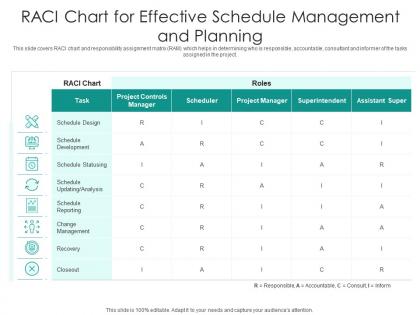
Raci chart for effective schedule management and planning




Try Before you Buy Download Free Sample Product
 Impress Your
 Audience
 100%
100% Editable
 Save Hours
 of Time


This slide covers a schedule control table which help in tracking the trends in schedule performance. It also helps in tracking the number of times the project was going behind the scheduled time.
People who downloaded this PowerPoint presentation also viewed the following :
Raci chart for effective schedule management and planning with all 2 slides:
Use our RACI Chart For Effective Schedule Management And Planning to effectively help you save your valuable time. They are readymade to fit into any presentation structure.
FAQs for Raci chart for effective schedule
A RACI chart is a project management tool that clarifies roles and responsibilities by assigning team members as Responsible, Accountable, Consulted, or Informed for each task or deliverable. It streamlines project execution by eliminating confusion, reducing bottlenecks, and enhancing communication across teams, with many organizations finding that clear accountability frameworks ultimately deliver faster project completion and improved stakeholder alignment.
Customizing a RACI chart involves tailoring role definitions, adding organization-specific accountability levels, incorporating your company's terminology, and adjusting the matrix structure to reflect actual decision-making hierarchies. Many organizations enhance standard RACI frameworks by including additional stakeholder categories, integrating with existing project management systems, and defining clear escalation paths, ultimately delivering improved clarity and streamlined accountability processes.
RACI charts define four distinct roles: Responsible (performs the task), Accountable (owns the outcome and final approval), Consulted (provides input before decisions), and Informed (receives updates after decisions). These roles streamline project management by establishing clear accountability boundaries, eliminating confusion over task ownership, and ensuring proper communication flows, ultimately delivering faster project execution and reduced conflicts across teams.
Determining RACI assignments requires analyzing each task's decision-making authority, execution requirements, and stakeholder involvement patterns. Assign Responsible roles to those performing the work, Accountable to single decision-makers with ultimate ownership, Consulted to subject matter experts providing input, and Informed to those needing updates, ensuring clear accountability chains and streamlined communication across project teams.
Common pitfalls include assigning multiple "Accountable" roles per task, creating too many "Responsible" assignments, failing to involve stakeholders in the creation process, and making charts overly complex with excessive detail. Many organizations find that starting with high-level activities, regularly reviewing assignments, and ensuring clear role distinctions ultimately delivers better project clarity and prevents responsibility confusion across teams.
RACI charts should be reviewed at major project milestones, during scope changes, team restructuring, and when role confusion emerges, typically every 2-4 weeks for dynamic projects. Regular updates ensure accountability remains clear as projects evolve, with many project managers finding that proactive reviews prevent bottlenecks, enhance team coordination, and ultimately deliver smoother project execution and stakeholder alignment.
Yes, RACI charts enhance remote team collaboration by clearly defining roles, responsibilities, and accountability across distributed teams, eliminating confusion about task ownership and decision-making authority. Through digital project management platforms, remote teams streamline communication, reduce redundant meetings, and maintain project momentum, with many organizations finding that structured responsibility frameworks ultimately deliver faster project completion and improved team coordination.
RACI charts enhance cross-functional team collaboration by clarifying role boundaries, eliminating task overlaps, improving accountability, and streamlining decision-making processes. These frameworks enable organizations to reduce project delays, minimize conflicts between departments, and accelerate deliverable completion, with many enterprises finding that clear responsibility mapping ultimately delivers better resource allocation and stronger project outcomes.
A RACI chart improves communication by clearly defining who is Responsible, Accountable, Consulted, and Informed for each task, eliminating confusion about roles and expectations. This clarity streamlines decision-making processes, reduces duplicate efforts, and ensures stakeholders receive timely updates, with many project teams finding that structured accountability ultimately delivers faster project completion and enhanced collaboration.
Several tools can streamline RACI chart creation, including Microsoft Excel, Google Sheets, Smartsheet, Lucidchart, and specialized project management platforms like Asana and Monday.com. These platforms enhance collaboration by enabling real-time editing, automated notifications, and seamless integration with existing workflows, with many organizations finding that dedicated project management tools ultimately deliver better stakeholder alignment and accountability tracking.
A RACI chart helps clarify responsibilities by defining who is Responsible, Accountable, Consulted, and Informed for each project task, eliminating role confusion and overlap. Through clear accountability mapping, project teams streamline decision-making, enhance communication, and minimize delays, with many organizations finding that RACI frameworks significantly reduce project bottlenecks and deliver faster execution.
Successful RACI chart implementations include software development project management at tech companies, hospital patient care coordination, manufacturing quality control processes, financial services compliance initiatives, and marketing campaign launches at retail organizations. These implementations streamline accountability, eliminate role confusion, and accelerate decision-making, with many organizations finding that clear RACI definitions reduce project delays by 30-40% while enhancing cross-departmental collaboration and operational efficiency.
RACI charts focus specifically on four responsibility types (Responsible, Accountable, Consulted, Informed) for task execution, while DACI emphasizes decision-making roles and MoSCoW prioritizes requirements by importance rather than assigning responsibilities. These frameworks serve different organizational needs, with RACI streamlining project accountability, DACI enhancing decision processes, and MoSCoW optimizing resource allocation, ultimately delivering clearer governance structures across diverse business contexts.
Misalignment in a RACI chart creates confusion over roles, duplicated efforts, accountability gaps, and delayed decision-making across project teams. These issues result in missed deadlines, budget overruns, and frustrated stakeholders, with many organizations finding that regular RACI reviews and updates significantly enhance project coordination, streamline workflows, and ultimately deliver better outcomes.
A RACI chart facilitates better stakeholder engagement by clearly defining roles as Responsible, Accountable, Consulted, and Informed, eliminating confusion about expectations and communication requirements. Through this structured approach, project managers streamline stakeholder interactions, reduce conflicts over responsibilities, and ensure appropriate involvement levels, with many organizations finding that clear role definition significantly enhances collaboration and project outcomes.
-
Colors used are bright and distinctive.
-
Very unique and reliable designs.