

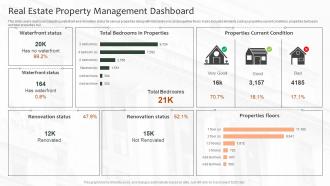
Real Estate Property Management Dashboard





Try Before you Buy Download Free Sample Product
 Impress Your
Audience
 100%
Editable
 Save Hours
of Time


This slide covers dashboard depicting waterfront and renovation status for various properties along with total bedrooms and properties floors. It also included elements such as properties current conditions, properties built years and total properties buil
People who downloaded this PowerPoint presentation also viewed the following :
Real Estate Property Management Dashboard with all 7 slides:
Use our Real Estate Property Management Dashboard to effectively help you save your valuable time. They are readymade to fit into any presentation structure.






FAQs for Real Estate
Real estate management dashboards should include occupancy rates, rental income trends, maintenance costs, tenant retention rates, and lease expiration timelines. These metrics enable property managers to streamline operations by identifying revenue opportunities, optimizing maintenance schedules, and enhancing tenant satisfaction, with many organizations finding that comprehensive tracking ultimately delivers improved cash flow and competitive market positioning.
A real estate management dashboard enhances decision-making by consolidating property performance metrics, financial analytics, tenant data, and maintenance schedules into unified visual displays. Through real-time reporting capabilities, property managers can identify underperforming assets, optimize rental pricing strategies, and streamline operational workflows, ultimately delivering faster tenant services and improved portfolio profitability across their managed properties.
Integrating financial data into real estate management dashboards delivers enhanced visibility into property performance, streamlined expense tracking, automated rent collection monitoring, comprehensive portfolio analysis, and real-time profitability insights. These capabilities enable property managers to optimize resource allocation, identify underperforming assets, and accelerate decision-making processes, with many real estate firms finding that centralized financial integration ultimately reduces operational costs while improving investor transparency and competitive positioning.
Visual analytics revolutionizes property data interpretation by transforming complex datasets into intuitive charts, heat maps, and interactive dashboards that reveal market trends, occupancy patterns, and performance metrics instantly. Through these visual tools, real estate managers can identify underperforming properties, optimize pricing strategies, and make data-driven investment decisions more efficiently, ultimately delivering faster portfolio growth and enhanced competitive advantage.
Real-time data enables property managers to make immediate, informed decisions by providing instant updates on occupancy rates, maintenance requests, rent collections, and market trends. This continuous data flow streamlines operations, enhances tenant satisfaction through faster response times, and optimizes revenue management, with many property management firms finding that real-time insights deliver significant competitive advantages.
Predictive analytics enhances property investment strategies by analyzing market trends, rental yields, property appreciation rates, vacancy patterns, and demographic shifts within management dashboards. These insights enable investors to identify high-potential markets, optimize portfolio diversification, and time acquisitions strategically, with many real estate firms finding significantly improved ROI through data-driven investment decisions.
Software solutions best suited for creating customizable real estate management dashboards include Tableau, Power BI, Salesforce Analytics, PropertyRadar, and AppFolio's reporting tools. These platforms streamline property portfolio tracking, tenant management, and financial reporting by offering drag-and-drop customization, real-time market analytics, and automated lease monitoring, with many real estate firms finding that integrated dashboards ultimately enhance operational efficiency and accelerate investment decision-making.
**INPUT**: What types of visualizations (charts, graphs, etc.) are most effective for real estate performance metrics? **OUTPUT**: Effective real estate visualizations include heat maps for market trends, bar charts for comparative property values, line graphs for price fluctuations, pie charts for portfolio allocation, and geographic maps for location analysis. These visualization tools streamline decision-making by highlighting performance patterns, identifying investment opportunities, and tracking ROI across properties, with many real estate professionals finding that visual dashboards ultimately enhance client presentations and accelerate strategic planning.
A dashboard facilitates real estate team communication by centralizing property data, client information, transaction updates, task assignments, and progress tracking in one accessible platform. Through shared visibility of listings, lead statuses, and project timelines, teams can coordinate more effectively, reduce information silos, and respond faster to client needs, ultimately enhancing operational efficiency and customer service delivery.
Property managers face challenges including data integration from multiple systems, staff training requirements, initial setup costs, and ensuring data accuracy across platforms. While these implementation hurdles require strategic planning and resource allocation, many organizations find that proper change management, phased rollouts, and comprehensive staff education ultimately streamline operations, enhance tenant experiences, and deliver significant competitive advantages.
Real estate management dashboards can be tailored by customizing key performance indicators, data visualizations, and operational metrics specific to each property type's unique requirements and business objectives. Residential dashboards focus on occupancy rates, tenant satisfaction, and maintenance requests, while commercial properties emphasize lease terms, square footage utilization, and tenant mix optimization, with industrial dashboards tracking warehouse efficiency, logistics coordination, and equipment performance metrics.
Compliance considerations include data privacy regulations like GDPR, fair housing laws, financial reporting standards, tenant rights protections, and accessibility requirements for users with disabilities. These regulations vary significantly by jurisdiction and property type, with many real estate organizations finding that proactive compliance design ultimately streamlines operations, reduces legal risks, and enhances stakeholder trust while maintaining competitive advantage.
Data on real estate management dashboards should be updated in real-time for critical metrics like occupancy rates and lease expirations, with financial reports updated monthly and market trends quarterly. This strategic timing enables property managers to respond immediately to vacancy changes, track rental income accurately, and make informed investment decisions, ultimately delivering enhanced operational efficiency and competitive market positioning.
User feedback enhances real estate management dashboards by identifying pain points, streamlining workflows, and highlighting missing features essential for daily operations. Through iterative improvements based on agent and client input, property management firms can optimize search functionality, enhance property visualization tools, and refine reporting capabilities, ultimately delivering more intuitive interfaces and improved operational efficiency.
Mobile accessibility enhances real estate management dashboard effectiveness by enabling property managers to respond to tenant requests, conduct inspections, and monitor properties remotely from any location. Through mobile-optimized interfaces, managers can access critical data, approve maintenance orders, and communicate with stakeholders instantly, ultimately delivering faster response times and improved operational efficiency across their property portfolios.
-
The way SlideTeam professionals work is exceptional. Thanks for being so helpful!
-
Visually stunning presentation, love the content.