

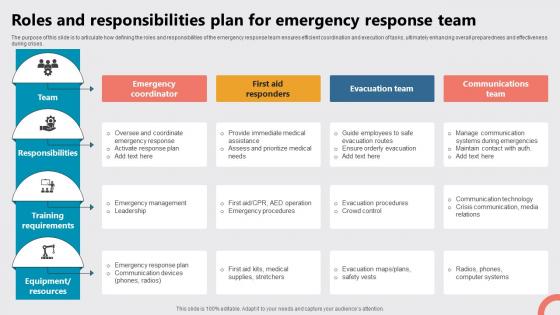
Roles And Responsibilities Plan For Emergency Response Team




Try Before you Buy Download Free Sample Product
 Impress Your
 Audience
 100%
100% Editable
 Save Hours
 of Time


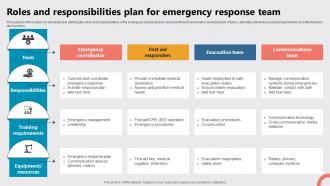
The purpose of this slide is to articulate how defining the roles and responsibilities of the emergency response team ensures efficient coordination and execution of tasks, ultimately enhancing overall preparedness and effectiveness during crises.
People who downloaded this PowerPoint presentation also viewed the following :
Roles And Responsibilities Plan For Emergency Response Team with all 9 slides:
Use our Roles And Responsibilities Plan For Emergency Response Team to effectively help you save your valuable time. They are readymade to fit into any presentation structure.








FAQs for Roles And Responsibilities Plan For
Honestly, start with the basics - who does what when stuff hits the fan. Someone needs to call 911, another person alerts management, that kind of thing. Map out your evacuation routes and pick meeting spots everyone can remember. Different emergencies need different responses, so break those out separately. Keep contact lists updated (seriously, these go stale so fast). Mark where your first aid kits are stashed. The whole thing should be simple enough that panicked people can actually use it. Oh, and practice quarterly - muscle memory is everything here.
So first thing - run regular drills and tabletop exercises to see if your team actually knows what they're doing. Track stuff like how fast people get notified and how quickly you can get resources moving. Response times are huge. After any real incident (or drill honestly), do a proper debrief with everyone involved. Figure out what went wrong and what didn't suck. I'd say quarterly assessments work well - gives you enough time between reviews but keeps you on track. Oh, and don't skip the scenarios part even if it feels tedious. That's literally where you'll catch most problems before they bite you.
Dude, you absolutely need regular training - that's what separates teams that actually save lives from ones that just panic. Your emergency plan is basically useless if nobody's practiced it. I've watched crews with amazing procedures completely lose it during real situations because they'd never run through stuff together. Honestly, quarterly drills should be your bare minimum. Mix up medical scenarios, evacuation runs, communication protocols. Throw in surprise drills too - keeps people from getting too comfortable. Without that muscle memory, even your best people will freeze up when things go sideways.
Check it every six months if you can swing it - annually is really the bare minimum. After any real emergency hits, update it right away since you'll spot problems you never saw coming. Staff changes are another big trigger for reviews. Honestly, most people set it and forget it, which is why calendar reminders are clutch. Also update after facility changes or new regulations drop. Your team should know when it was last touched up too. Real emergencies teach you way more than any theoretical planning session ever will.
Definitely put people first - medical emergencies, fires, bad weather, workplace accidents. That stuff's your top priority. After that, think about what'll really mess up your business operations. Cyber attacks are huge right now, plus power outages and supply chain issues. But here's the thing - don't go crazy planning for zombie apocalypses or whatever. Figure out what could realistically happen where you work and in your area. Do a basic risk assessment first. It'll save you time since you won't waste energy on elaborate plans for stuff that'll probably never happen to you.
Look, your main communication system WILL fail at the worst possible time, so you need backups. Have radios, cell phones, landlines ready to go. I know it sounds ancient, but designate actual runners too - when all the tech dies, someone's gotta physically carry messages. Pick specific people as communication liaisons for each team, otherwise everything gets twisted like a game of telephone. Keep messages super short and clear during emergencies. Nobody has time for explanations when things are going sideways. Practice all this stuff during drills so it's automatic.
So basically your team leader runs the show and calls the shots. Then there's someone handling all the communications - they keep everyone in the loop. The safety officer is honestly the MVP because they watch for dangers and keep you alive. You've got logistics people managing supplies and gear, medical folks for first aid stuff, and operations people doing the actual emergency work. Oh, and definitely know your role ahead of time - trust me, you don't want to be figuring that out when everything's going crazy. Practice it beforehand too.
So first, figure out where your communication is totally falling apart - that's your starting point. Real-time messaging apps are a game changer for instant updates between everyone. GPS tracking lets you see where your team is and what's happening where. Mobile apps with emergency protocols and contacts are clutch when you're scrambling. Drones for checking damage? Yeah, they're actually pretty sweet, especially when you can't physically get somewhere. Oh, and digital systems that log everything as it happens - you'll thank yourself later when you're trying to piece together what went wrong (or right). Honestly, don't try to fix everything at once though.
So basically, map out all the stuff that could go wrong - natural disasters, power outages, security issues, whatever applies to your spot. Get people from different departments involved since they'll catch things you won't. Then use one of those probability vs impact grids to figure out what deserves your attention first. Honestly, those matrices look fancy but they're pretty straightforward once you get the hang of it. Review everything quarterly because things shift constantly. Document it all clearly. Don't overthink this - just tackle your most likely high-impact scenarios first and expand from there.
When agencies actually work together, nobody's standing around assuming the other guy has it covered. Fire brings their rescue gear, cops handle traffic, medics do triage - everyone stays in their lane but coordinates. Each team has skills the others don't, which is huge. Communication flows way better under unified command too. I've watched disasters where departments barely talked to each other and it was a total shitshow, honestly. My advice? Hash out those partnerships and communication plans now, before you're dealing with an actual emergency. You don't want to figure out who's in charge while buildings are burning.
Honestly, community partnerships can totally save your butt in an emergency. You want hospitals, fire departments, police, local businesses - basically anyone who can help when things go sideways. It's like having a bunch of extra teammates who already know what they're doing. They've got equipment you probably don't have, plus they know the area better than you do. Community groups are surprisingly good at getting word out fast too, whether it's for evacuations or just letting people know where to get supplies. Oh, and definitely map this stuff out beforehand - you don't want to be scrambling for contacts when everything's chaos.
Running drills is honestly the best way to figure out where your ERT falls apart. The first one's usually a mess - but that's perfect! Your team gets to practice talking to each other under pressure and nail down those protocols without anyone actually getting hurt. You'll catch equipment problems early too. I'd do them monthly and switch up the scenarios each time. Oh, and definitely debrief after - that's where you really learn what worked. It's crazy how much faster you get once everyone knows their role by heart.
So the big ones you can't skip are contact lists, evacuation routes, and who does what on your team. Equipment locations too - seriously, nothing's worse than scrambling around looking for stuff when you're already stressed. Keep your drill reports updated and any risk assessments. Training records matter if you ever get audited. Oh, and those response checklists are lifesavers. I'd set up quarterly reviews because waiting until after an emergency to update everything is just asking for trouble. Maybe put a reminder in your phone right now?
Definitely learn from past emergencies - that's your best training material right there. After each incident, sit down with everyone involved (not just the bosses) and hash out what went wrong. Communication breakdowns, missing supplies, timing issues - write it all down. Then actually fix those problems in your protocols. I've seen too many places do debriefs and then... nothing changes. Update your training based on real situations you've faced, not just textbook scenarios. It's way better than guessing what might happen next time.
Okay so legally speaking, you've got a few things to cover. OSHA's gonna be your biggest pain point - they don't mess around with workplace safety and emergency stuff. Building codes and fire regs are obvious ones to check too. Industry-specific compliance depends on what you do obviously. The liability piece is huge though - spell out who does what so nobody gets sued later. Honestly I'd have a lawyer look it over before you roll it out. Way better to catch problems now than deal with them after something goes wrong, you know?
-
Placing an order on SlideTeam is very simple and convenient, saves you a lot of your time.
-
It's always a delight to see new templates from you! I am extremely pleased with the fact that they are easy to modify and fit any presentation layout in seconds!